
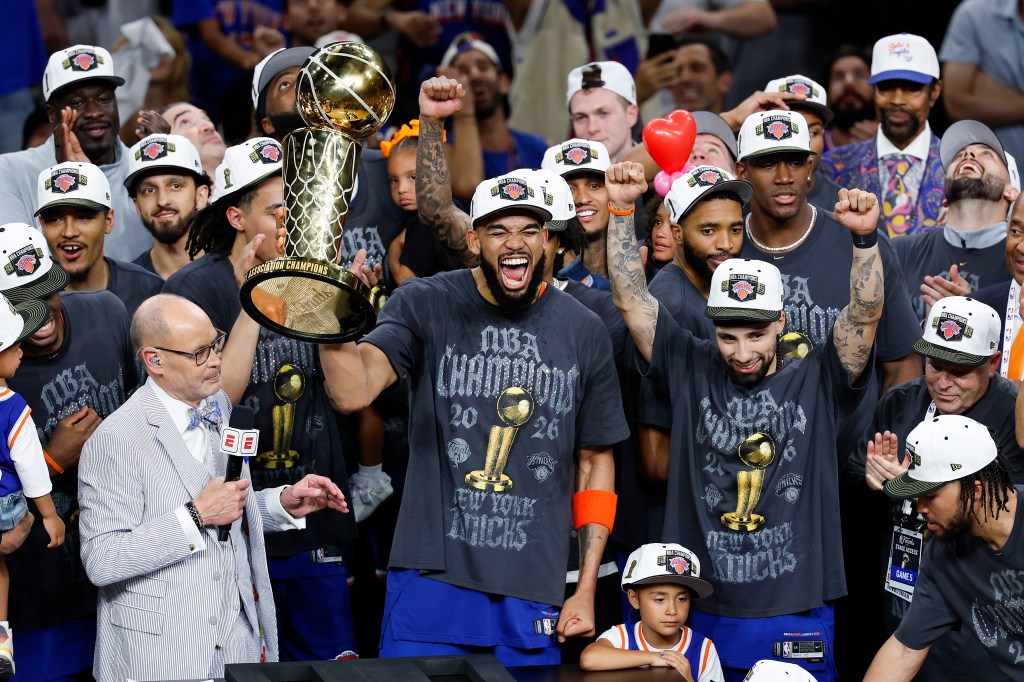
It’s tempting to make overconfident assertions after the rush of a title. Too rash to say the Knicks could have taken any of the last five NBA champions; too soon to call Jalen Brunson the greatest Knick ever. But it is entirely proper to conclude once, New Yorkers stop filling the streets and exhausted every last celebratory bottle, that these Knicks will go down as the most loved team in the city’s history.
Some of that is by default. New York is a city of neighborhoods historically divided, more than united, by sports — split not in a fuzzy way (where does the East Village end and the Lower East Side begin?) but the way the East River splits Manhattan from Queens and Brooklyn. Mets and Yankees; Jets and Giants; Rangers, Islanders, and Devils. As flawed as the Knicks have been for decades, and with apologies to the Nets, there is no such competition in the NBA.
But there’s more to it than that. It’s also a story about basketball, cosmopolitanism, and — like everything else in New York — real estate.
Postwar, baseball culture never recovered from the Dodgers and Giants going west, and the familiar forces of the era — Robert Moses, the highways, white flight — pulled the city’s teams toward the suburbs. The Mets landed in Flushing; the football Giants drifted to the Bronx and finally New Jersey, the Jets trailing after.
The Knicks, though, refused to suburbanize and continued playing in Manhattan. They cultivated an urban basketball ecosystem — Rucker Park, the chain-net playground rims, the streetball style that would come to dominate the NBA — that gives New York a valid claim to being the basketball capital of the world.
Maybe Jalen Brunson didn’t grow up here, but he was a Big East point guard, just like his father, and a Knick, just like his father — he might as well have.
The streetball style gained mystique on our grand stage: Madison Square Garden, our La Scala. (Never mind that many of the most memorable performances came from the Knicks’ opponents — Kobe’s 61, Steph’s 54, the Reggie Miller game.) Any show looks better under that beamed, golden ceiling, and its centrality — atop the busiest transit hub in the Western Hemisphere — is why delirious fans thought on Saturday night, “Let’s head to the Garden.” If the Jets ever win, good luck walking to MetLife.
This was a team from all over. Not just the three old Villanova Wildcats but OG Anunoby, born in London to Nigerian parents; Dominican-American Karl-Anthony Towns; and Jose Alvarado, raised in Brooklyn and Queens but playing internationally for Puerto Rico.
The most inescapable meme of the finals — “My mayor Muslim / my bagel Jewish / my Christian Dior / Knicks in four” — will persist (even though it took them five). It was an homage to the city’s multiculturalism, more tossed-salad than melting pot. Like our mayor, more than a third of the city’s population is foreign-born, and Donald Trump can’t change that, try though he might. He couldn’t curse the Knicks, either, who went 15–0 after April 23 in games the president didn’t attend.
When the Garden faithful let Trump have it on the jumbotron, it was one manifestation of the resistance New York has mounted against his attempts to reduce America to ethnonationalism. Here Haitians and Dominicans join white and Black Americans to say “Black Lives Matter,” and New Yorkers of all origins unite to defend our neighbors from ICE. The basketball gods have spoken, and reminded us what makes New York — and America — great.
Soros is chair of the Open Society Foundations.