
Rail: … an Englishman.
Schnabel: Exactly, who lived in America like so many expatriates who came from so many other countries. Take another example, Francesco Clemente who has lived in the United States for long enough, can he have a show in the Whitney Museum as Malcom did? It’s interesting that each artist has their own definition of what art is, which is visible in their use of materials and imagery.
Rail: You mean the alchemy of the image!
Schnabel: Yes, again, everybody’s got their own version of what alchemy is. What I was saying is that it doesn’t necessarily come from other artist of your own generation. Malcolm and I were friends, but we made very different kinds of paintings and I never think about Malcolm’s paintings when I’m working, but I do think about Ron Gorchov’s paintings, especially how he found many permutations of the curved shaped canvasses that somehow embody the two marks, which say everything he wanted to say.
Rail: These two marks are very similar at times, or on some occasions with just minute differences, other times they’re overtly dissimilar.
Schnabel: Exactly. Ron applied different consistencies of paint depending on the image and its temperature. His paintings projected off the wall, and I wanted to do the same.
Rail: Which means quiddity– a distinct character that makes a thing exactly what it is and not something else.
Schnabel: Yes, some things need to be thick and some things need to be thin. I felt like a painting that was 7.5’ x 7’ with resin on it, had this ornate frame that I cast in fiberglass, was chunky enough to have the same kind of weight as a 16-foot-square painting on a tarp that was without a frame. I was always thinking about how things, physical objects, sat in a room and how they affected the architecture, how they affected people. When I made the series of Weather Paintings in 2015, the floor in my studio accumulated so much resin. I had been using purple ink and gesso when I was making previous series with the Goat Paintings (2012-16), and I used a hose to spray and disperse the ink, which I thought it was a good way to apply paint. Anyway, when I saw what remained on the floor, it looked like a topographical image of Mexico City–the streets are organized with clouds in between your arial view and the floor. So, when you looked at these paintings it looked like you were looking at them from up in the air rather than from standing on the ground.
Rail: Like at the beginning scene of Andrei Rublev (1966) when the peasant inventor Yefim was trying to escape from an angry mob in the balloon, you were able to recreate your own version in Before Night Falls (2000). Now, having watched In the Hand of Dante a few times now, the experience reminds me of how you’re able to express yourself as fluidly in your films as in your paintings. There seems an equal pictorial continuity as there is a filmic one, from Basquiat (1996), Before Night Falls, The Diving Bell and the Butterfly (2007) or say At Eternity’s Gate (2018). In other words, this film is a culmination of various sensibilities, from the painterly, the made images, the mediated images, photography, print, to everything filmic, classic experimental film, poetry, literature, music, everything else you love! Without being redundant, I think what ties everything together is your love for water, as you’ve been surfing since you were a little kid. It emerged in the Basquiat film, with the surfer in the sky, then the scene with Arenas escaping from Cuba on the boat to Miami in Before Night Falls, or the segment of the glass of water in The Diving Bell and The Butterfly that lead to the prolonged underwater segment, and finally say how In the Hand of Dante, Nick Tosches jumps in the water, and the powerful waves that swallow Giulietta standing in the big scallop shell, referencing Botticelli’s The Birth of Venus (c. 1485). What are your thoughts on this reading?
Schnabel: Michelangelo Antonioni once said that he was more interested in truth than logic. When people talk about or think about narrative, I say to myself ‘what is narrative?’ I’m usually not surprised most of the time by what happens next in most films. With In the Hand of Dante, we’re looking at this group of individuals who are trying to find the original manuscript of Dante Alighieri’s Divine Comedy (1321), which then needed to be authenticated. At the same time, I’m showing the real situation that occurred, and what the process was shifting from the present to the past, and vice versa, while at the same time keeping the suspense of Nick Tosches’ involvement with the manuscript. You remember when he says “I’ve been working on this translation for ten years, I know this poem so well, I feel like I wrote it myself.”
Rail: It’s as if he’s the reincarnation of Dante.
Schnabel: Exactly. It makes me think of Mikhai Bulgakov’s The Master and Margarita (1967). The reason why the devil paid a visit to Russia was partly because the Master wrote a description of what happened on the terrace with Pontius Pilate and Jesus Christ which was so accurate. It’s as if the Devil felt like he needed to come down and defend the Master. What does it mean when you make a masterpiece? Dante could make this work that was considered a masterpiece, but his life could be a total mess. The fact that his art succeeded but his family life was a failure, I thought that people should be aware that art is incongruous to life. In a film called Random Harvest (1942), made by Mervyn LeRoy, Ronald Colman plays this guy who has post-traumatic stress and he’s in the hospital in World War I. The day the war ends, he walks out of the hospital and finds himself in a bar. Greer Garson is a singer in the bar, and she sees this puppy-eyed lost guy over there and she takes him under her wing, and they go off. They escape to a little village, get married, have a baby, he writes for The Liverpool Times, and one day in Liverpool he gets hit by a car. The next scene he’s sitting in a manor house outside of London, and basically, he’s a lord of industry. He forgets that he had a wife and a child, he became who he was before. At some point he presses a button on his intercom, and a woman comes in and it’s his wife. The audience knows it’s his wife, but he doesn’t. I thought having Gal Gadot playing Gemma in the fourteenth century, then Giulietta in the 21st century, the audience just hears the voice and sees this woman, the reincarnation of Gemma, and she is reeling him in her home, as if she had a fishing rod, and by the time he shows up in Ravenna, where he lived before with her, and he sees her and he looks around at the surroundings, he realizes that, well, there’s something familiar about this place, and she says, ‘Familiar is good.’ And she knows that he’s Dante; he doesn’t know. I like the idea that he doesn’t know who he is until the end of the film, but that’s not something that was in Nick Tosches’ book.
Rail: Yes, I suspected that.
Schnabel: Nick Tosches couldn’t say that he was Dante, but I could. I thought I could superimpose this other feeling and this thing onto this story. Remember the scene in the Marciana Library, where the arrival of Rosario (played by Jason Momoa) is a reminder that you don’t kill a guy like Don Lecco without getting into some kind of trouble. Rosario is an avenging angel. By the way, the decision to shoot the end of the film in Venice is not that different than the decision to put a bra on Louie the assassin (played by Gerard Butler) when he was lying in bed. To me, it’s the same with mixing a color to paint with. If you ask me, ‘why do you do that?’, I’d say ‘I don’t know!’
Rail: [laughs] I feel the same way about the Rail not having a mission statement.
Schnabel: You know, I gave the commencement speech at the University of Houston in 2025, and I said “If somebody asks you a question and you say ‘I don’t know’, that’s a pretty good answer because usually if somebody gives you an answer they’re lying to you.”
Rail: It’s true Julian! By the way, everything in the present was shot in black and white, and everything belonging to the past was in color, was this a very conscious decision from the get-go?
Schnabel: Absolutely. After I watched Mervyn LeRoy’s Random Harvest, shot in black and white, and not long after Victor Fleming’s two films The Wizard of Oz and Gone with the Wind, both made in 1939, it was intuitive to me to include both black and white and color for In the Hand of Dante. It’s a good way to have the rug pulled out from under the viewer, as you’re following one story and all of a sudden, you’re in this other story. It’s all happening simultaneously, but that’s how you know that it is in a different time. But at the same time, you’re being told these stories simultaneously and you’re making equivalences about Nick’s journey, his desperation, his falling apart in the same way that you see the trials and tribulations of Dante. Mind you, I’m not analyzing The Divine Comedy whatsoever. The fact is, Nick as Dante hadn’t finished Paradiso while he’s making these trips to visit Isaiah, this Kabbalistic Jew, who is basically sharing knowledge with him. And the first time when he shows him La Vita Nuova (1294), he doesn’t even look at it. Later, when he says to Dante, ‘You’ve lifted the veil on the inexpressible. You’ve entered the sigh. You’ve become the poem.’ That was the best reaffirmation he could ever get. What does an artist want to be? They want to become the poem. They want to become their work. Or everything that is in their work will end up being what they had to say.
Rail: ‘You dare to give form to the formless,’ he says.
Schnabel: Right. And finally, when he says ‘My name is Jacob.’ I mean, he told him his name. That was the best review, reaffirmation he could get and it’s always nice when you get the ball back in your court finally.
Rail: Reading Alfred Mac Adam’s insightful review of the film, I’d like to ask, how would a hard-boiled crime be infused with a tragic comedy? And how would one character simultaneously become two, and how does a child at the age of nine fall in love with another child at the age of eight and then spend the rest of his life immortalizing her?
Schnabel: What Alfred wrote was so true about human nature–the idea that you could have a fascination, a fixation with someone and then you would immortalize them but really, what you’re doing is becoming obsessed with your own projection of the idealized version of that someone. If you’re making a painting, for example, your wife or husband, if they’re not involved in what you’re doing, they could feel very left out. The question is: do you see making art as a narcissistic practice or do you see it as something that exists in an otherworldly sense? Art is an entity that has its own autonomy from your life in a way, but you need to spend your life doing it at the same time. You’re spending your life making art instead of being with that person who has committed to being with you, but the fact is that without artmaking you can’t be yourself and love the person that you’re with. It’s a serious predicament! I’ve been lucky enough– my wife Louise and I worked together on this film. Even though we don’t paint together, I’d always ask her what she thinks, as I trust her eye. In Gemma’s case, she was left out, and you would imagine it might be very hard for his children to hear him talking or reading his love for Beatrice. Anyway, I thought it’s both ironic and provocative that Nick Tosches is trying to steal the original manuscript of the Divine Comedy which he himself wrote as Dante.
Rail: As I was happy to see Franco Nero, who was a huge movie star in Vietnam after he appeared in Sergio Corbucci’s classic film Django (1966), in his brief appearance as Don Lecco. My next question is, how did you manage to cast all these mainstream film actors to perform in your experimental art films? Say with Basquiat, Gary Oldman as Albert Milo (yourself), David Bowie as Andy Warhol, Dennis Hopper as Bruno Bischofberger, Jeffrey Wright as Jean-Michel, then Javier Bardem as Reinaldo Arenas, as well Johnny Depp, Oliver Martinez in Before Night Falls, and Willem Dafoe in At Eternity’s Gate. The lineup for In the Hand of Dante is equally impressive, from Oscar Isaac, Gal Gadot, Gerard Butler, Jason Momoa, not to mention John Malkovich, Al Pacino, and Martin Scorcese, all of whom I thought were anchors of the film.
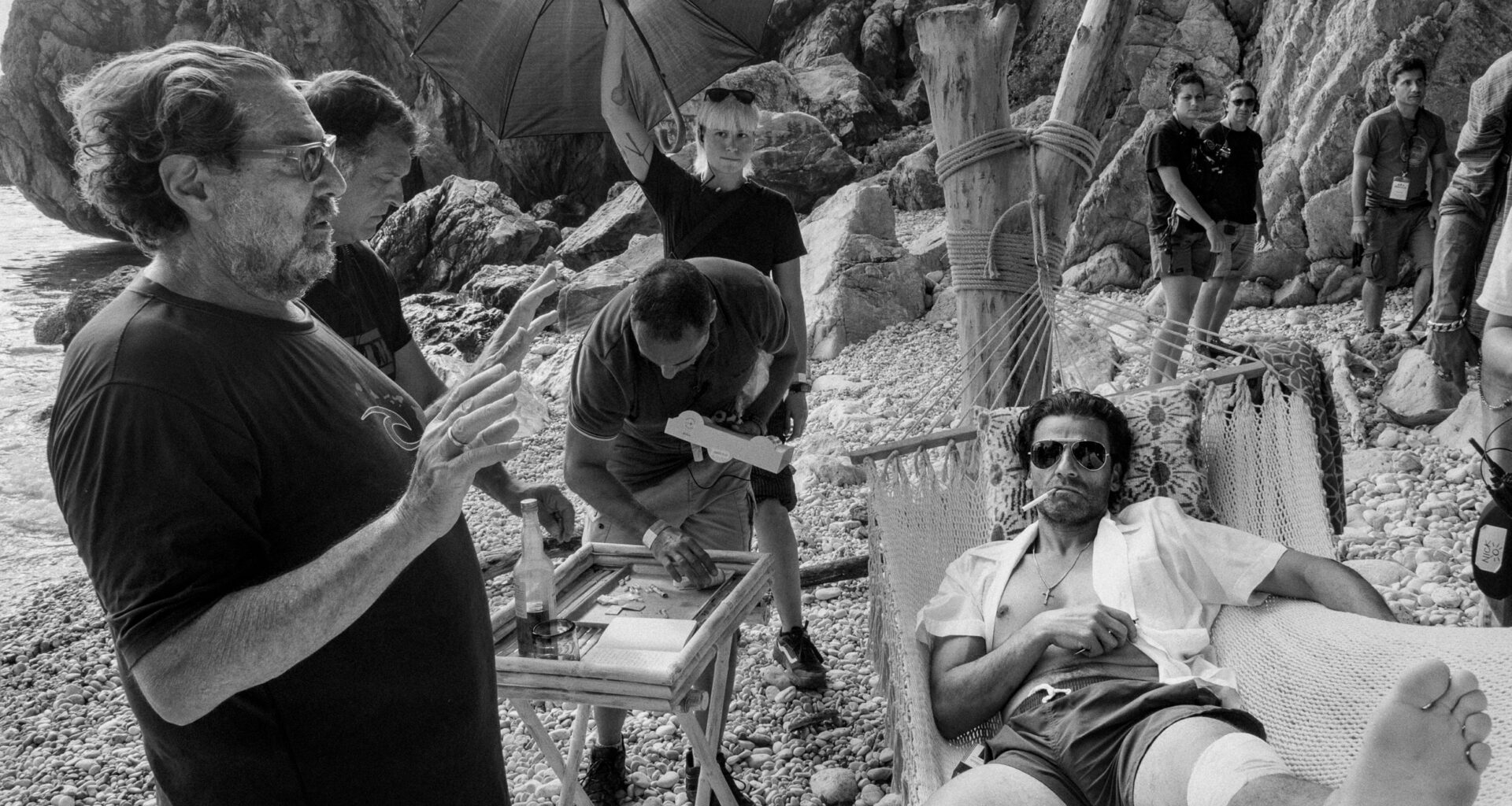
Schnabel: First of all, I know all the actors you mentioned pretty well. As for this film, they all read the script and liked it. I’ve known John Malkovich for over thirty years. I’ve known Al Pacino since he made Scarface (1983), we’ve always wanted to do something together. Al once said to me “You’re the only person I know that’s never compromised.” Anyway, I’ve been friends with the others for a long time, and I feel all the actors trusted me. I’d never seen Gerard Butler do anything like he did in this movie. Johnny Depp had given me this book originally. Johnny was going to do this film and somehow, he fell out of it–life has a way of taking you different places. When Nick heard that I was going to do this film before he died in 2019, he was super excited. So was Greg Cimino, the lawyer of Nick’s literary estate. Oscar Isaac read the script seven years ago and said to me if this ever gets made, I’m your man. I thought Oscar’s performance was extraordinary. Jason and I are dear friends. I surfed with his uncle, Titus Kinimaka, in Hanalei Bay years ago. Gal Gadot, Louis Cancelmi and Sabrina Impacciatore were all amazing. So was Benjamin Clementine, who did the music.
Rail: What we admire about Dante and the Divine Comedy is it inspires us to appreciate his use of language rather than trying to analyze it.
Schnabel: Yes, it’s all about learning, figuring things out as you’re doing it. The actors, the production team, and I, we’re building this film brick by brick, as we’re making forms and rhythm. Most importantly, I respect the audience. I want to be true to my voice and not talk down to people or dumb anything down. I don’t want to make it hermetic, but I do want to make it accessible enough for someone to understand what I’m intending to do. Even though we are all prisoners of our own subjectivity, I’d like viewers to see the film the same way they would look at a painting. When Marty Scorcese says when you let the viewers enter the dreamscape of the film and take them along, it will be continuously rewarding.
Rail: E.M. Forester once said, “Spoon feeding, in the long run, teaches us nothing except the shape of the spoon.” Why make compromises when you can provide the slowness of discovery?
Schnabel: That’s right, like what Isaiah said, “Time flies is what they say, but it is breath that is the winged thing. It is breath that flies.”