
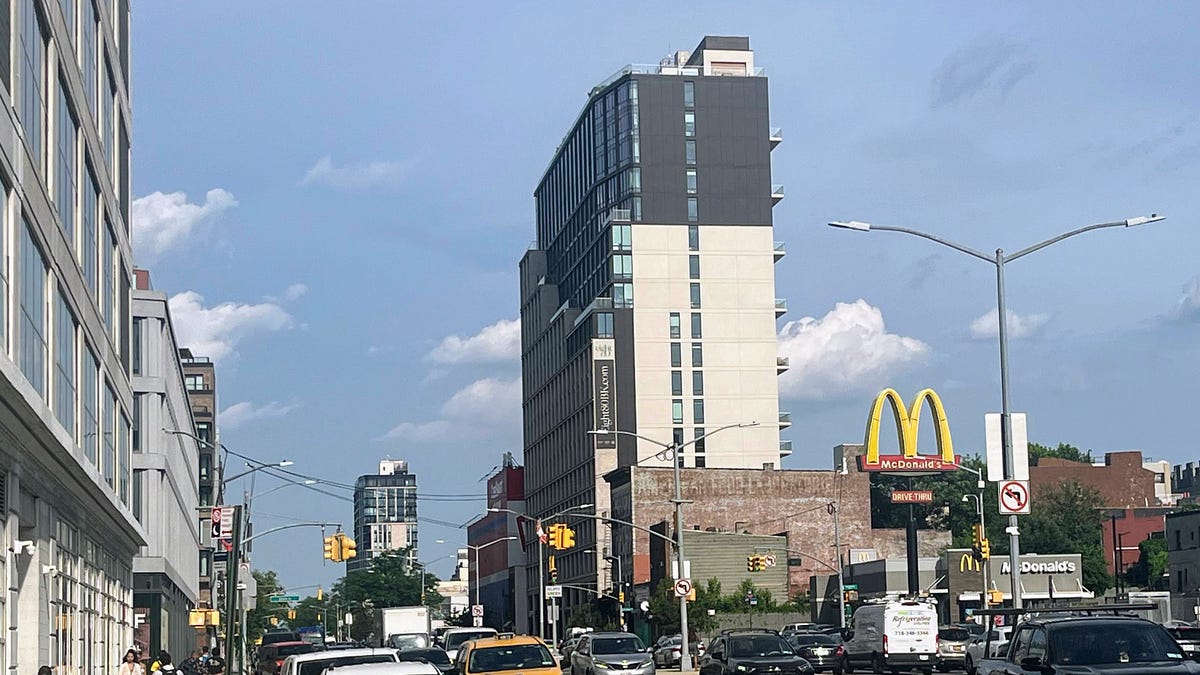
Just east of Atlantic Avenue and Vanderbilt Avenue, the eastern border of the Atlantic Yards site, a new, 19-story building, known as Eight80, has risen. Further east, another tower, known as Prosper Brooklyn, is visible.
They result from the last spot rezoning—special permission—to build big in the area, preceding the area rezoning known as the Atlantic Avenue Mixed-Use Plan (AAMUP), led by Council Member Crystal Hudson. Eventually, the scale along Atlantic Avenue should be similar.
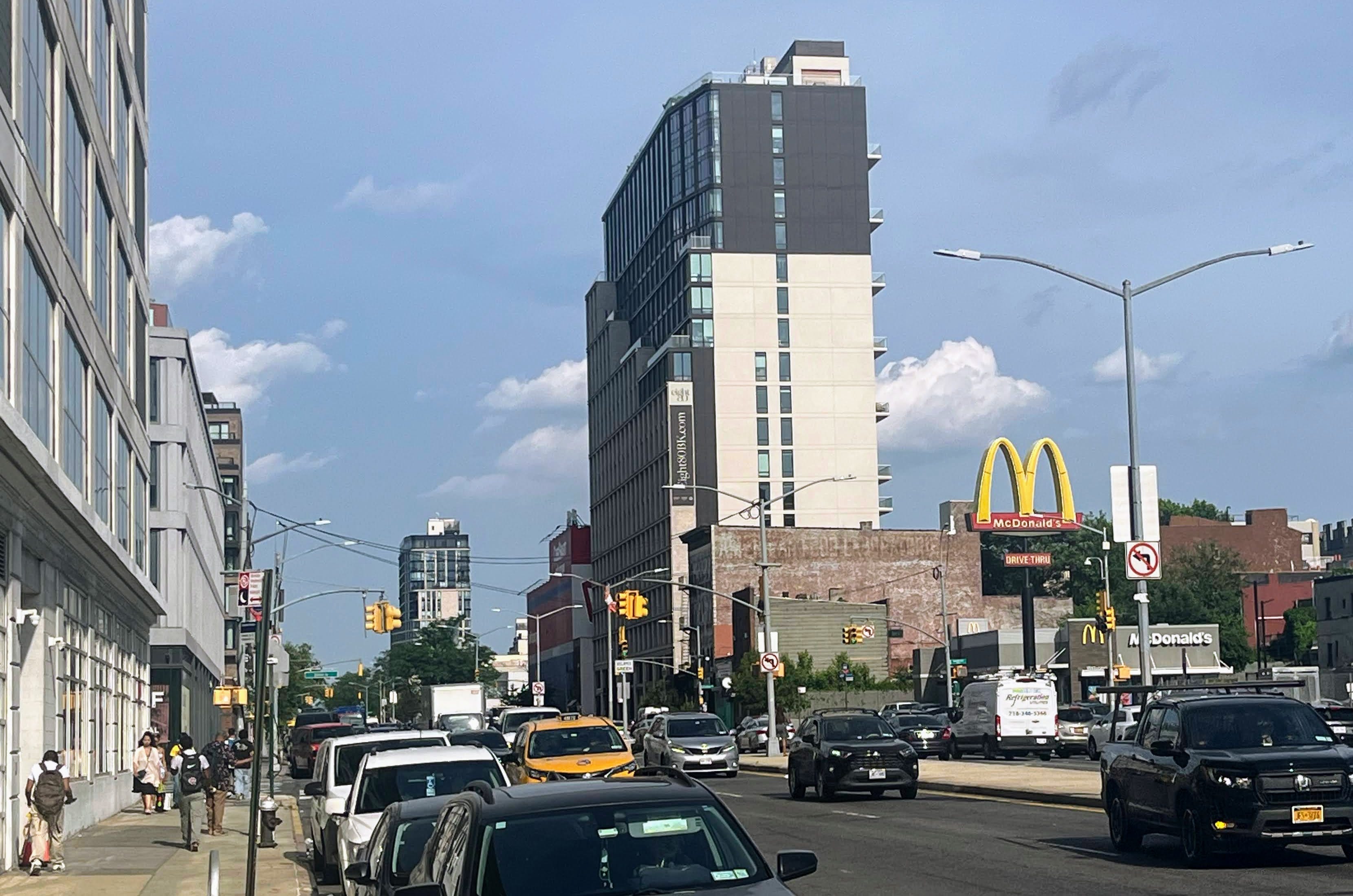 Looking east along Atlantic Avenue past Vanderbilt Avenue. Photo: Norman Oder
The two towers were supposed to include 35% affordable housing, exceeding the city’s 25% standard, in exchange for getting ahead of other projects.
That didn’t happen, as I reported yesterday for the policy publication City Limits, How a 35% Affordable Housing Pledge in Brooklyn Was Torpedoed.
The subheading: In 2022, developers behind two Atlantic Avenue projects committed to making a “record-setting” 35 percent of the apartments affordable. But after interest rates shot up and the owner cited cost pressures, nonprofit partners recruited by Councilmember Hudson agreed to renegotiate, rather than pursue enforcement.
The “news of a breached agreement is a disappointing development,” Hudson observed, “that shows the limitations of existing legal mechanisms to secure additional affordable housing beyond current requirements.”
Indeed, accountability in the process was scarce, as my reporting suggests. The developer didn’t tell the Council Member. The nonprofits didn’t inform Community Board 8. The developer came before Community Board 8, but they didn’t discuss the affordability promise.
It also shows that we have too few journalists keeping track. I had covered these spot rezonings as an outgrowth of coverage of Community Board 8’s M-CROWN initiative, a precursor to AAMUP.
My previous coverage of the spot rezonings for City Limits, as cited in the latest article, noted the difficulty in getting the names of the nonprofit counter-parties to the agreements Hudson negotiated, and then the actual documents.
Was that coverage too negative, as some suggested? After all, the 35% affordability was an achievement.
I wasn’t planning to follow up—I’ve got way too much else on my plate—but, when I saw the Housing Connect ads for the buildings’ affordable housing lotteries, I noticed a discrepancy between what had been promised and what was delivered.
I then went to ACRIS, the city’s property records database, and discovered that the agreement had been quietly revised, including the donation of the site below as a partial substitute.
Will the obligation be fulfilled by having the developer donate the site below to the nonprofit Fifth Avenue Committee and IMPACCT Brooklyn, as the page above suggests?
It’s a little more complicated, as my article explains.
I backed into covering this news. Ideally, more journalists would be keeping track. From 2012-2017, the publication DNAinfo, focusing on neighborhood news, sent paid staff to cover community board meetings.
Today, local news has withered. The daily newspapers have fewer metro reporters. DNAinfo is gone.
The local chain Schneps, which owns the Brooklyn Paper, Brownstoner, amNY, and more, doesn’t have the staff for comprehensive coverage and pays its existing staff so little that they’ve just started a union drive, seeking living wages, better health care, and editorial integrity.
Let’s note one positive but very much incomplete step. Brooklyn—notably gentrified neighborhoods—has recently seen a proliferation of hyperlocal newsletters, almost all on the Substack platform, which helps build audiences with recommendations.
They’re clearly filling a niche, gaining thousands of subscribers. (See coverage of the phenomenon in The New Yorker.) They include, in alphabetical order:
(Let’s not forget existing neighborhood publications like the Red Hook Star-Revue, Our Time Press (Bed-Stuy, especially), and Greenpointers, as well as publications that cover multiple neighborhoods, like the Brooklyn Paper, Brooklyn Eagle, Brooklyn Home Reporter, and BKReader.)
These hyperlocal newsletters can alert readers to neighborhood changes and happenings, especially regarding retail, aggregate others’ relevant reporting, and help build community. They can also offer service journalism, such as interviews with business owners.
But it’s tougher for such newsletters—mostly one-person enterprises, and presumably part-time—to scale up to more significant reporting.
Sustained attention in journalism isn’t easy. Maybe we need some new funding models.