
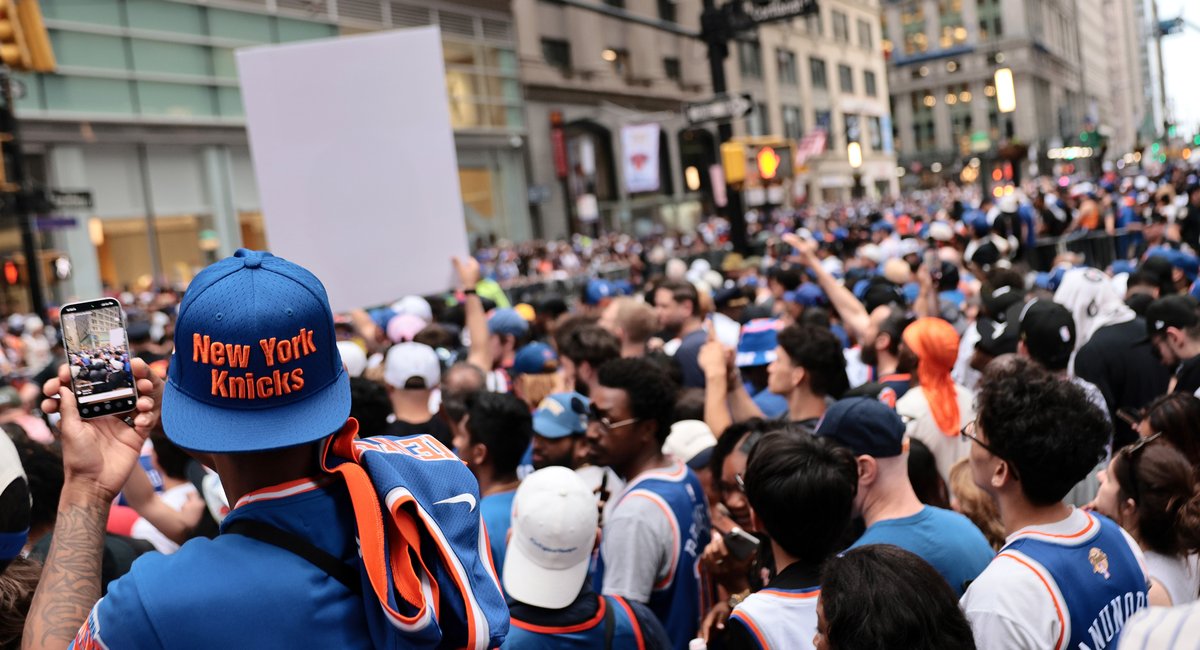
Lower Manhattan was a scene of jubilation for Knicks fans Thursday morning and a scene of chaos and confusion for everyone else.
Police locked down most of southern Manhattan in the middle of the morning rush hour Thursday as Knicks fans filled parade viewing pens to capacity hours before the event was scheduled to step off at 10 a.m. But officers still struggled to communicate with each other and some agencies involved in the event provided contradictory information.
The NYPD announced that it would be suspending train service at all stations, in all directions, south of Canal Street, after parade viewing pens reached capacity at 7:30 a.m. The surprise move caught commuters off guard, including those working, studying or going to appointments in the area.
It also contradicted the MTA. Spokesperson Aaron Donovan said trains were still making stops in stations south of Canal, though some were bypassing as many as five stops. The only closures were two that were previously announced: the R and W lines at City Hall and the 4/5 line at Wall Street.
“People are getting where they need to go, and stations are open,” Donovan said. “Any time that trains are bypassing any additional stations besides those two, it’s at the request of the NYPD, and it’s temporary.”
But people on the ground said they were definitely not getting where they need to go and even within the MTA there seemed to be some confusion.
A little after 9 a.m. an empty train rolled through the Bowling Green station to pick up stranded commuters. An MTA employee with a megaphone announced it would be the last train on the 4/5 line to stop at the station until 5 p.m.
PATH Trains in New Jersey were running but trains were dangerously overcrowded and commuters were trying to force their bodies into trains, while hundreds of others were stranded on platforms.
Workers trying to get into their offices also faced confusion. At 111 Broadway, employees had been told to enter through a side entrance. But by 7:30 a.m. the crowd was preventing them from getting anywhere near the police barriers, and officers ignored their pleas for help getting through.
An officer posted nearby told commuters that many people were having trouble getting through the police barriers to go work and medical appointments. He said communication between officers was difficult because personnel had been brought from all over the city and were on unfamiliar terrain.
Daniel Shapiro and Ann Givens contributed reporting.
This is a developing story and will be updated.