
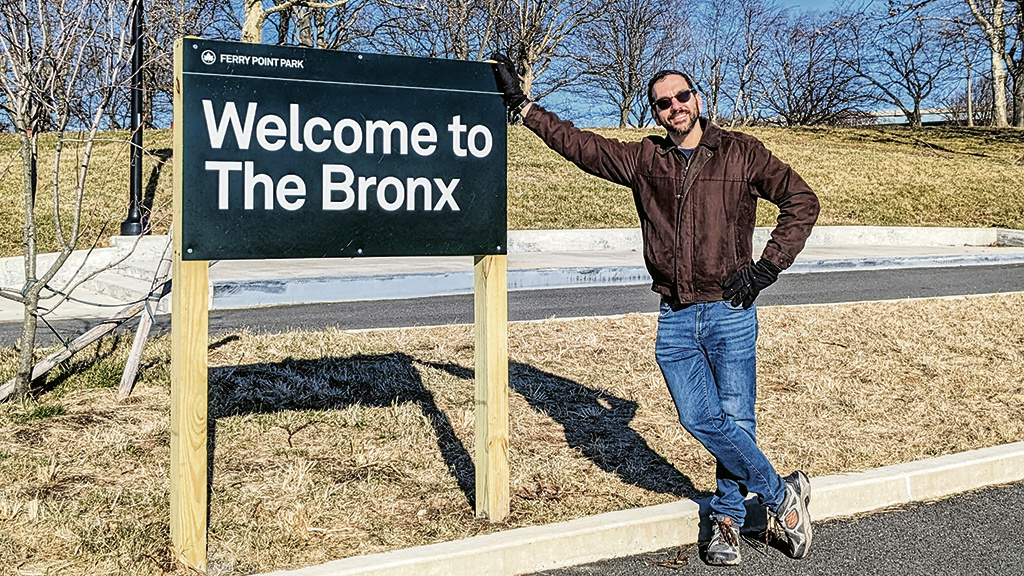
My sister, Lynn, and I always knew that our father grew up first in East New York and then in Flatbush, pure Brooklyn in every way, including his accent. (How much I’d give to be able to hear that accent again! Now almost no one except Bernie Sanders has it; his is oddly unaltered by his half-century or so in Vermont, proving once again that you can take the boy out of Brooklyn, but…)
We also always knew that our mother was from the Bronx. The South Bronx, in fact, the neighborhood that was so brutally underserved, victimized, and set alight during the city’s financial crisis in the 1970s. Her accent was far less audible than our father’s; when she was in college, she told us, she took a speech course that took particular aim at glottal stops.
Our parents, Ashkenazi both, used to tell us that theirs was a mixed marriage. His family spoke Yiddish, hers spoke Hungarian, and then there was the Brooklyn/Bronx thing. But it worked.
Lynn and I both know what Brooklyn looks like, and we know parts of the Bronx, but not the South Bronx, so when we saw that the Bronx County Historical Society was offering a walking tour of the neighborhood called Longwood, we jumped. (Then we walked…)
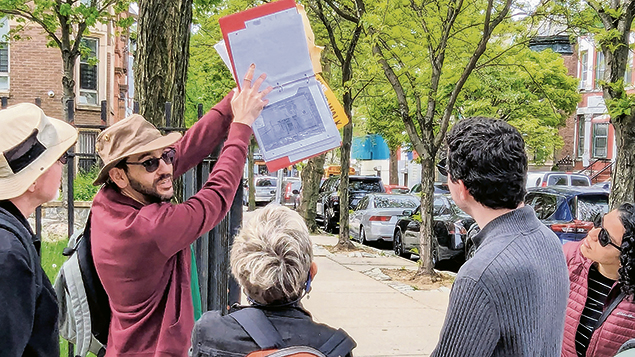
Dr. David Herszenson leads a tour in the Longwood section of the South Bronx. (All photos courtesy David Herszenson)
It was wonderful.
There are all kinds of love — romantic, platonic, parental, obsessive, healing. Our tour guide, David Herszenson, showed us another kind of love. A love of place. His love of the Bronx — both pure and clear-eyed — informed every stop we made on the walk, advertised as being 90 minutes but lasting for more than two hours, every minute of it fascinating.
There’s a story to how David came to fall in love with the Bronx and guide the tour. He’s a licensed New York City tour guide, which means that he had to pass a test about the city’s history, landmarks, geography, and public transit system, among other categories. It’s not up there with London’s famous black-cab driver test, the Knowledge, which is notoriously difficult, but it’s real nonetheless.
David is also Dr. Herszenson, a physician who practices family medicine, of course in the Bronx. And he’s the son of a father born in a DP camp, so his attraction to the South Bronx began with his interest in the old synagogues that lie, some repurposed, some disintegrating, in the neighborhood.
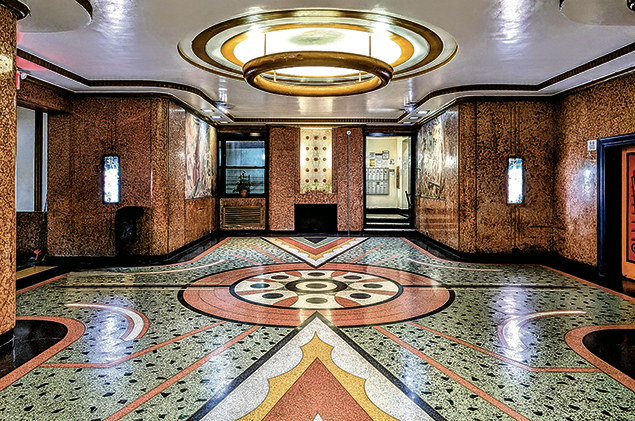
This spectacular lobby is in the Fish Building on the Grand Concourse.
Its architects, Horace Ginsbern (né Ginsberg) and Marvin Fine, were Jewish. In 1940 a Yiddish movie, “The Amerikaner Shadchen,” was shot there.
So first, Dr. Herszenson’s story.
David Herszenson was born in Milwaukee. His father, Sidney Herszenson, was born in a DP camp in Germany. His parents were Polish Jews, who fled east to the Soviet Union, and ended up in a gulag in Siberia. Like many of the Jews who survived the war there, frozen, starved, only half alive at the end, they went back to their homes to hear the even more harrowing stories of the camps and clammed up, locked up by survivor’s guilt for having had what they thought of as a relatively easier time. (All of this is relative; it is fair to say that the gulag survivors survived hell.)
The family planned to go to Palestine, but they didn’t because Sidney’s older sister was sick — possibly with malaria — so a doctor advised staying away from there. (And that most likely was a wise decision; Palestine was Malaria Central at the time.) They were able to get visas to the United States and at first planned to join relatives in New Orleans, but that city’s basically built in a swamp, so that move would have been unwise. They ended up in Brooklyn.
Dr. Herszenson’s maternal grandparents came from Odesa and got into the United States just before quotas began to be imposed. They moved to Milwaukee; that’s where David’s mother, Suzanne, was born, and a generation later where she gave birth to David.
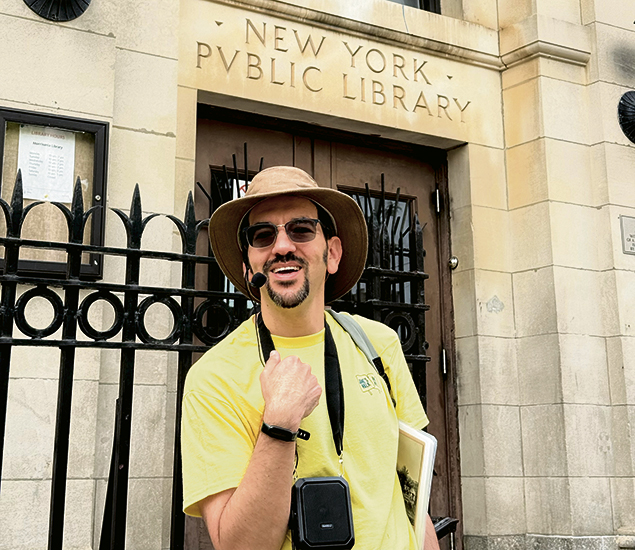
David is in front of another Carnegie library in the Bronx; this one’s in Morrisania.
About the family’s last name — “We are the only people in the world with the name Herszenson,” David said. Or at least the only people in the United States. Everyone else changed it to the more phonetic Hershenson, he said.
The Herszensons belonged to a Conservative synagogue in Milwaukee.
David graduated from the University of Wisconsin at Madison as a premed student with a bachelor’s degree in social work, and then he stayed local, earning his MD at the university’s medical school. He arrived in the Bronx for his residency at the Montefiore Medical Center, where he finished that part of his studies as chief resident. That was in 2008. He also earned a masters degree in public health, specializing in policy and management, at Hunter College.
The Bronx was a logical place for him. Montefiore “had and has a social medical program, for people who are interested in the social aspects of medicine.” That doesn’t mean going to medical school to make friends; it’s for doctors who care for their patients as whole people, and who are interested in the broader social policy that underlies medical care. He’s now an assistant professor of family medicine at Montefiore Einstein. His practice centers on helping patients manage the kinds of healthcare issues that are common in poor communities, particularly diabetes and hypertension. He worked at the Bronx Health Collective until 2021; now he’s at a clinic at Einstein.
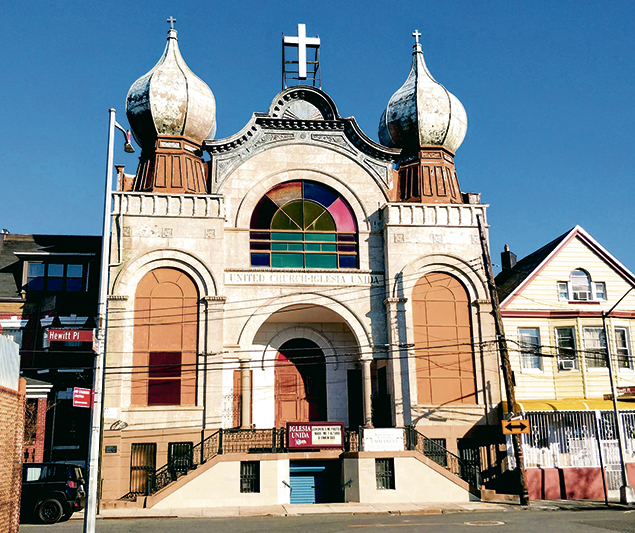
The Romanesque Revival-style, twin onion-domed Montefiore Hebrew Congregation opened in 1906. Its longtime rabbi, Jacob Katz, also was a chaplain in the Sing Sing prison in the 1920s and ’30s. Now it’s home to two churches.
And, once again, he’s a licensed city tour guide.
There is at least one place where those two seemingly disparate lives come together, David said. He’s involved with a nonprofit called Walk With a Doc, which “encourages doctors to take walks with their patients on a regular basis.”
So how did he start to lead walking tours in the Bronx?
At least in part because of all the synagogues there.
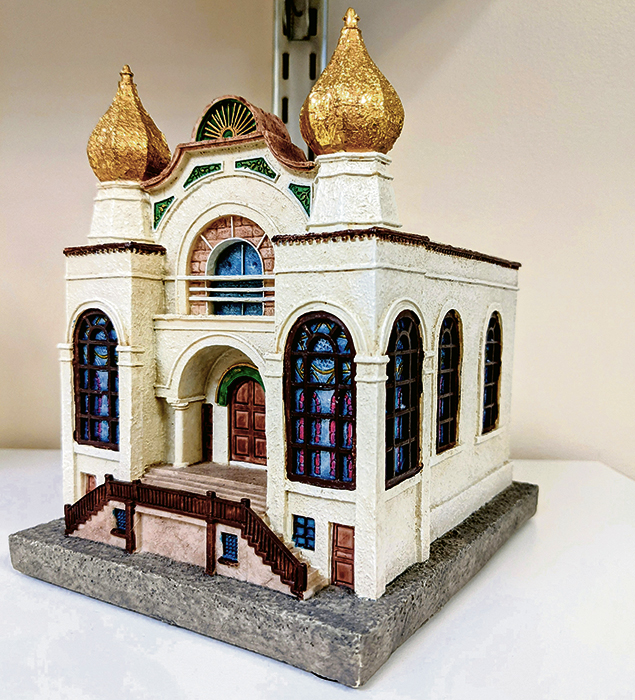
A model of the building as a shul.
“In 2020, it was covid, and I couldn’t do what I used to do. I used to see lots and lots of Broadway shows,” he said. “I was really busy. But all the things that I used to do I couldn’t do.” He lived on the Grand Concourse, “so in the evenings, I would just walk around.
“There is a really nice website about Bronx synagogues, and that started me. I was walking from synagogue to synagogue And then I started to look at other buildings, and they were all really interesting. They each had a story, and I would start to read about them.
“When I moved to the Grand Concourse” — that avenue of once and some still grand Art Deco apartment buildings, many of them home to Jews, particularly between the wars — “I started to post about it on Facebook. I started sharing neighborhood and building profiles, and people responded to them. One friend, who runs an outdoor group, said, ‘You really should give us a tour,’ and I agreed, and I did. That was five years ago.
“I got addicted to tours then.”
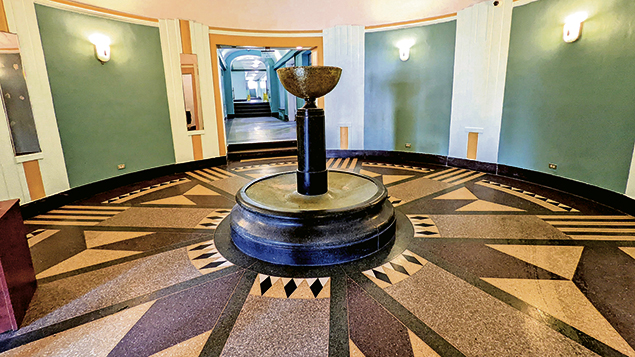
This is the lobby at 888 Grand Concourse, the only Emery Roth building in the Bronx. Roth, a famous and influential architect, was Jewish.
The tours are a mixture of history, sociology, art history, and architecture. “I’d always been interested in history,” he said. “Architecture is new. I learned a lot.”
He talked about the Bronx. When Jews first moved into New York, most began in Manhattan, in the extraordinarily crowded Lower East Side. (The story of the Jews of Newark, the ones born at the Beth, is similar in kind but different in detail.) When they could no longer take the density and could afford to leave, many first moved uptown, to Harlem, or out to Brooklyn. When Harlem became crowded, they went further north, to the Bronx; from there, they fanned out to North Jersey and Westchester County. (Meanwhile, the Jews in Brooklyn, to continue to generalize, moved further out in that borough, then east to Queens, then further east to Long Island.)
“The Bronx was called the Jewish borough,” David said. That was most true in the 1930s and ’40s. At one point, he said, the South Bronx was about 40 percent Jewish.
There were many synagogues in the borough. Each one has a story; there are grand ones, with imposing architecture. Many of them are churches now, but when you look up, you see the stars of David in the stained glass and Hebrew words and the Jewish year etched in the stone on the upper levels. David can tell the stories of each of them.
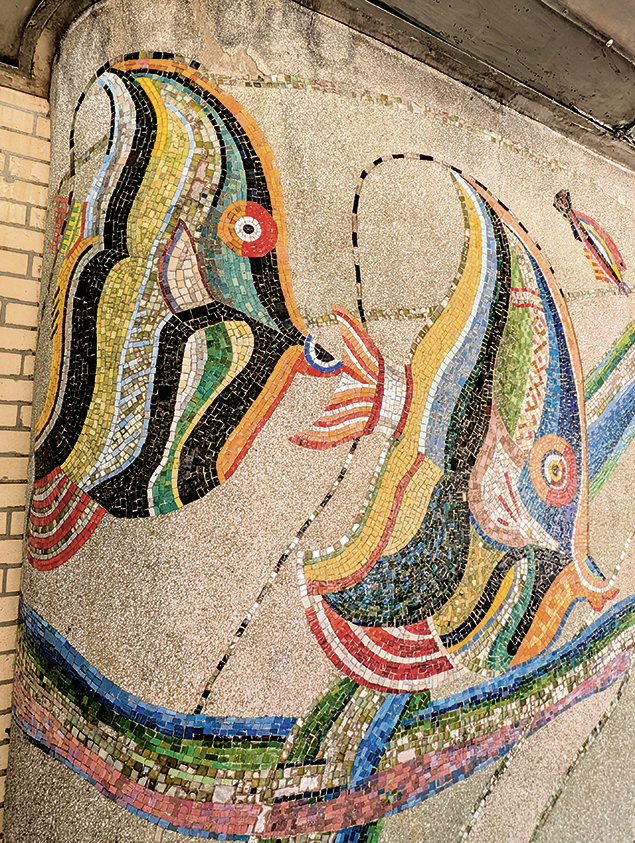
This mosaic, unsurprisingly, is in the Fish Building on the Grand Concourse.
There’s another detail that describes the travels of the Jews of the Bronx. On many doors of many buildings, including his own, there are painted-over mezuzot. That wasn’t done out of any animus, just a simple lack of knowledge. Nobody knew what that thing on the door was.
Back on our tour, my sister and I got to see our mother’s neighborhood. Some of it is rundown, although our walk did not go through any streets that anyone who remembered the “Bronx is burning” era might have expected. Some of it was vibrant; there are brightly colored murals all over. The South Bronx was where hip hop was born; there’s much of that culture visible too. The Yiddish theater had thrived in the Bronx; there’s a theater, now in total disrepair, that had housed one of its troupes.
David was able to get us into one of the apartment buildings there. We climbed up the stairs to the roof — many, many stairs — and were able to look down at the borough.
We walked by one of the original Andrew Carnegie libraries; this one, called Woodstock, was designed by McKim, Mean & White.
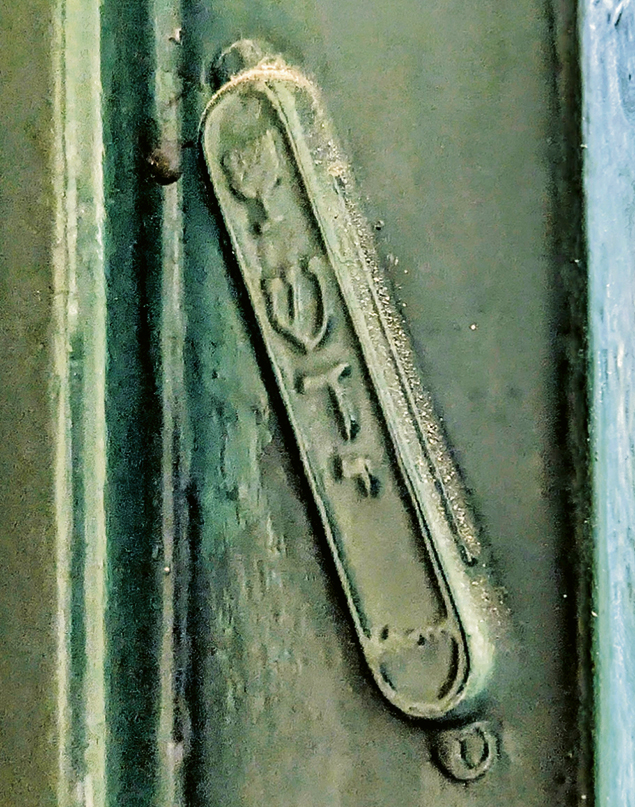
This painted-over “ghost mezuzah” hangs in a building on the Grand Concourse.
We went past a shul that’s still in business — it’s now home to two churches, one of them Spanish-language Seventh Day Adventist — that is crowned by two onion domes. David’s not sure why.
As we got closer to Fox Street, the buildings started getting nicer. There were a few blocks that looked like brownstone Brooklyn; David said that those were built early in the Bronx’s development, when it still was considered to be more rural than urban. (That’s before the concept of suburban really took root.) Our mother’s building was brick, and it was neatly painted in a subdued, pretty red. There was a courtyard, and three elderly women sat on benches there, talking. There was a neatly tended city park next to it, and children playing in it.
Neither of us had any idea what to expect, but neither of us expected what we saw. It was neither bursting with wild, exuberant life nor at all threatening. It was pretty. It was even a bit sedate. It looked like a good place to grow up.
We don’t know what shul our mother and her family went to, but we do know that they went to shul, and that it would have been Orthodox. Now that the neighborhood has been demystified but instead brought to life for us, maybe we can begin to figure out where it might have been.
And we plan to go on more walking tours with Dr. David Herszenson. He gives tours to anyone who wants them, he said; fees go to the Bronx County Historical Society, not to him. He does them free, out of love. And he knows what he’s talking about.
He’s at dshersze@yahoo.com; his walks, and many of his photographs, are at facebook.com/BronxandBeyond and Instagram.com/HerszensononGuiding. The neighborhoods he tours with the most Jewish stories, he said, are Longwood, the Grand Concourse Historic District, and Morrisania. And he’s really good.