
An excerpt of this interview first appeared in Stage Whisperer, Vulture’s weekly newsletter for theater gossip, interviews, and more. Sign up here.
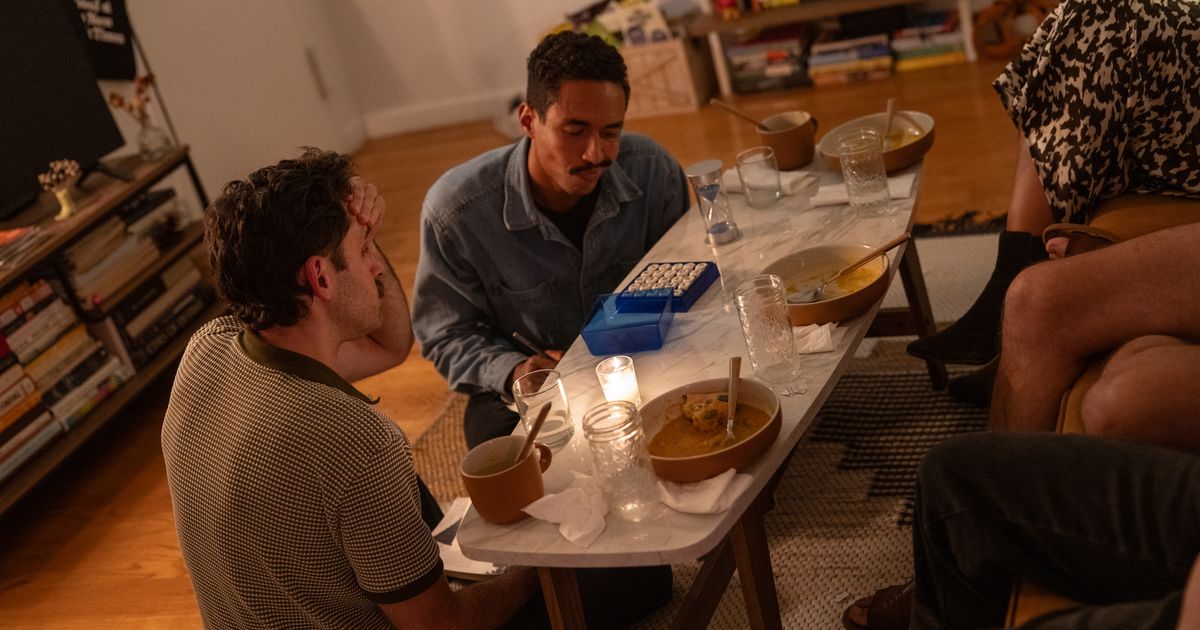
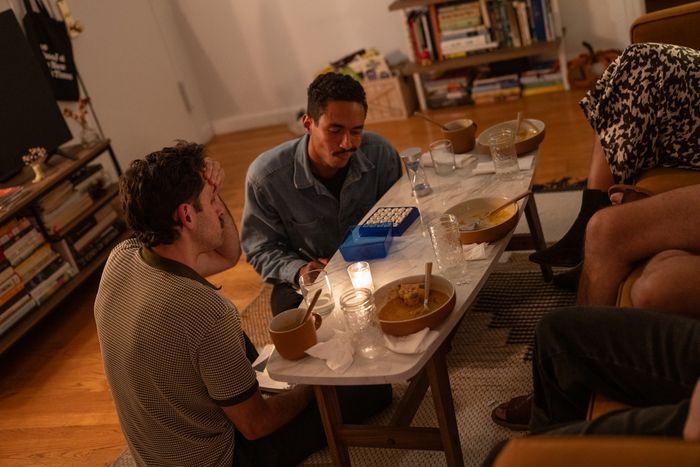
It almost feels cruel to recommend Slanted Floors, although it’s one of the buzziest productions currently running in New York. But the truth is that, for the few who can get tickets, it’s a revelation. Written by Billy McEntee and directed by Ryan Dobrin, the show’s stage is the same Greenpoint apartment in which it is set. Each night, six audience members gather in the living room, sitting on the sofa and a few assorted chairs, and watch a day in the life of the gay couple Kaplan (Adam Chanler-Berat) and Teddy (Kyle Beltran). Kaplan is a freelance writer working in theater, and the play begins by speed-running his daytime routine. He leads Zoom tutoring sessions, he sits around, he puts on a tutu, he scrolls Grindr. Throughout, the living room TV displays his screen time. When Teddy, also working in theater, gets home, the play slows down to become théâtre vérité as they interact. Teddy serves dinner, and everyone in the audience gets a bowl of his carrot stew. Then he tells Kaplan he’s had an idea for a show, and he launches into an extended monologue in which the six audience members are cast in his play, and he looks at each of us when describing the characters. Finally, the couple goes to bed.
The level of intimacy can be thrilling but also a bit eerie. Chanler-Berat and Beltran are both acclaimed actors with Broadway experience who last performed together in 2014’s Fortress of Solitude, and they feel entirely at ease with the closeness. Slanted Floors is, by nature, voyeuristic. Though it’s theatrical during Teddy’s monologue and Kaplan’s daytime showcase, the couple’s one-on-one interaction remains entirely grounded in reality, to the point where the audience feels like they’re intruding. Beltran, in particular, holds such extreme eye contact that I, at one point, found myself catching my breath.
Curious about what it feels like to perform in such close quarters, I talked with Chanler-Berat and Beltran about their production, which is currently in its second run. “It feels like an investment in the future of the theater landscape in New York,” Chanler-Berat says. “It feels like an important kind of theater that needs to exist.”
How did you get involved with this production?
Kyle Beltran: Billy and Ryan emailed us. I knew Ryan from theater circles, but I didn’t know Billy. They were like, “What do you think about this strange adventure?” Adam and I talked about it a lot. We hadn’t been onstage together since Fortress of Solitude at the Public in 2014, which is something very precious and meaningful to us. But we were excited about the piece of writing and curious about the uniqueness of the experience, and we both love Greenpoint, so we decided to go for it.
Part of the story of Fortress is that its creator, Michael Friedman, whom you both knew, has since died from complications of HIV/AIDS. How was it getting back in the rehearsal room together after over a decade?
Adam Chanler-Berat: Kyle is my favorite actor in New York. I have been eager to get back in a room. Slanted Floors is, in a lot of ways, the opposite of the Fortress experience, but the intimacy between the characters feels very interconnected.
Beltran: Our very first preview was the anniversary of Michael’s passing. That was wild and a beautiful wink from the universe. We experienced so much grief over his loss, but it felt special and tender to feel his presence with us on our first time onstage together again.
Some people are so thrilled by the experience. Some people get so nervous or very emotional, because staring into someone’s eyes is so intimate.
What were the early shows of Slanted Floors like, when you were getting adjusted to the intimacy?
Beltran: What was exciting and terrifying about it is that we put it up pretty quickly. Those first few shows were pretty white knuckle. I learned my aria in the center of it in two days. There was the immediate fear of: Do I know these words? But Adam and I both love to work at that intimate scale. It’s the best of working onscreen and onstage, because you get the immediacy and connection of live theater, but you get to work with the specificity and detail of working on-camera.
Adam, you start the show with what I’ve been thinking of as a dream ballet, showcasing your entire day as a freelancer. How has that been to calibrate?
Chanler-Berat: Or a nightmare ballet! That piece feels theatrical, and then other parts of the show feel filmic. Part of the delight of doing something so intimate is figuring out the scale of your performance. I was constantly trying to figure out how to modulate the beginning. We’re eating dinner right here, and an audience member is literally a foot away from my face. One of the elements that’s special is that it feels like a piece of theater and not. There are also a couple of sections in the show that are current-event things, and we collaborate on those with Billy, sometimes nightly.
I got a reference to the upcoming PACNYC show Giulia: The Poison Queen of Palermo in mine.
Beltran: The Poison Queen of Palermo has been sticking around this run. It’s a living, breathing thing in a way I’ve never experienced. The day after the Tonys, because Teddy worked at a reading, we added something about how crazy it was that he had to do that on that day, because that’s an industry-blackout hangover recovery day.
The show is particularly honest about gay male life, to the point where it was even uncomfortable to me that an older straight woman was in my audience. I was like, She doesn’t need to see how Grindr gets used. How did you approach that?
Chanler-Berat: It used to be even more explicit. I think in the first draft that I read, Kaplan jerked off in the first sequence.
Beltran: He did what?
Chanler-Berat: I know he jerked off, but I have this weird memory that he jerked off into a bottle or used the bottle to deal with his come. It was very … There is also nudity this time, and there wasn’t last time. It felt so weird that there wasn’t nudity — if he’s alone in his house, like he would be naked. But then how do we do it so it’s not gratuitous?
How did you feel about getting naked, personally?
Chanler-Berat: I get naked in my bedroom when I’m not hiding myself from an audience. It feels behavioral. This is just this person’s day. It’s prepping the audience for the kind of intimacy that they experience with us throughout the rest of the evening.
Beltran: The play is very different every night depending on the energy in the room and the identities of the people in the room. There is so much that’s resonant about living in the city, being in partnership, being an artist, dealing with a life on the internet, being a millennial. But there is a layer of what it’s like to be doing all those things and queer. There’s an … I’m going to use the word indictment, but I don’t mean it with severity. The play can create some real melancholy. We feel it most when the room is all gay men. People will share afterward the intensity of that reflection.
Do you remember the people who go to each individual show?
Beltran: Yeah. I describe it as a séance, because I feel like I’m inhabiting the people who come to watch. It can be a deep connection and presence, and I tend to remember because the characters and the stories Teddy tells are so vivid, and the audience members become so vivid to me.
Kyle, your “aria” is unique because you’re looking audience members individually in the eyes as you’re performing it, within the context of the show, for an audience of one. How do you approach it?
Beltran: It reveals itself slowly to have layers. We watch something shift from being in the present to then existing in some sort of mysterious metaphysical layer. Adam evoked the image of stretching taffy. It expands slowly to include the room. It’s one of the greatest exercises in true presence I’ve ever had. It’s entirely based on the energy in the room and the people whose eyes I’m staring into and what they offer.
What do you see when you look into people’s eyes?
Beltran: Fear, joy, surprise, sadness, excitement. Some people are so thrilled by the experience. Some people get so nervous or very emotional, because staring into someone’s eyes is so intimate. We are living in a time when we’re desperate for connection, but there are forces getting in the way of us feeling connected. We have less practice with intimacy because we spend so much time staring at screens and phones. The play makes an offering. Because of the story I’m telling, people sometimes take on the qualities of the story.
You refer to people on the couches as characters in the story. Are you purposefully sitting people in specific slots?
Chanler-Berat: We cast it every night. We go online and look at audience members’ Instagram profiles and we Google them. We’re playing casting director on top of the other things we do in the show.
Beltran: Sometimes you can figure out some information on the internet, sometimes you can’t. You might make some choices that you think make sense, but every day you’re completely surprised by how a particular person’s energy matches the seat they’re in.
Adam, then you have a difficult job. Once the audience is so onboard with Kyle after this intimate aria, Kaplan deflates that. What is that like to play each night?
Chanler-Berat: The audience and Kaplan are very aligned in the beginning of the play. Once the story begins, the audience converges with Teddy, we’re all sort of in it together, and it’s actually a moment of real connection for everyone. There’s a specific moment in the story where Kaplan diverges and Teddy and the audience stay together. Because of the magic that’s in the room, the audience might not clock exactly what’s happening. There’s a moment where Kaplan feels like Teddy is coding something about their relationship in the story. Kaplan really wants to understand, but that takes him away from what’s happening, whereas the audience and Teddy stay together. It’s a play about connection and disconnection. And that is the moment where I start to feel like I’m a satellite leaving an orbit.
How is this show financially possible?
Chanler-Berat: That’s a very good question. To be completely honest, I’m not sure this incarnation is solvent.
Beltran: It’s above our pay grade.
Chanler-Berat: We’re all doing it for the love of it and for our deep commitment to this kind of storytelling. It feels like an investment in the future of the theater landscape in New York. It feels like an important kind of theater that needs to exist. Everyone involved is showing up because they believe in this work.
Do you think the script would work in a proscenium house?
Beltran: There are definitely discussions about how this might scale, what that would look like, and how you maintain the integrity of the actual intimacy and not performed intimacy. I’m probably the most concerned about it, and the most attached to preserving the current version, because I don’t think it can be replicated. But we’ve had lots of interesting discussions about how it would function if there were more bodies in the room.
Chanler-Berat: I have been thinking a lot about Every Brilliant Thing and how, in that huge space, it creates such a sense of smallness and intimacy.
Are you guys bored of carrot stew?
Beltran: No, it’s delicious.
Chanler-Berat: You’re speaking to two people who eat Sweetgreen pretty much every day. It’s hard anytime you do a play where you have to eat something. There’s a little bit of wow, I’m going to eat this every single day.
Beltran: But it’s nice that it’s so warming. Part of how the spell is made is that everybody has this warm bowl of delicious stew.
Chanler-Berat: We did try a cold soup at the very beginning of this run because it felt more appropriate, and we learned very quickly that that was not the right spell to cast.
Sign up for Stage Whisperer
Weekly theater news, delivered a little louder for the people in the back.
Vox Media, LLC Terms and Privacy Notice
Related