
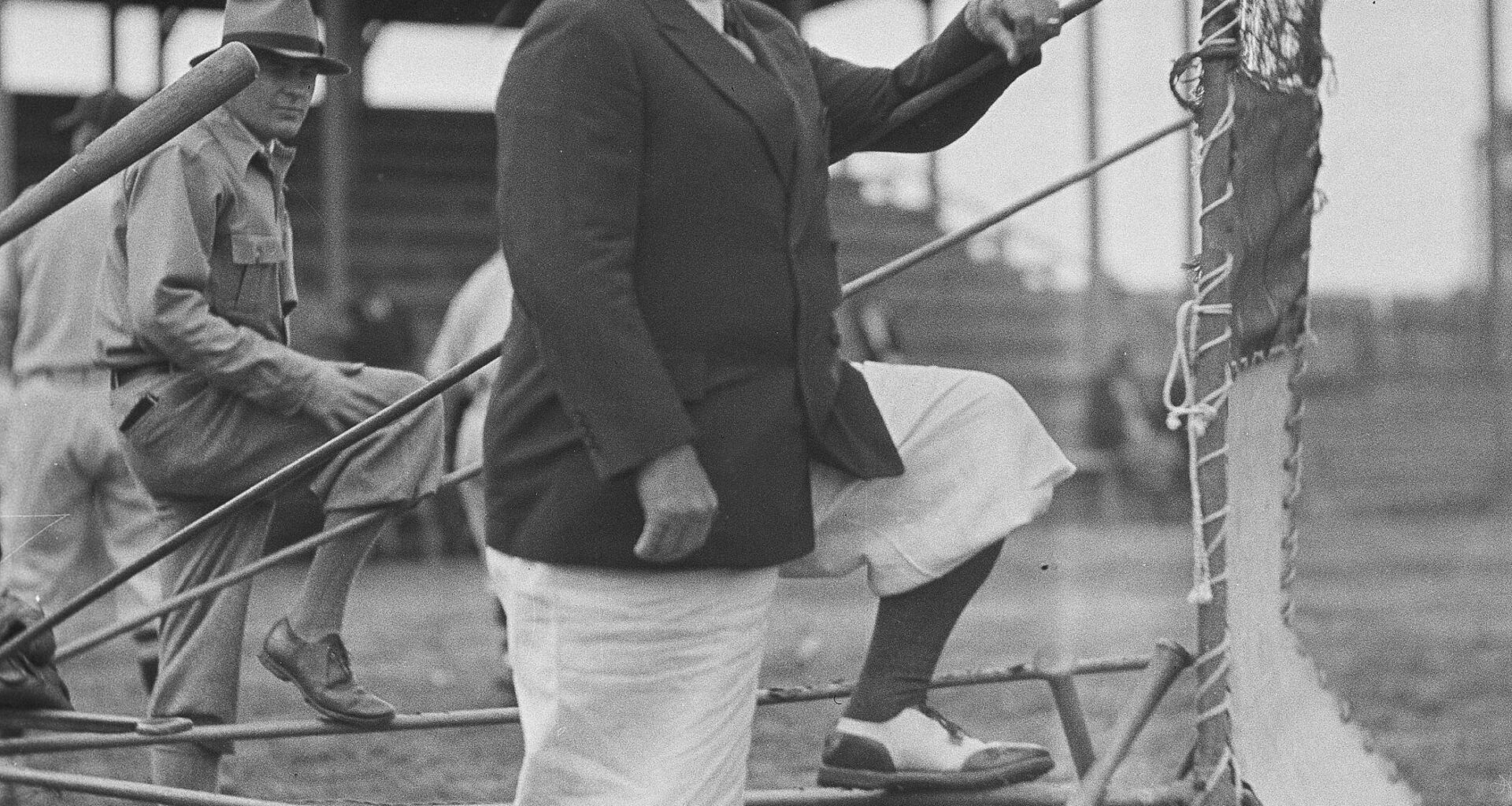
Dodger history has always been associated with screwballs and screwball happenings. Take, for example, having a ragtag group of musicians become the Dodger Sym-Phony. Which was screwier, the sight or the sound?
For June, I present you with a few more such stories. They revolve around one of the Dodgers’ most successful managers, but not someone you’d pick from a list of persons likely to be involved in a screwball stunt. The person? Wilbert “Uncle Robbie” Robinson, born June 29, 1863. He was a person who had multiple impacts on the Dodger brand. The Baseball Hall of Fame says that the folksy, neighborhood team image of the Dodgers that has endured through the years was, in fact, an enduring reflection of Robinson’s personality.
Robinson is remembered today primarily as the jovial, rotund “Uncle Robbie” who managed Brooklyn to two National League pennants and a 1,399-1,398 record from 1914 to 1931. His congenial nature and happy-go-lucky attitude made him one of the most beloved characters in baseball. But on the diamond, he was a never-say-die competitor who specialized in getting the most out of his pitchers. He is enshrined in baseball’s Hall of Fame.
Robinson managed the Brooklyn Dodgers for so long that local sports reporters began to call the team “The Robins.” It stuck and became one of the many names the team had, including, at the same time, the moniker “Brooklyn Trolley Dodgers.” That name came from the field’s location, a challenging piece of urban real estate where several trolley lines came together, requiring an eagle eye and fleet feet to cross the interchange without facing off with an unyielding trolley car whose bell was clanging away wildly, “Get out of the way! Get out of the way!”
Robinson was a very good ball player. He was a righty, both throwing and hitting. According to the Baseball Hall of Fame, he was a catcher with a .273 lifetime hitter who topped .300 five times in his career. He’s still in the record books, having gone 7-7 in a nine-inning game. The starter and loser of that game was Baltimore’s Pretzel Getzien. I tell you that just to get that zany name into the article. We’ll come back to it. The batting feat was only done by one other player, the Pirates’ Rennie Stennet in 1975.
Then there is the story of how two storied baseball players who were best friends became bitter enemies. The other character in this play is John McGraw. Here’s what happened. The short of it is that both men went into business together in Baltimore, where they were teammates. They owned a bar called The Diamond. The friendship itself was one of opposites attracting. Robinson was a rolly polly, genial person loved by all. McGraw, 10 years Robinson’s junior, was plain evil in personality and roundly hated by all. After bouncing around a bit, McGraw began a 31-year stint as the manager of the Giants. What happened next sparked a feud that I believe seeped permanently into the DNA of both teams and their fans. The Dodger/Giant hatred of the ’50s was legendary. I hated the Giants for no other reason than they were the Giants.
McGraw hired Robinson as his pitching coach. The former catcher was great at handling pitchers. After a few years with the Giants, Robinson was hired on to manage the Dodgers. The Dodgers began an ascendency that eclipsed the Giants, with the Giants falling short several years in a row during the drive for the National League pennant. The two men met at The Diamond and got plastered at a party thrown by McGraw. McGraw blamed Robinson’s coaching legacy for his Giants’ poor pitching in the clutch, while Robinson told McGraw it was his lousy managing. McGraw became incensed, he threw Robinson out — a possible forerunner of “It’s My Party, and I’ll Cry If I want To?” Not to be outdone, Robinson poured his beer over McGraw’s head. A possible forerunner of, “He who laughs last, laughs best?” The two remained estranged for 17 years until right before McGraw’s death. Boys will be boys, no matter how old they are.
The most famous of the Robinson stories is, like many Dodger stories, a little screwy, this one a bit more so. It involved Robinson, the former catcher, a stunt pilot, Ruth Law, who did or did not drop a baseball or something from a plane to someone waiting to catch it. Who got it in their head to have the performance duplicated is unclear. Some say Robinson boasted he was such a good catcher that he could catch a baseball dropped from a plane. Others say the idea was brought to him because someone else had done it. Law either did or did not have a baseball because she did or did not forget to put it in the plane. She either planned or did not plan to switch the ball, which she did or did not have, with a grapefruit, which she definitely did drop from the plane from the height of 525 feet, to Robinson, who was expecting a baseball.
Why 525 feet? The previous go at this nonsense was from a few hundred feet up. Robinson’s ego might have had him want to make the catch even more challenging. This time, it was decided that the drop would come from above the height of the Washington Monument. Why the Washington Monument when this was to take place in Florida, not in the nation’s capital? Don’t ask, but it’s fortunate the switch was made because Robinson misjudged the catch and was hit in the face with the grapefruit that then exploded all over him. He actually was none the worse for wear; the grapefruit wasn’t. Robinson, probably in shock, began clawing at his face. He began to scream. The acidic juices from the grapefruit burned his face, and the pulp covered it. He believed he was bleeding to death. One thing we do know for sure. Even though this foolishness took place during spring training in Daytona Beach, Florida, it had absolutely nothing to do with winter ball being called the Grapefruit League. Ba da boom!
Wilbert Robinson, who died in 1934 in Atlanta, Georgia, is buried in a little town outside his beloved Baltimore, where he retired to fish and hunt. But even his death was an oddball affair. He fell and hit his head sharply on the bathtub in his hotel room. He also broke his arm. He made light of it, saying he was too tough to die. Turns out he wasn’t. He had a brain hemorrhage that killed him shortly thereafter.
There were tributes aplenty. Society for American Baseball Research reports that “his conversation was a continuous flow of homely philosophy, baseball lore, and good humor. He knew baseball as the spotted setter knows the secrets of quail hunting, by instinct and experience.”
Here’s a tribute from New York Times sportswriter John Kieran: “It is doubtful that baseball ever produced a more colorful figure than the esteemed Wilbert Robinson. … Like Falstaff, he was not only witty himself but the cause of wit in others.” Uncle Robbie may be the only baseball player ever to evoke Shakespeare from a writer.
While one could argue the point, Robinson was an original. Yes, baseball has seen its share of memorable players —Dizzys and Daffys, the Wonder Hamster, Glass Shins, Sleeper, Boileryard, Penguin, and the aforementioned Pretzel. In the category of “you can find anything on the internet,” there are several lists of goofy nicknames for ball players past and present. One is the Baseball-Reference Nick Name Library. Reading through it, one realizes that over time, every team had several players whose physical characteristics or strange behavior warranted them being tagged by their teammates. But for this writer, no one had the total package that was Wilbert Robinson.