
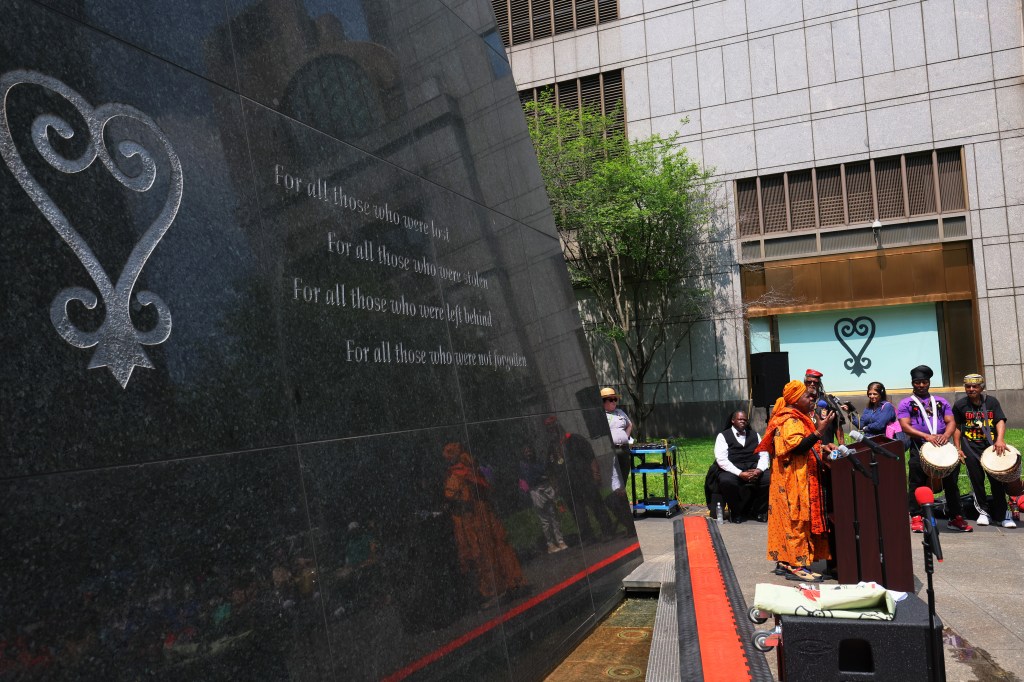
My tour group descended slightly as we passed steel barricades and sidestepped retractable bollards that keep traffic out of this quiet stretch of Lower Manhattan. Elk St. has a somber feel to it, which fits our purpose of visiting the African Burial Ground National Monument.
The African Burial Ground holds the distinction of being the oldest and largest known excavated burial site in North America for both free and enslaved Africans. I’ve been sharing its story with visitors since I became a NYC guide in 1995. I’ve returned with groups regularly since the memorial opened in 2007, and I never miss it on Juneteenth, when we also spend time in the visitor center that brings the history of slavery into sharper focus.
It’s one of the most powerful places in the city to reflect on emancipation, and on the people whose labor built New York long before freedom was declared.
In 1991, construction workers in Lower Manhattan uncovered more than 400 sets of remains buried roughly 30 feet below the surface, part of an estimated 15,000-person, 6.6-acre burial ground used during the 17th and 18th centuries.
What followed became one of the most significant archaeological investigations of slavery in the United States, revealing evidence of extreme physical labor, malnutrition, high infant mortality, and shortened life expectancy among people whose origins traced to various regions in Africa. After excavation was halted, the remains were reinterred, and the site was preserved under the National Park Service.
Today, the memorial includes seven sacred reinterment mounds, a towering Ancestral Chamber that represents the soaring African spirit, and a circular below-ground “Libation Court,” is engraved with African symbols. It’s a place of deep reflection, and I’ve never brought a group that wasn’t deeply affected by it. On Juneteenth, that impact feels even more immediate.
Juneteenth marks June 19, 1865, when Union troops arrived in Galveston, Texas, to announce that enslaved people were finally free more than two years after the Emancipation Proclamation. Though Abraham Lincoln issued it on Jan. 1, 1863, enforcement depended on Union presence, and in remote parts of Texas, slavery continued until that day in 1865. Though rooted in Texas history, Juneteenth is now widely observed as a celebration of emancipation and Black freedom. It became a federal holiday in 2021.
Those buried in the African Burial Ground never lived to see that freedom. Slavery in NYC was abolished in 1827, long before Emancipation, but that’s what makes the Burial Ground such a poignant place to commemorate Juneteenth. This year’s Juneteenth programming, according to Ramon E. Mangual, supervisory park Ranger, will be held outdoors from 11 a.m. to 2 p.m., featuring performances, African cultural programs, interpretive activities for all ages. It is free.
It has been a difficult year for the site. Its proximity to ICE headquarters and nearby protests has caused unexpected closures. Like other parks across the country, it has altered its operating hours because of administration-directed policy shifts, which doesn’t always align with school trips or guided tours. That fragility makes this year’s Juneteenth observance feel even more urgent, reminding us that even sacred public places can’t be taken for granted.
Juneteenth commemorations will take place across NYC, including a Rock the Bells concert at Forest Hills Stadium hosted by LL Cool J. But I am always glad we have the African Burial Ground, reminding us that much of Lower Manhattan was built on the labor of enslaved Africans. They lived lives marked by pain and erasure, yet here — beneath the city that rose above them — they are finally given a place to be seen, named, and remembered.
Ray Stanton is author of “Out of the Shadow of 9/11: An Inspiring Tale of Escape and Transformation.”