
NIAGARA FALLS, N.Y. — When you think of Niagara Falls, considered by many as an unofficial eighth wonder of the world, what’s the first thing that comes to mind? Probably not electricity.
In the 1750s, well before the 1776 signing of the Declaration of Independence, the hydropower of Niagara Falls was being used for a French trader’s sawmill.
When you step inside Niagara Falls State Park, there are signs leading you every which way. Ultimately leading you to the falls. But if you back track a bit, you’ll find a building filled with the original correspondence from when the park became a park, even “The Distinguished Visitors Register” with Harry Houdini’s signature.
But the lobby of the education building is where Power and Revolution are on full display.
What You Need To Know
In the 1750s, well before the 1776 signing of the Declaration of Independence, the power of Niagara Falls was being used for a French trader’s sawmill
In 1896, Tesla flipped the switch for AC transmission to transmit the power to Buffalo
Niagara Falls State Park has an exhibit on display called “Power and Revolution” in the Education Building to celebrate America 250
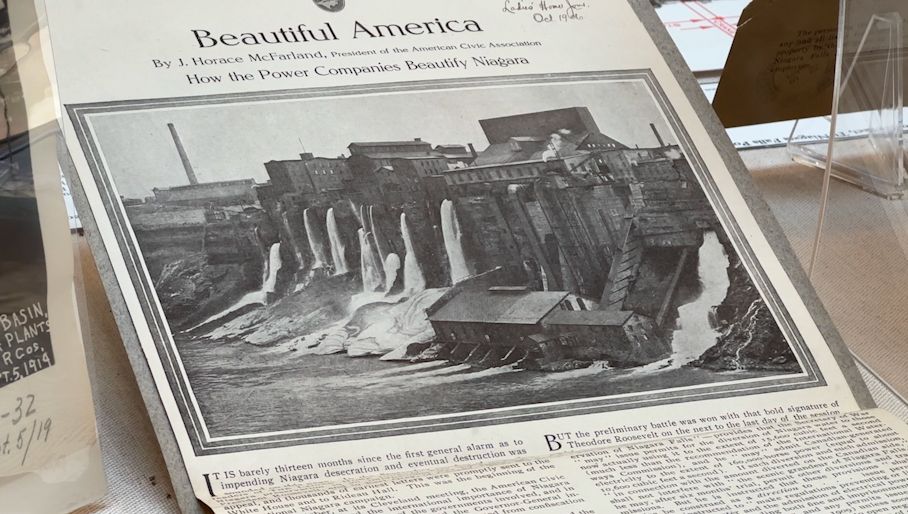
“We are combining the three anniversaries of the 1776 revolution and a 250-year anniversary,” said Courtney Geerhart, curator one for Niagara Falls State Park. “We are doing the 1896 AC transmission revolution. And then we’re also doing the 1956 anniversary of the Schoellkopf collapse. There’s always those two kind of powers clashing. Right? So, the state park that wanted to preserve the falls at all costs, and the power companies that very much wanted to utilize the falls, for their own benefit.”
The exhibit shows the battle of preservation versus progress. Geerhart says in the 1820s through the ’70s, mills and factories crowded the gorge. It included the charter of the Niagara Falls Hydraulic Power and Manufacturing Company and the completion of the hydraulic canal.
In 1884, Nikola Tesla came into the picture, arriving in the U.S.
“But there was a dichotomy at the time between the parks and the industrialization of the area,” Geerhart said. “And that’s why the parks were created in 1885.”
But industrialization didn’t stop. In fact, it made history in 1896, “when Tesla flips the switch for AC transmission to transmit the power to Buffalo,” Geerhart said.
That 20-mile transmission of power started at Edward Dean Adams Power Plant, at 12:01 a.m. on Nov. 16.
“It really revolutionized the idea that we could transmit power at long distances,” Geerhart smiled.
In 1901, the Pan-American Exposition was held in Buffalo. It was the first world’s fair to be lit by hydroelectric power.
The Schoellkopf Power Station opened a year later and grew to become one of the largest hydroelectric operations in the world. That was 1902-1918. But then in 1956, devastation struck. On June 7, three-quarters of it collapsed into the Niagara Gorge.
A year later, the Niagara Redevelopment Act was signed, paving the way for the next generation of the Niagara Power Project, which powers homes today.
“The overall theme of just the falls, which is very huge and mystical and overwhelming in its own sense, which is great,” Geerhart said. “And I think sometimes it’s very worthwhile to get into the back doors of history.”
The Niagara Power Project is the state’s biggest electricity producer. It’s two facilities that have a combined 25 turbines spun by nearly 750,000 gallons of water per second.
Power and Revolution is a free exhibit. It’s open from noon-4 p.m. through Halloween.