
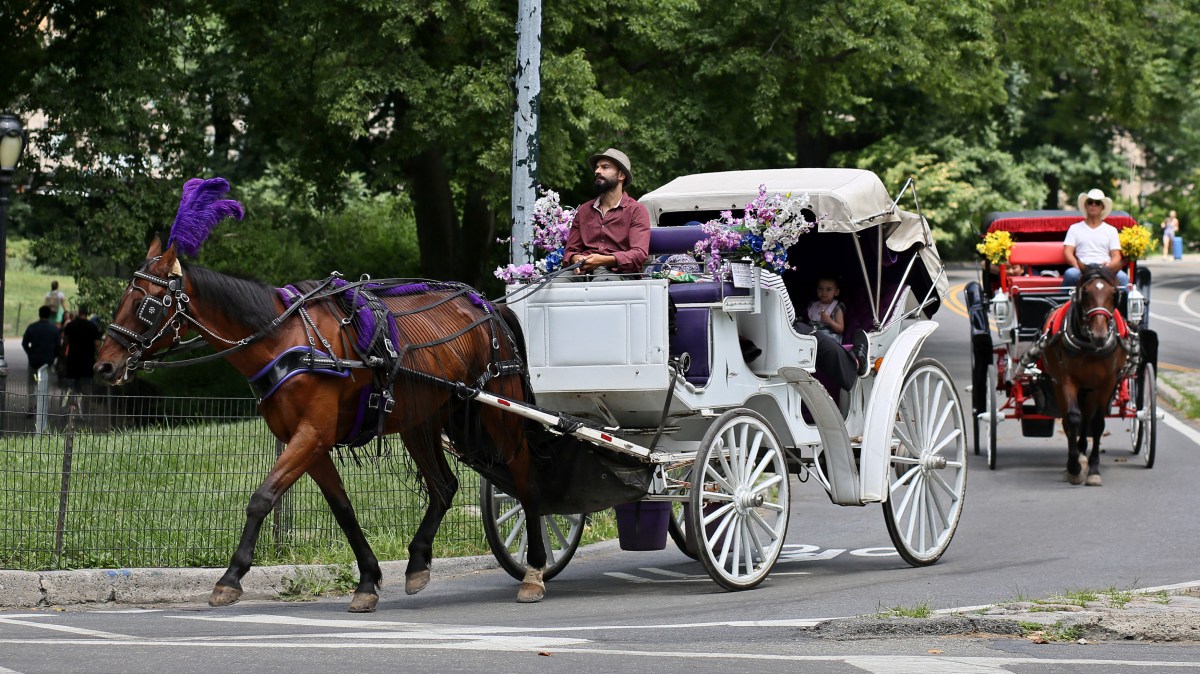
Horse-drawn carriage rides through Central Park have been a staple of New York City since the mid-1800s, but a series of recent tragedies, including the death of an 18-year-old tourist last week, has renewed calls to ban the tourist attraction.
Carriage rides in New York City are heavily regulated regarding how much the horses can work, but advocates for Ryder’s Law argue that these regulations are not enough to keep horses and people safe. The bill, introduced in 2024, would ban horse-drawn carriages and replace them with alternative vehicles. A hearing on the bill is scheduled for July.
What Is Ryder’s Law?
Ryder’s Law is legislation that would phase out New York City’s horse-drawn carriage industry and ultimately replace the rides with electric carriages. The proposal is named after Ryder, a carriage horse that collapsed in Manhattan during the summer of 2022 and later died. His death sparked widespread outrage and renewed calls for a ban on carriage horses operating in the city.
Read More on News
The measure was first introduced by city lawmakers in the aftermath of Ryder’s death. Previous versions of the legislation sought to stop the issuance of new carriage licenses, establish a timeline for ending the industry and ensure that horses were sent to appropriate retirement homes rather than sold for slaughter.
Although the proposal attracted support from animal welfare groups and some elected officials, it failed to advance in the City Council last year after a committee voted against sending it to the full council. Former Mayor Eric Adams publicly backed the legislation, arguing that horse-drawn carriages posed safety concerns for animals, pedestrians and drivers alike.
Supporters revived the effort this month following the death of a horse and the fatal carriage accident involving Indian tourist Romanch Mahajan. New Yorkers for Clean, Livable, and Safe Streets held a vigil on Monday for Mahajan and announced that Ryder’s Law would be renamed Romanch’s Law in honor of the 18-year-old.
Mayor Zohran Mamdani has said that he would support phasing out the horse-drawn carriages.
1 of 11
Recent Horse-Drawn Carriage Incidents
On June 9, a 16-year-old carriage horse named Deniz collapsed and died while pulling a carriage in Central Park. Initial videos of the horse lying motionless in the roadway quickly spread online, prompting renewed criticism of the industry from animal welfare advocates.
A subsequent necropsy conducted through Cornell University’s College of Veterinary Medicine found the horse died after ingesting Japanese yew, a highly toxic ornamental plant. The findings sparked a dispute between carriage operators and the Central Park Conservancy over whether proper safeguards had been in place.
Then, on June 17, Mahajan was riding in a horse-drawn carriage with family members in Central Park when the horse reportedly became startled and bolted away. According to officials and union representatives, the carriage driver had stepped away from the horse while taking a photograph for the family. The runaway horse struck another carriage, causing the vehicle to overturn. Mahajan suffered a fatal head injury after being thrown from the carriage and later died at a Manhattan hospital.
The incident drew national attention and immediately reignited calls to end horse-drawn rides. The Central Park Conservancy, animal welfare organizations and several elected officials cited the crash as evidence that the system creates risks for passengers, pedestrians and the horses themselves.
Advocates have pointed to additional incidents in recent years, including horses bolting into traffic and carriage collisions, as evidence that the problem extends beyond isolated accidents. The Central Park Conservancy has said there have been multiple horse-related incidents in and around the park over the past year, including:
May 19, 2026: A horse gets spooked and hits another carriage, causing it to tip over.January 8, 2026: A horse runs into oncoming traffic, ripping the bumper off a cab and hitting up to five cars.September 4, 2025: Two tourists jump from a carriage after the horse bolts off.May 26, 2025: Two horses pulling carriages run off, injuring their drivers while they tried to get control of the animals.May 18, 2025: Two carriages collide in Central Park, causing one carriage to overturn and trap the driver.How Long Have Horse-Drawn Carriage Rides Been Happening in Central Park?
Horse-drawn carriage rides have been part of New York City’s landscape since the mid-19th century, tracing their roots to an era when horses were the city’s primary mode of transportation.
The modern carriage industry emerged alongside the creation of Central Park, which officially opened in the 1850s. By the late 1860s, commercial carriage rides were already a familiar sight around the park, making the tradition roughly 160 years old. Over subsequent decades, the rides evolved from practical transportation into a tourism attraction. Historic photographs from the turn of the 20th century show horse-drawn carriages traveling through Central Park and Manhattan long before automobiles dominated city streets.
Today, the carriage rides remain one of the park’s most recognizable attractions. Tourists can still book rides near Central Park South, where drivers line up with decorated carriages waiting for customers. The experience has appeared in countless movies, television shows and postcards, helping cement its place in New York City’s cultural identity.
That history is one reason the debate has proven so contentious. Supporters of the industry argue that eliminating horse-drawn rides would erase a cherished piece of the city’s heritage and eliminate jobs for carriage drivers, stable workers and horse owners. Critics counter that tradition alone is not a sufficient justification if there are ongoing concerns about safety and animal welfare.
Horse-drawn carriage rides have been temporarily suspended while drivers do additional training. The union representing the drivers initiated the suspension and said it would remain in place until at least Tuesday.
What Rules Are There for Horses Working Carriage Rides?
New York City’s carriage horse industry already operates under scrutiny and regulation. Carriage horse drivers are required to complete a course before obtaining a horse driver’s license, and horses are subject to restrictions on how much they can work. Those restrictions include:
Carriage horses shall not be at work more than nine hours in any continuous 24-hour period.Riding horses shall not be at work more than eight hours in any continuous 24-hour period.Carriage horses shall receive no less than five weeks of vacation or furlough every twelve months at a horse
stable facility.Every rental horse required to be licensed hereunder shall be examined by a veterinarian prior to its use in a rental horse business, at intervals of 4 to 8 months from the license date and at the time of license renewal.
Following Mahajan’s death, union officials emphasized that drivers are not supposed to leave their horses unattended while passengers are aboard. The union has supported an investigation into the crash and acknowledged allegations that the driver involved may have violated safety protocol by stepping away from the carriage.
Yet critics argue that even extensive regulations cannot eliminate the inherent risks of keeping large animals in one of the world’s most densely populated urban environments. Supporters of Ryder’s Law contend that the only way to fully prevent future tragedies involving horses or passengers is to end the industry altogether.
Contact Newsweek editors on this story: Jenni Fink and Sam Wilson.