
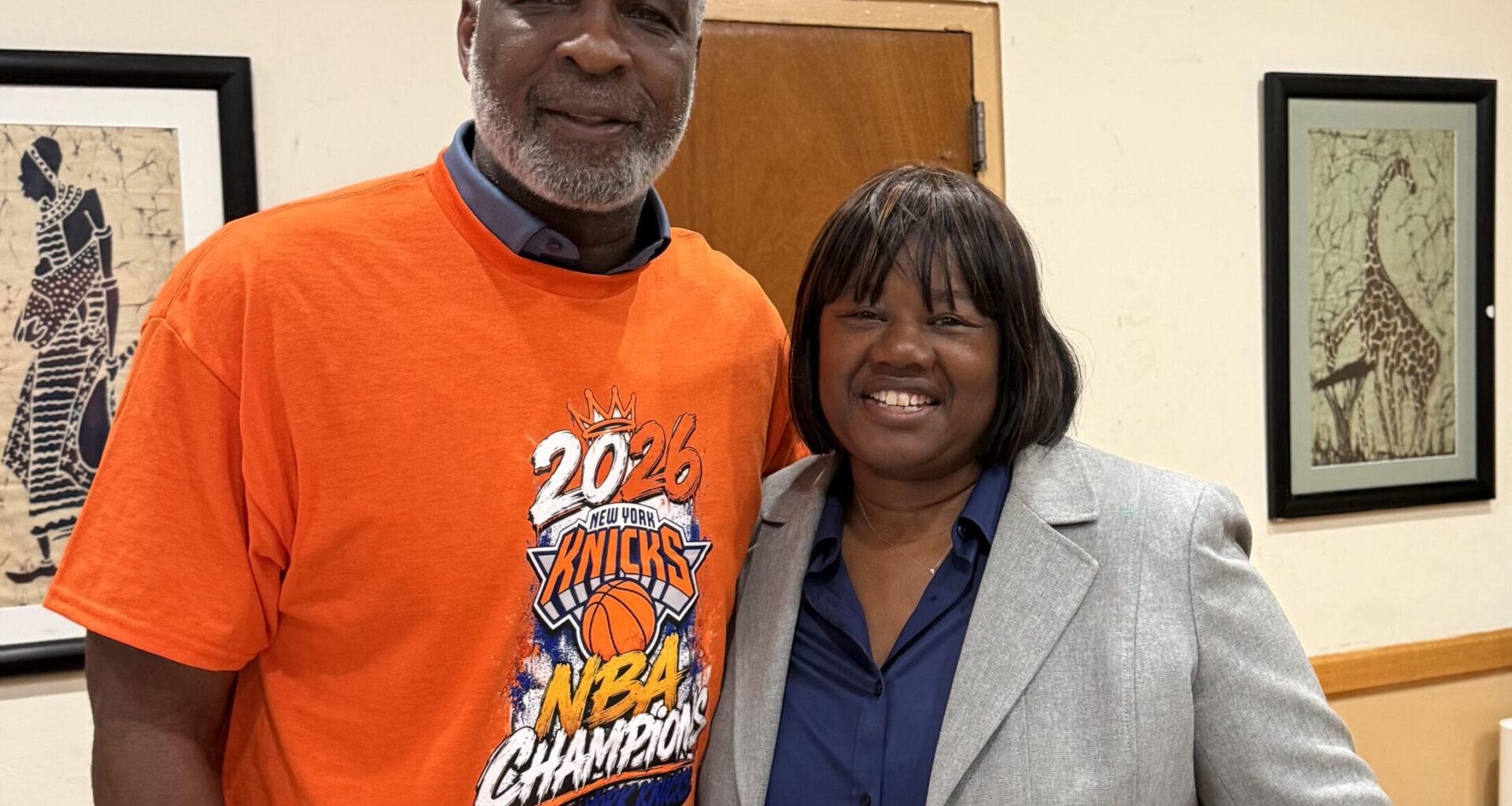
In the past, Oakley has owned car washes, detailing centers, salons and other businesses, including operations in Brooklyn and Yonkers.
Oakley called the recent Knicks win “great,” adding that he was really proud of them.
“All the fans around the city of New York and around the country have been waiting on this for way too long,” he said. “Fifty-three years is a long drought.”
Oakley, who played in New York for a decade, pointed out that his greatest memory as a Knick was going to the NBA Finals in 1994.
“We took it seven games and went down to the last minute,” he said. “We worked incredibly hard as a team but just couldn’t close it out.”
When asked about his thoughts on the NBA today as compared to decades ago, when many would argue the game was significantly more physical, Oakley called it “a completely different league.”
“A lot of that has to do with Europeans becoming NBA players,” he said. “The game has kind of adapted to their style of playing. Often, the big man, the center, has the ball and is bringing it up and running the offense. To me, it’s some dumb basketball, but ultimately, it’s all about money.”
Oakley also played with Michael Jordan on the Chicago Bulls and was often described as Jordan’s on-court protector. He called Jordan “a classy guy.”
“His work habits, the way he carried himself — I’m just so glad I got a chance to play with him and to be his friend,” Oakley said.
Oakley also addressed the ban that remains in place, preventing him from attending games at Madison Square Garden, which stems from a February 2017 incident.
During a Knicks home game, Oakley was removed from his courtside seat near Knicks owner James Dolan. Oakley was arrested and charged with misdemeanor assault and trespassing. Although he was later cleared of all criminal charges, Dolan issued a formal ban. However, as of June 2026, the matter is “in litigation.”
“I don’t know what’s going to happen with that,” Oakley said. “I certainly can’t control it, but I hope it eventually gets resolved, maybe even this year.”
Oakley said that these days, he’s been busy with his charitable organization, the Charles Oakley Foundation, whose mission is to combat hunger and poverty in underserved neighborhoods primarily through its “Oak Out Hunger” initiative.
New York State Supreme Court Judge Cenceria P. Edwards, also in attendance, is a close friend of Oakley’s. Edwards spoke to the Eagle about her connection to the Knicks legend as well as her personal ties to basketball.
“About a decade ago, I was in Harlem at a Southern restaurant, and I’m ordering my food. I turn around, and he walks through the door. I said, ‘Charles Oakley?’ and he just looks at me and starts laughing,” she said. “We started talking for a while, mostly about basketball. He was like, ‘This girl knows what she’s talking about!’ Eventually, we exchanged numbers.”
Edwards was a point guard in high school and college. “At [Samuel J.] Tilden High School, we were division champs for all four years,” she said. “I still have my jacket.”
The judge referred to Oakley as “a very normal person and a real down-to-earth guy.”
“He’s really a good friend, perhaps one of my best friends,” Edwards said. “I will tell you that if Charles Oakley is your friend, he’s pretty much like he was on the court — ‘The Enforcer,’ a guy that has your back for life.”