
Lisa Yuskavage
David Zwirner
May 14-June 26, 2026
New York
In 1914, the Rokeby Venus, a sultry reclining nude painted by Diego Velázquez between 1647–51, was violently slashed with a meat cleaver by the suffragette Mary Richardson in the National Gallery of Art in London. Venus’s perfectly defined shoulders, narrow back, classically proportioned gluteal muscles, and long legs were mutilated by gaping wounds in the canvas, à la classic Lucio Fontana. This suffragette’s anger could not have been merely academic, nor the act a merely a protest in defense of Emmeline Pankhurst, one of the organizers of the British Suffragette movement. It was bred of hatred, jealousy, but also arousal. Lisa Yuskavage has always questioned this love/hate dichotomy that plays out in the controversies over human attractiveness, and in this new series of paintings that narrates artistic production as well as sexual mores within a broader investigation of genre painting, she inserts herself into the drama through tragicomic means. Indeed, this is an exhibition very much about Velázquez too, not just the Rokeby Venus, but also Las Meninas (1656). Yuskavage invents a studio which is not a realistic representation of the messy banality of a workplace, but instead a zone in which the painting exists as a magical performance, and the painter performs their role to the hilt. In Las Meninas, Velázquez is the brilliant courtier, knight, and creator. In the paintings of the artists and her models, Yuskavage is both suffragette and pornographer—a tired but happy practitioner.
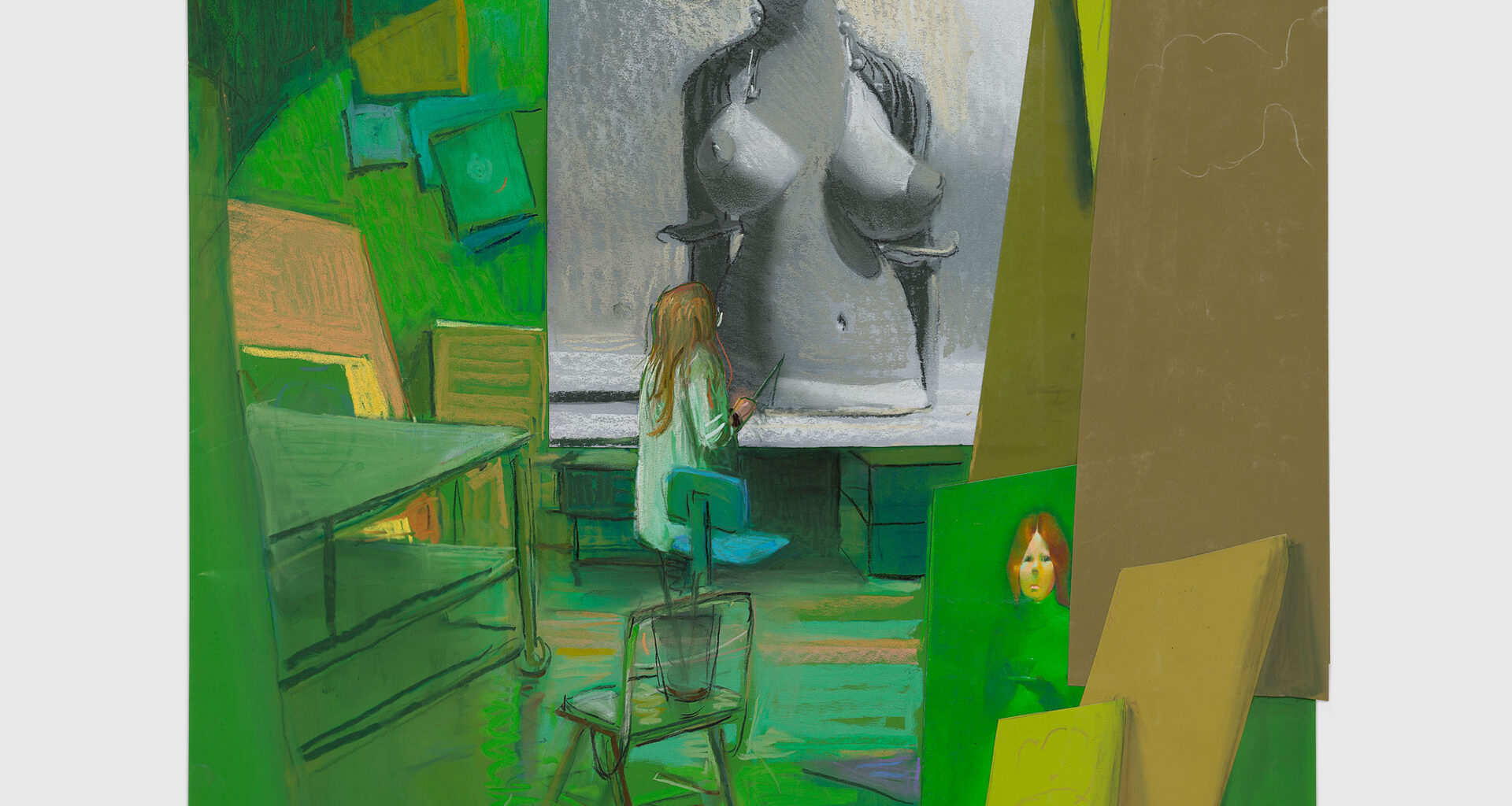
The nudes in Yuskavage’s repertoire are not slashed, but they are heavily annotated. Scraps of paper that include notes, sketches, color swatches, and photographs are taped to the surfaces of the paintings in the artist’s studio, and to the surface of the paintings themselves, in the smug and bookish trompe l’oeil style of John F. Peto and William Michael Harnett. A recurring theme in Yuskavage’s studio is a monumental portrait of a woman with light-colored hair, held in a bob, with very large breasts at slightly uneven heights. This image appears as the subject of several of the paintings, occurring as the central work of art being created in the painting Artists and Models (2025), a small study, and The Joy of Painting (2025), a much larger diptych. In this pair, one of the scantily clad models crouches in the foreground, seemingly touching up the painting by fixing the left breast, while the painter dozes stage left, and another model also paints in the background—Yuskavage is implicating the models in the production of the works, and leaving is to question the artist/model/muse collaboration. In Painter Painting (2024), the painter, now awake, visually situates herself between the painting-in-a-painting’s gargantuan bosoms, and with her brown hair and yellow jacket, she becomes an erotic chocolate covered banana in the erotic fantasy of the painting’s composition. Another version of the painting of the bob-cut model is blue-taped to the surface, of either our, or her, painting. In it, there is also a clay bust of the subject on a tall modernist table in the foreground. In an oval self-portrait of the painter at the start of the show, Painter Painting, Act 1 (2026), amongst several post-its and prints, there is a black-and-white photo of two nudes. Perhaps it is here that we find the original image of this woman who has captured Yuskavage’s heart, a sometime muse? An earlier version of the self portrait from 2025—a small study entitled Easel Portrait—depicts a version of the painting sans notes/photos/notations. In both paintings, Yuskavage playfully emphasizes her own breast and hips via a contrapposto stance (must have been hard to hold for a painting). Between these two self-portraits, we can question the purpose of the trompe l’oeil paper additions. Are these simply for the sake of nudging these paintings into a genre, or are the source notes meant to instigate some kind of normalcy in Yuskavage’s fantasy world?