
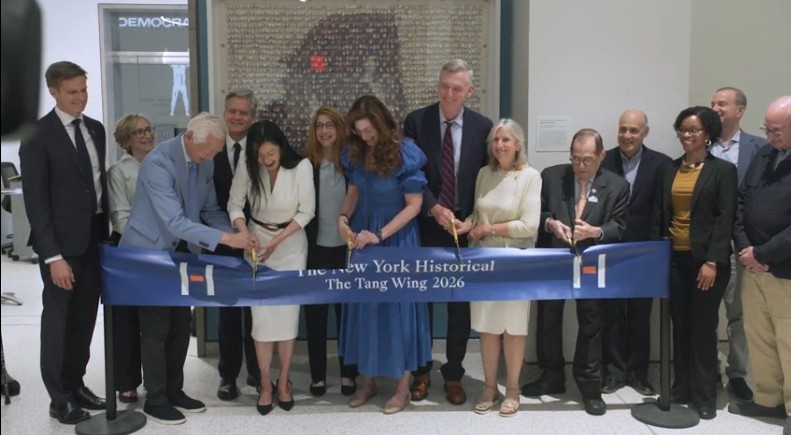
The New York Historical (formerly the New York Historical Society) on June 22 made some history of its own when it cut the ribbon on a 71,000-square-foot addition just ahead of the nation’s 250th anniversary.
The 5-story Tang Wing for American Democracy, named for archaeologist, art historian and museum Board chair Agnes Hsu-Tang and her husband Oscar Tang, was designed by Robert A.M. Stern Architects.
The $175 million expansion opened to the public June 18 followed by a members-only viewing and then the cutting of a blue ribbon, in a major expansion on a kind of Museum Row on Central Park West near the American Museum of Natural History.
Formerly known as the New York Historical Society, the organization dropped the word “society” as too exclusive, and acquired land adjacent to it, allowing the expansion.
“Today we come together on this special occasion to celebrate the completion of our historical campus, after 222 years of institutional history,” Agnes Hsu-Tang said at the ribbon cutting.
The museum was founded in 1804, the year Napoleon crowned himself the emperor of France and Thomas Jefferson was elected as the third president of the United States of America.
The addition was announced in July of 2021, construction began in the fall of 2023, it was topped out in spring of 2025, and substantially completed that winter before opening this month.
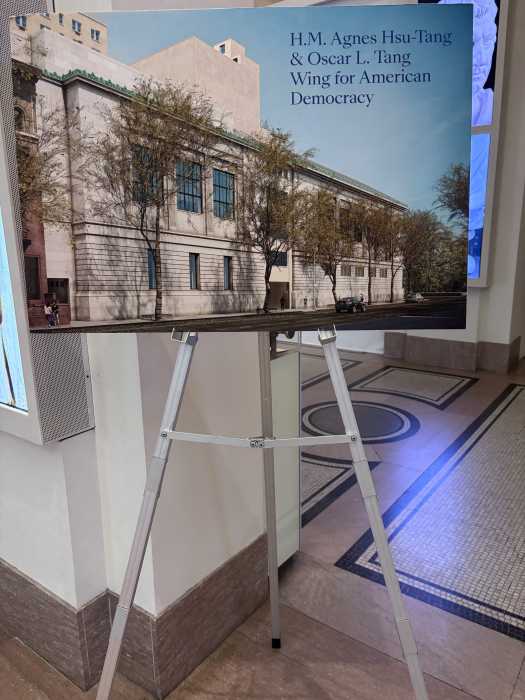 The 5-story Tang Wing for American Democracy, named for archaeologist, art historian and museum Board chair Agnes Hsu-Tang and her husband Oscar Tang, was designed by Robert A.M. Stern Architects. Photo by Claude Solnik
“New York was America’s first capital,” Hsu-Tang said of New York’s role in the nation’s history. “George Washington was inaugurated in New York City in 1789. New York City is where modern democracy and the American presidency begins.”
It was a major moment for the museum, at 170 Central Park West, as Hsu-Tang said the word “Liberty” as she cut a ribbon that was a finish line for construction and a starting line for a new chapter.
“The opening of the Tang Wing for American Democracy marks a defining milestone for New York’s first museum,” CEO and President Louise Mirrer said in a statement.
The museum expansion includes more than $14 million in New York State funding including $9.25 million from Empire State Development and $5 million from the New York State Council on the Arts.
The project also included renovations to more than 30,000 square feet of existing museum space.
“New York’s cultural institutions tell our stories, strengthen our communities and power our tourism economy,” Governor Hochul said in a written statement. “As our nation prepares to celebrate its 250th anniversary, this expansion reaffirms New York’s role as a global capital of culture, education and ideas.”
Empire State Development President, CEO and Commissioner Hope Knight said this will “expand access to history, strengthen New York City’s tourism economy and create new opportunities for learning and engagement at a moment of national significance.”
New York City’s first museum includes a nationally renowned research library and more than 14 million works of art, artifacts, documents and objects.
That includes the Robert A. Caro Archive, Time Inc. Archive, Billie Jean King Archive and other collections that, potentially, could attract museum goers from New York City and nationwide.
As part of the opening and nation’s 250th anniversary, the museum is showing a rare printing of the Declaration of Independence, long in the organization’s collection, believed to have been produced soon after the signing, on view through July 5.
In addition to a roof deck, sculpture court, and art conservation studio, the new wing adds classroom space to the Chang Chavkin Academy for American Democracy.
The new structure is crowned with copper similar to the original building, energy-efficient windows clad in bronze designed to filter sunlight.
Sustainably sourced building materials including terrazzo, mosaic tiles, as well as Tennessee marble were all designed to achieve LEED Gold Certification for environmental construction.
Exhibits around the nation’s 250th anniversary include House Made of Dawn: Art by Native Americans 1880 to Now; Selections from the Hsu-Tang Collection; Old Masters, New Amsterdam; Revolutionary Women; Democracy Matters, and You Should be Dancing: New York, 1976 and Beyond.
Installations also tell the story of the International Ladies’ Garment Workers’ Union and provide a timeline of LGBTQ+ civil rights.
The Stuart and Jane Weitzman Shoe Museum, a permanent gallery, opened in the Tang Wing for American Democracy, showcasing more than 100 pairs of historic shoes,
A folk art collection, assembled by sculptor Elie Nadelman and his wife Viola Spiess Flannery, features weathervanes, paintings, and other objects.
The new wing will also provide a home for the American LGBTQ+ Museum, slated to open in 2028.
The museum projects additional classrooms and expanded programming capacity will let it expand from welcoming 5,000 students to 30,000 students annually.
In addition to expanding space, New York Historical is temporarily expanding hours until 8 p.m. Thursdays through Saturdays through July 4. Admission during expanded hours on those dates is pay-as-you-wish from 5-8 p.m.
“Songs of America,” musical performances presented in conjunction with Jazz at Lincoln Center, is being presented free with pay-as-you-wish admission during extended hours through July 4.
Filmmaker Ken Burns on June 25 is joining David M. Rubenstein to discuss the recent PBS series, The American Revolution. Livestream tickets are available.
In-person and livestream tickets are available for historian and author Doris Kearns Goodwin on June 28 talking with David M. Rubenstein in “Leadership for a More Perfect Union: Lessons from America at 250.”
“For more than two centuries, the New York Historical has preserved the history of our state and nation,” Gov. Hochul added. “The new Tang Wing will ensure that millions of visitors, students, scholars and families can continue to learn from that history for generations to come.”