
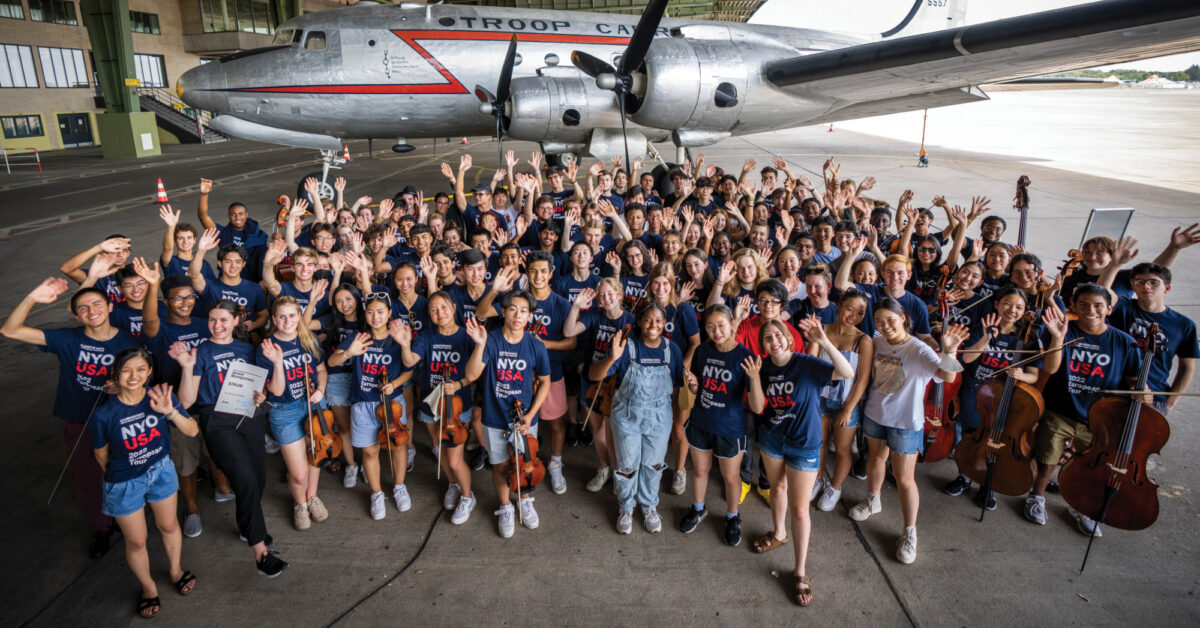
Sixteen-year-old clarinetist Leila Novak Mostaghimi from Newton, Massachusetts, recalls that it was pouring rain last August as she and her fellow NYO2 instrumentalists prepared to play a family concert at the Edinburgh International Festival alongside their Scottish peers. Everyone was worried that no one would show up, but the well-attended performance turned out to be a highlight of the American ensemble’s trip—a memorable and melodious collaboration of youth musicians from both sides of the pond.
Every summer, Carnegie Hall’s Weill Music Institute brings together talented up-and-coming musicians for its trio of youth ensembles: the National Youth Orchestra of the United States of America (NYO-USA), NYO2, and NYO Jazz. Teens from across the nation audition to be part of these free, rigorous training programs that culminate in concerts on celebrated stages around the globe.
While the participants are eager to hone their performing skills, they are also keen to bond with their fellow youth musicians, both domestically and abroad. The artistic and cultural exchange among peers is not only invaluable, but it is also perspective shifting.
“Before we even left on tour, I had already gained so much from connecting with other musicians who were from around the United States,” says Mostaghimi. “Our country is so big and diverse—I met people from so many different backgrounds. Then when we went to Edinburgh, it felt like the world expanded so much more. I just adore meeting people from many different places. We’re able to connect not just through music, but also the small things that make us human.”
Nicky Sim, a 17-year-old clarinetist from Edinburgh, Scotland, who played alongside NYO2 last summer, enjoyed introducing Mostaghimi and her fellow Americans to his hometown and his native cuisine, particularly haggis and Irn-Bru, a carbonated beverage affectionately known as Scotland’s other national drink. “It’s not often that you get to meet young musicians from halfway across the world, especially musicians of such great caliber,” he says. “Being able to play alongside NYO2 at the Edinburgh International Festival—which I looked up to my whole life—had a really memorable impact. I still feel such a close connection with so many of the orchestra members.”
Clive Gillinson, Carnegie Hall’s executive and artistic director and an alum of the National Youth Orchestra of Great Britain, knows firsthand how transformational these peer exchanges can be. That’s why he launched the first of the Hall’s trio of youth ensembles in 2013. “What young musicians learn from each other goes far beyond playing the notes,” he says. “They learn how to listen—not only to the music, but to one another. They discover more about the importance of collaboration, and they experience how exhilarating it can feel to be in an environment where everyone inspires one another to raise the bar musically as they strive toward a common goal. Just as important is the sense of community that develops. These are formative years, and the friendships and connections made in youth orchestras often last a lifetime, no matter what professional paths these young people ultimately choose to follow.”
Margarita Miranda Mitrov—president of Fundación Sinfonía, which hosted NYO2 in the Dominican Republic in 2023 and NYO Jazz last summer—recalls watching a particularly meaningful interaction between two young instrumentalists who found a musical way to bridge their language gap. When an NYO2 percussionist showed an interest in the traditional tambora, a Dominican peer demonstrated its distinctive rhythmic pattern, which the American mimicked on his congas. “It created a moment of real exchange and discovery,” she says. “Opportunities like these go beyond allowing our musicians to share the stage with the outstanding members of NYO2. They also create space for our musicians to share their own musical traditions, roots, and identity, while inspiring curiosity and openness among their American peers toward new instruments, sounds, and styles.”
Braxton Headley, a bassist with NYO Jazz from Fort Wayne, Indiana, says that playing in the Dominican Republic enhanced much more than his music skills. “The most important thing I learned from collaborating with other student musicians was the principle of intentionality with my playing and how I move in my day-to-day life,” he says. “Being surrounded by extremely talented peers and faculty who were thoughtful and intentional about every choice they made gave me a strong push to reflect on my own approach to the music. It reshaped the way I’ve gone about every single performance, practice, and rehearsal. And it’s influenced howI carry myself in my relationships with those around me.”
In an increasingly polarized society, the empathy and understanding that playing music together inspires reverberates far beyond the concert stage. Gillinson shares an especially profound anecdote to prove the point: After an early NYO-USA concert, “a US ambassador came back to meet with the orchestra, and he told us that the connections these young musicians were making—simply by playing, spending time together, and getting to know their peers from other countries—were, in many ways, more powerful than any number of treaties he could negotiate at a governmental level.”
All three of the Hall’s national youth ensembles play the storied venue this summer as part of the institution’s wide-ranging United in Sound: America at 250 festival that reflects on the nation since the signing of the Declaration of Independence. Each then embarks as American music emissaries on respective international tours: NYO2 to the Dominican Republic, NYO Jazz to Asia, and NYO-USA to Europe, including a return to the Edinburgh International Festival.
This time around, Mostaghimi returns as part of NYO-USA. She’s excited to head back to Scotland to see Sim and the other musicians she met last year, try another helping of haggis, and perform once again for appreciative international audiences.
“Last summer’s family concert was so impactful,” she says. “We played some classical music but also some pop and some Disney. The children in the audience were dancing and laughing and clapping along. It doesn’t matter if we’re playing the most prestigious thing from a musical standpoint, because ultimately what’s most important is that reaction and connecting with people who are so different than us. It was really lovely.”