
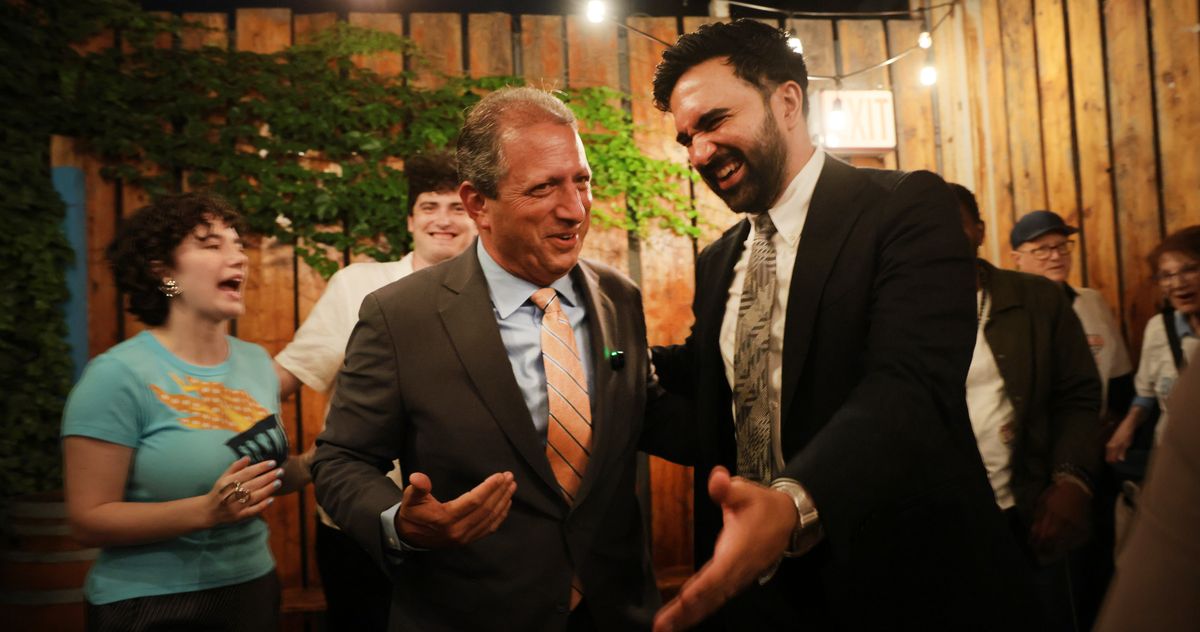
It was a good night for Brad Lander. It was a good night for Zohran Mamdani.
Photo: Spencer Platt/Getty Images
As New York’s contentious primary season hurtled to a close this week, the constellation of mainstream Democratic politicians, operatives, and insiders who have long run this city started to feel something resembling hope. Flummoxed by Zohran Mamdani’s rise a year ago, they noticed a distinct shift in the vibes and thought their fortunes might change on Tuesday. Turnout for the early vote — which boosted Mamdani a year ago in his race against Andrew Cuomo — was weak. Those voters who did turn out skewed older, more rank-and-file Democrat than Democratic Socialist. It seemed to spell good news for the incumbents and Establishment politicians that Mamdani-endorsed candidates were against. The mayor had been campaigning relentlessly for the three congressional upstarts as well as for a handful of state-legislative candidates — a sign, many political professionals insisted, that he was nervous about the results. If his slate lost, he knew as well as everyone else that the Democratic Establishment would have the upper hand against him and surely be ready to take revenge.
Instead, a political class that had doubted Mamdani’s strengths a year ago found itself flummoxed yet again by a movement that they scarcely understand. The hotly contested primaries in New York were over almost as soon as the polls closed. Brad Lander, the former city comptroller, whom Mamdani endorsed on the day he announced his campaign, defeated incumbent Dan Goldman by over 30 points in a race dominated by Goldman’s support for Israel. Claire Valdez, a one-term State Assemblywoman who had only moved to New York a decade ago to pursue a career in the arts, defeated, with Mamdani’s support, the handpicked successor of retiring representative Nydia Velazquez, a pillar of the city’s liberal old guard. The margin was 21 points. Darializa Avila Chevalier, a graduate student and mainstay of Columbia University’s encampments in protest of the war in Gaza, had defeated Adriano Espaillat, the first Dominican to serve in Congress and the boss of uptown Manhattan’s political machine. The entire roster of state-legislative candidates that Mamdani had backed won, as had a handful of others who ran without Mamdani’s explicit backing (he demurred, in deference to the folkways of Albany) but with the support of the wider DSA universe.
“The mayor’s campaign last year really transformed the electorate,” Valdez said moments after she had finished stumping for last-minute votes with Mamdani at a Greenpoint polling station just before polls closed. “He brought in a lot of people that have previously not been engaged locally, and that follows a trajectory of organizing within DSA that both he and I have been a part of for years. We elected a democratic-socialist mayor, and the movement that won that election is now continuing.”
The results Tuesday night were the validation of an extraordinary intervention into New York’s political life by a mayor who has just passed the six-month mark in office. There were many reasons to think it would not succeed. Four years ago, Eric Adams, fresh off the high of his own mayoral victory, endorsed a handful of state-legislative candidates who supported his tough-on-crime policies in their campaigns against sitting lawmakers; all went down to defeat. Eight years before that, Bill de Blasio threw himself into an attempt to wrest control of the State Senate from Republicans. That too failed.
Successful politicians tend to try to find an easy accord even with their ideological adversaries. They need allies in a business where relationships matter, and they need as large a coalition as possible. Just two months ago, Mamdani made a surprise endorsement in a City Council special election, supporting Lindsey Boylan, a onetime campaign surrogate against a candidate backed by the rest of the city’s political infrastructure. Boylan lost in a landslide, and an embarrassed mayor was presumed to be rethinking his political strategy.
Instead, Mamdani endorsed Avila Chevalier, a 32-year-old with no political experience and a string of problematic old tweets (“Fuck Kamala Harris” read one, while another said that Joe Biden was a “rapist”) and who still called for ending all deportations and for abolishing the police. He then rolled out his state-legislative slate.
Mamdani’s political team sincerely believes him to be a singular figure. He is clearly a generational political talent. But he is also a politician with a rare unbridled enthusiasm for campaigning — leading him to spend huge amounts of time stumping for his candidates. When the early-vote numbers in a rapidly gentrifying corner of Brooklyn showed weakness for Claire Valdez, Mamdani marched with her across a portion of the district. During the day, he stood at the head of a selfie line where anyone who showed up with an “I Voted” sticker could pose for a pic with the mayor. In the evening, he hit a half-dozen Bushwick bars and nightclubs to rally enthusiasm for her. Hundreds participated in the march, and as they waited on line, campaign aides asked them to text ten of their friends to remind them to vote and to vote for the entire slate of Mamdani-backed candidates. All of those selfies were then shared across social media thousands and thousands of times.
It was a highly successful campaign event — but it was also a manifestation the mayor’s “surround sound” communications strategy that would have Mamdani reaching voters across traditional media, X, Instagram, TikTok, and mail. No matter where voters find him, he always looks like a mayor who is a New Yorker not that different from his voters: in love with the city, out at the same places, approachable, and living and dying alongside the Knicks.
The mayor came into office as a man without many allies. The few fellow elected socialists had been slow to embrace his candidacy, and even as Mamdani gained momentum in the Democratic primary, there was a sense among his team that many of his newfound friends were with him to benefit their own political projects, not his. The next election is only three and a half years away, and City Hall is aware that there are already plots afoot to take him down. So what should an enterprising mayor do but go out and create an ever-growing squad of like-minded and loyal allies?
Despite his thin résumé before taking office, he has proved to be a ruthless and savvy political operator as he goes about doing that. Mamdani’s allies in the Democratic Socialists of America, whose door-knocking operation powered many of the victories Tuesday night, want a maximalist war-footing against non-DSA Democrats at all times, but the mayor, believing that the media’s capacity for focusing attention is finite, adopted a more measured approach. He actively dissuaded DSA from running a candidate against Hakeem Jeffries, the House minority leader, and endorsed Kathy Hochul early in her campaign over a better-aligned challenger. After legislative leaders in Albany delivered far more in state aid to the city than anticipated, Mamdani endorsed only in open races for the Assembly and the State Senate.
This election was supposed to be a test of the size of the anti-Mamdani coalition as allies of would-be mayoral candidates in 2029 — including City Council Speaker Julie Menin or even Police Commissioner Jessica Tisch — start to map out what a potential campaign could look like. That coalition as of now consists of pro-Israel voters, deep-pocketed finance and real-estate interests, moderate Democrats, Establishment Democrats, and older voters of color. But that appears to be it. Mamdani has a lock on young voters of all races, college-educated voters, immigrants and the children of immigrants, progressive Democrats, and voters who barely pay attention to politics except when Mamdani is running.
Conversations with Democrats who want to pull the party back toward the center reveal a coalition in despair. They have been attacking Mamdani over his alleged antisemitism (and certain anti-Zionism), but no voters seem to care. The county parties that used to rule New York have long been shells of themselves but were at least a bulwark for the mainstream of the Democratic Party. No more, not after Tuesday, when in Brooklyn a group of Mamdani-aligned reformers appear to have won enough seats to overthrow the longtime leader of the local party machine. The major labor unions, once fearsome political players in New York, were revealed to be largely toothless just as they were in the primary a year ago. It is hard to imagine how an anti-Mamdani coalition could cobble together a majority of the city or who would even attempt it. “If you are Jessie Tisch or Julie Menin and you are thinking about running for mayor right now,” said one Democratic operative referring to two of the most-talked-about 2029 contenders. “You should probably stop thinking about it.”
The glimmers of hope for this set are that the Mamdani phenomenon is strictly limited to the five boroughs. Tom DiNapoli, the state comptroller, won 65 percent of the statewide vote against two progressive challengers. Cait Conley, an Army veteran and a favorite of D.C. Democrats, easily won her primary for a seat that is a must-win for Democrats in November. Mainstream Democrats fared well in the NYC suburbs.
But Mayor Mamdani and the DSA are on the march. An effort to oust Jeffries and claim a U.S. Senate seat are underway, and allies of the mayor are already talking about how best to utilize him in next year’s run-up to the Democratic presidential primary.
“People often ask me what I think of the state of the Democratic Party. This slate here today is our answer,” Mamdani said at a rally last week alongside his endorsed candidates and Senator Bernie Sanders. “When does the race for 2028 begin? It starts now. It starts on Tuesday.”
Sign Up for the Intelligencer Newsletter
Daily news about the politics, business, and technology shaping our world.
Vox Media, LLC Terms and Privacy Notice