
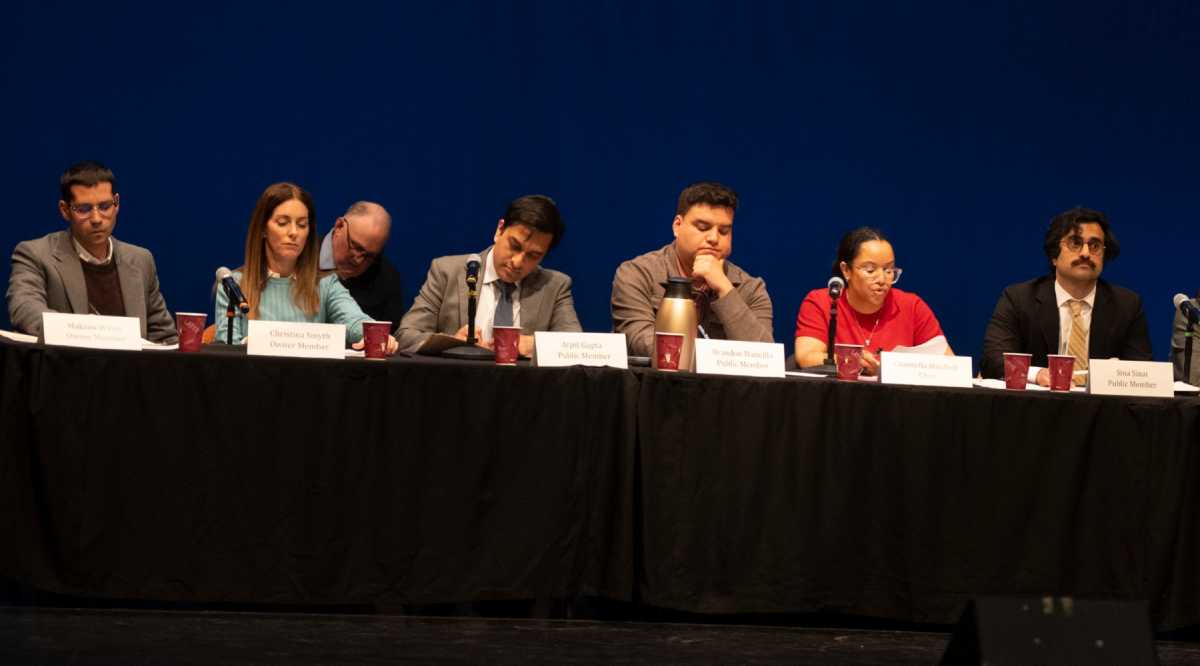
A Rent Guidelines Board owner representative has resigned hours before Thursday night’s final rent vote, accusing the Mayor Zohran Mamdani-appointed majority of steering the board toward a predetermined rent freeze and ignoring its own evidence on rising building costs.
Christina Smyth, an attorney who represented owners on the nine-member board, said in a June 25 statement posted to her LinkedIn account that she was resigning effective immediately because the process “is not administered the way the law requires.”
“The Rent Guidelines Board has stopped being a fact-finding body,” Smyth said. “It has become a body that starts with an answer and vibe codes its way backward to justify it.”
The resignation landed the same day the board was scheduled to take its final vote on rent adjustments for the city’s rent-stabilized apartments, lofts and hotels, with proposals before the board ranging from a full freeze to increases of up to 2% on one-year leases and 4% on two-year leases. Smyth’s departure also injected a late vacancy into a panel that city law says is supposed to include two owner representatives.
Under the city charter governing the RGB, the nine-member board is appointed by the mayor and must include two members representing tenants, two representing owners and five public members. The law says the mayor shall fill vacancies caused by death, resignation or other reasons in a manner consistent with the original appointment.
The law also requires the board, when deciding annual rent adjustments, to consider the economic condition of the residential real estate industry, including real estate taxes, sewer and water rates, operating and maintenance costs, insurance, government fees, fuel, labor, financing costs, housing supply, vacancy rates, cost-of-living data and other available information.
Smyth argued in her resignation statement that the board was disregarding the very cost data it is required to weigh.
City Hall did not immediately respond to a request for comment on Smyth’s resignation, the allegations in her statement or whether Thursday night’s vote would proceed as scheduled. The charter provision requiring the mayor to fill vacancies does not address whether a vacancy affects a scheduled vote. The RGB’s own explanation of its voting process says votes are taken on proposals “until at least five votes can be mustered for an apartment order.”
Small Property Owners of New York, a landlord group that has criticized the board’s direction throughout the process, said Smyth’s resignation raised concerns about both owner representation and the independence of the vote.
“We are deeply concerned that the RGB’s final vote will be held without the veteran, strong, and only meaningful voice representing the interests of financially struggling small property owners and distressed rent-stabilized housing,” said Ann Korchak, board president of Small Property Owners of New York. “More disturbing is the reason for her resignation. If the vote is already predetermined by the majority Mamdani-appointed RGB, then this independent board would be acting illegally by injecting political influence into its objective decision on rent adjustments.”
Resignation shocks Rent Guidelines Board ahead of crucial vote
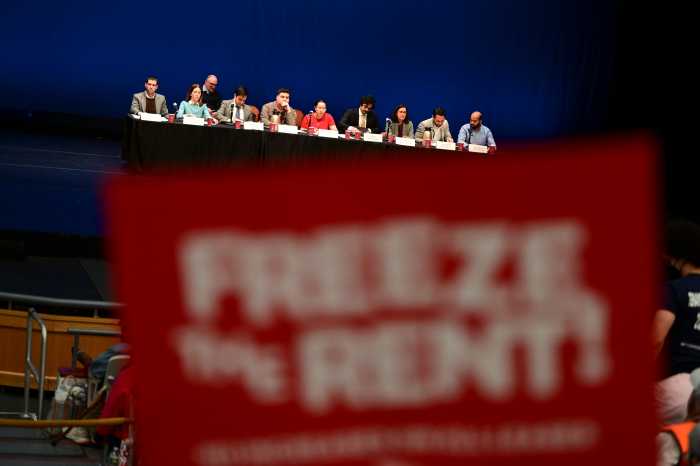 The New York City Rent Guidelines Board advanced preliminary rent ranges that could allow a freeze for the city’s more than 2 million rent-stabilized tenants — but left open the possibility of another increase, setting up a June vote that will test Mayor Zohran Mamdani’s central campaign promise.Photo by Lloyd Mitchell
Smyth’s departure adds a dramatic late twist to one of Mayor Mamdani’s most closely watched affordability fights. Mamdani made a rent freeze a centerpiece of his mayoral campaign, then appointed five new members and reappointed tenant representative Adán Soltren in February, giving his selections a majority on the board ahead of the June vote.
Smyth, who was first appointed by former Mayor Eric Adams in 2022 and reappointed as an owner representative on Dec. 18, 2025, during the final days of the Adams administration, argued that the result of this year’s process had been effectively decided before the board began its public hearings and review of staff reports.
“This year’s RGB order was decided last year on the campaign trail,” Smyth said. “Then in February, the Mayor appointed six of the nine members of this board. This rebuilt board was required to deliver a rent freeze. Everything since has been theater. The hearings, the reports, the public comment, the data. None of it was ever going to change the result.”
The rent vote has also drawn scrutiny because of Mamdani’s use of the city’s new Office of Mass Engagement, a City Hall outreach office he created by executive order in January to consolidate and expand existing civic engagement functions.
The office later launched Organize NYC, an initiative aimed at increasing participation in the Rent Guidelines Board process. At the April launch, Mamdani said canvassers would ask residents whether they knew if their apartments were rent-stabilized and whether they would testify before the board. He also said the effort would include outreach to landlords.
Mamdani has stressed that the RGB is an independent body and that the outreach effort is not intended to tell New Yorkers what position to take.
“This is not about telling New Yorkers what they should say,” Mamdani said at the launch. “This is about ensuring that everyday New Yorkers are as involved in the processes as the impact that these processes will have on their day-to-day lives.”
But landlord groups have questioned whether City Hall’s organizing effort amounts to political pressure on a board that is supposed to operate independently. Earlier this month, the City Council questioned Mamdani administration officials about the Office of Mass Engagement’s $53 million budget and what safeguards are in place to prevent taxpayer-funded civic engagement from crossing into political work.
At the June 9 hearing, Budget Director Sherif Soliman said government offices cannot engage in political activities and described the Office of Mass Engagement as a government office, “not a political operation.”
 Mayor Zohran Mamdani in a video explaining the Rent Guidelines Board process ahead of the panel’s first public meeting in MarchPhoto by Mayors Office
At the RGB’s May 7 preliminary vote, Smyth put forward a proposal to allow higher rent increases of 3% to 5.5% on one-year leases and 6% to 8% on two-year leases. That motion failed.
Tenant representative Soltren also proposed a rollback range of -3% to 0% for one-year leases and -4.5% to 0% for two-year leases. That motion failed as well.
The board instead approved preliminary ranges of 0% to 2% on one-year leases and 0% to 4% on two-year leases, preserving the possibility of a freeze while leaving room for increases. The final vote will set rent adjustments for leases beginning Oct. 1, 2026, through Sept. 30, 2027.
Smyth said in her resignation statement that she asked staff to explain the methodology behind operating cost reports and questioned why data showing rising costs and falling net income was not reflected in the board’s direction.
“Those questions went unanswered,” Smyth said. “They were too inconvenient to be answered.”
Smyth argued that a freeze would not reduce the cost of running buildings or help owners pay for repairs to boilers, roofs and elevators. She also warned that a freeze on both one-year and two-year leases would cross a legal line, though she said she would not lay out the full legal argument in a public statement.
“To be clear, this would be the first time there has ever been a rent freeze on a two-year lease,” Smyth said.
The RGB’s own reports have given both sides figures to cite. The board’s 2026 Price Index of Operating Costs found that owner costs for buildings with rent-stabilized apartments rose 5.3%, including an 11% increase in fuel costs and a 10.5% increase in insurance costs. The board’s Income and Expense Study found that net operating income rose 6.2% from 2023 to 2024 for buildings with at least one stabilized unit, though growth was weaker in buildings with larger shares of rent-stabilized units.
Tenant advocates have pointed to other RGB data showing continued landlord profits and rising building sale prices, including a 20.4% increase in the market value of buildings made up entirely of rent-stabilized units, after adjusting for inflation.
Tenant groups have pushed the board to adopt a freeze or rollback after years of rent hikes under Adams. Landlord groups have argued that the board’s data on rising costs and weaker performance in older, heavily stabilized buildings justifies an increase.
 Photo by Lloyd Mitchell
In her letter, Smyth also called on Gov. Kathy Hochul and state lawmakers to change state law governing vacant rent-stabilized apartments, arguing that allowing more revenue from re-renting vacant units could fund renovations without raising rents on current tenants.
“The state can change the rules on vacant apartments so that the revenue from re-renting them funds real renovation,” Smyth said. “Done right, that brings tens of thousands of newly renovated, rent-regulated apartments back online in months, not years.”
Smyth is the founder and owner of Smyth Law PC, a real estate law practice that represents multifamily residential building owners, operators and management companies in Manhattan, Queens, Brooklyn and the Bronx. She is also an adjunct instructor at the New York University Real Estate Institute.
“I took this appointment to do honest work with real numbers,” Smyth said. “It is no longer possible to do the work our mandate and this housing require from RGB. I will not put my name on a conclusion the facts do not support.”