
“My bounty is as boundless as the sea, my love as deep. The more I give to thee, the more I have, for both are infinite.”
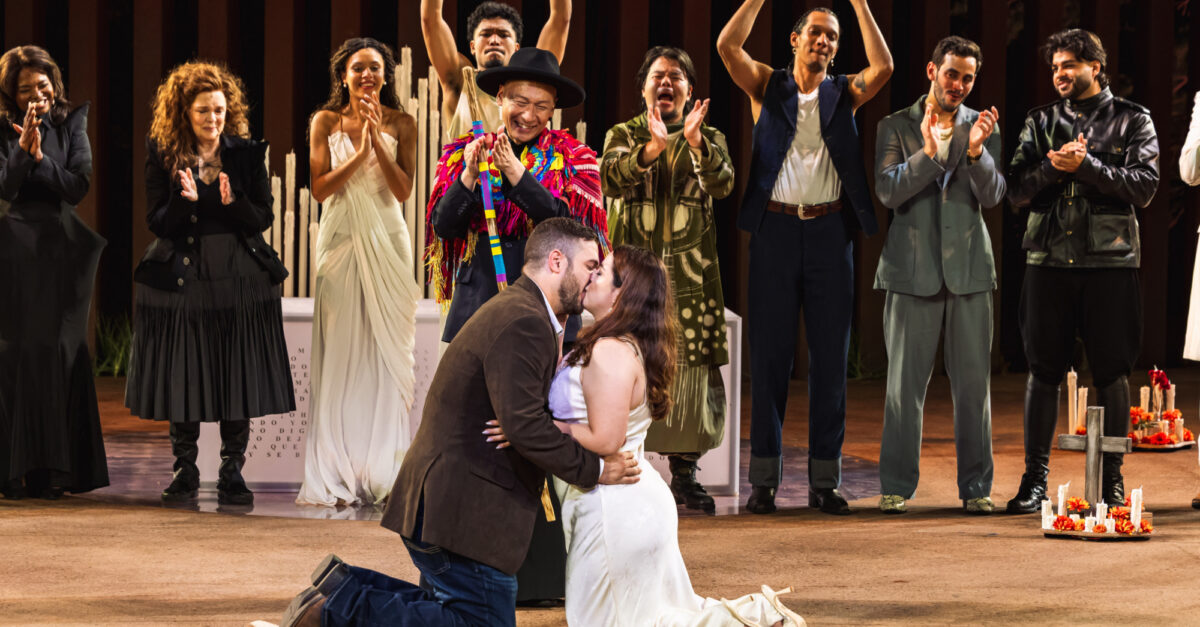
William Shakespeare‘s Romeo and Juliet may be a tragedy, but it is also one of the most famous love stories of all time. This summer, the team behind the Public Theater’s free Shakespeare in the Park production have come together to emphasize that love with a surprise wedding ceremony capping off each and every performance.
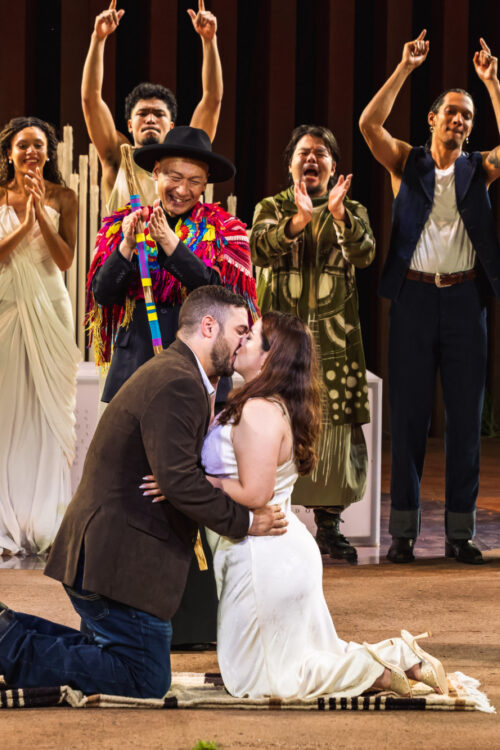
These ceremonies, officiated by Tony winner Francis Jue while still in costume as Friar Lawrence, are an uplifting capstone on what is, historically, a tragic night of theatre. Playbill caught up with Jue shortly before the end of the show’s run on June 28 to talk about his experience marrying dozens of couples onstage at the Delacorte.
Hi Francis! How is the Delacorte treating you, post renovation?
Francis Jue: I’m so grateful to the Public for all of the work they’ve done on refurbishing the Delacorte, making it more accessible, and everything that they’re doing to do outreach to all parts of the city, in all five boroughs. We’ve had really diverse and wonderful audiences. They work so hard in order to keep it free for everyone, and to make tickets accessible. We’ve had an amazing turnout, without big movie stars, or a lot of Hollywood talent. We’ve been packing the Delacorte, which is just astounding to me.
People love Romeo and Juliet.
Yes. Romeo and Juliet is such a great title, and everyone thinks they know what they’re coming to see in it. But at the end of the show we get to surprise them with not just the tragedy of the play itself, but also remind them of the hope that the play also offers with the wedding that we perform at the end of the show.
When in the rehearsal process did they come to you asking if you’d be willing to officiate marriages?
Maybe on the second day of rehearsal? During a break, Saheem [Ali, the director] sat next to me as I was marking up my script, and he said, “Have you ever officiated at a wedding?” And I said, “No.” And he said, “Well, would you like to?” And I said, “Why?” And he told me that he had met a couple who were engaged when he went down to Laredo, Texas, to look firsthand at the border wall, and they showed him around. They introduced him to all sorts of folks. They told him stories about border wall weddings, and that sparked this idea in Saheem, and he wondered whether they would be willing, as an engaged couple, to come to New York for the opening night of Romeo and Juliet and get married on the stage at the end of the show.
He brought the idea to [Public Theater Artistic Director] Oskar Eustis, and Oskar said, “Well, why not every night? Why just on opening night?” So they hired a wedding planner, who started just internally spreading the word. They thought that they’d get inundated, right from the start. My first impression was they’re going to have to beg people to do this, but no, I was wrong! They have a huge waiting list of people now because so many people wanted to do this.
So, shortly after the first week of rehearsal, I enrolled with the Universal Life Church online, and then when they sent me my certification, I sent it into the city clerk, so that I was properly registered as an officiant. During tech of the show, the city informed me that indeed I was entitled to marry people in New York, so we started at the very first preview, and I think I’ve officiated at maybe 25 or 24 different couples weddings.
It’s incredible. It’s actually the greatest gift I think I’ve ever received, aside from my own marriage. It’s really an emotional roller coaster, Romeo and Juliet, and I’m so grateful to participate in something so joyous that isn’t make believe at the end. It’s a tangible, real example of the hope that we might actually survive, we might actually come together and find ways to love one another again.
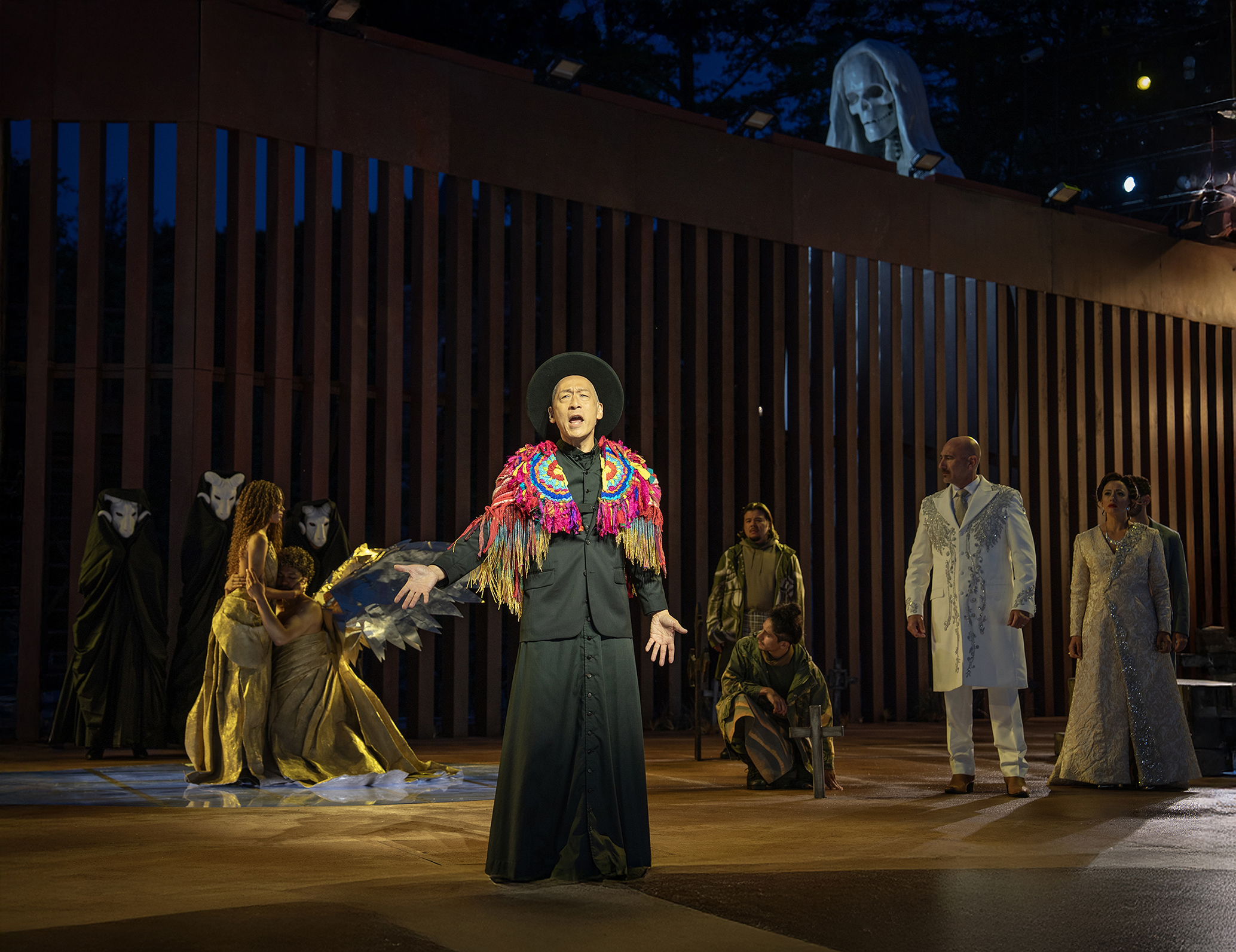
Francis Jue anc company of Romeo & Juliet
(Joan Marcus)
When it comes to the couples you’re marrying, how many of them are connected to the Public itself, versus being members of the general public?
It varies from couple to couple, because they spread the word quietly and internally at first. Some of them are directly attached to the Public, some of them are friends of people who are attached to the Public, there are friends of mine that I’ve now officiated at their weddings, there are two (and soon, there will be three) members of our acting company who are getting married or renewing their vows on the stage, too.
But it isn’t all people connected to the production, it’s a wide swath of people. Some people who are older, younger. The couple from Laredo, Texas, came up on opening night. There are gay couples, trans couples, straight couples, mixed race couples. It’s amazing how many different kinds of people are coming for this ceremony that we’re providing for them, and each one of them has felt like a completely different and new event. They’re all so lovely and so grateful. It’s been just amazing. The only tension or stress that I have about the whole thing is remembering their names.
Oh no!
I introduce myself to them before the show and walk them through what might happen after the show when I officiate at the ceremony. The rest of the time whenever I’m off stage, I’m reciting their names to make sure I don’t call out the wrong name or mispronounce their name at the end of the show.
One of the benefits of being ordained through the Universal Life Church is that you don’t have extremely specific vows to adhere to as well.
Towards the end of the rehearsal period, Saheem again sat next to me during a break and said, “So have you written the vows yet?” Me, “I thought you were coming up with a script!” And he says, “Well, let’s put our heads together.” So that night, I wrote out a draft of a wedding ceremony, and Saheem’s assistant, Miguel Brigante, wrote out his version of a wedding ceremony, and a story to transition from the play to the wedding. And we put our heads together over the course of tech to combine both of those drafts into what we are using now.
I wasn’t sure it would work, I wasn’t sure whether people would still be filing out of the theatre during the ceremony, or whether people would feel trapped. But I gotta tell you, every single performance, the audible gasp when people realize what’s happening, that an actual wedding is happening on stage in front of them, and the joy that it elicits from people is just overwhelming. It’s incredibly emotional. 1,800 people on their feet for this wedding couple just makes the play that much more meaningful to me.
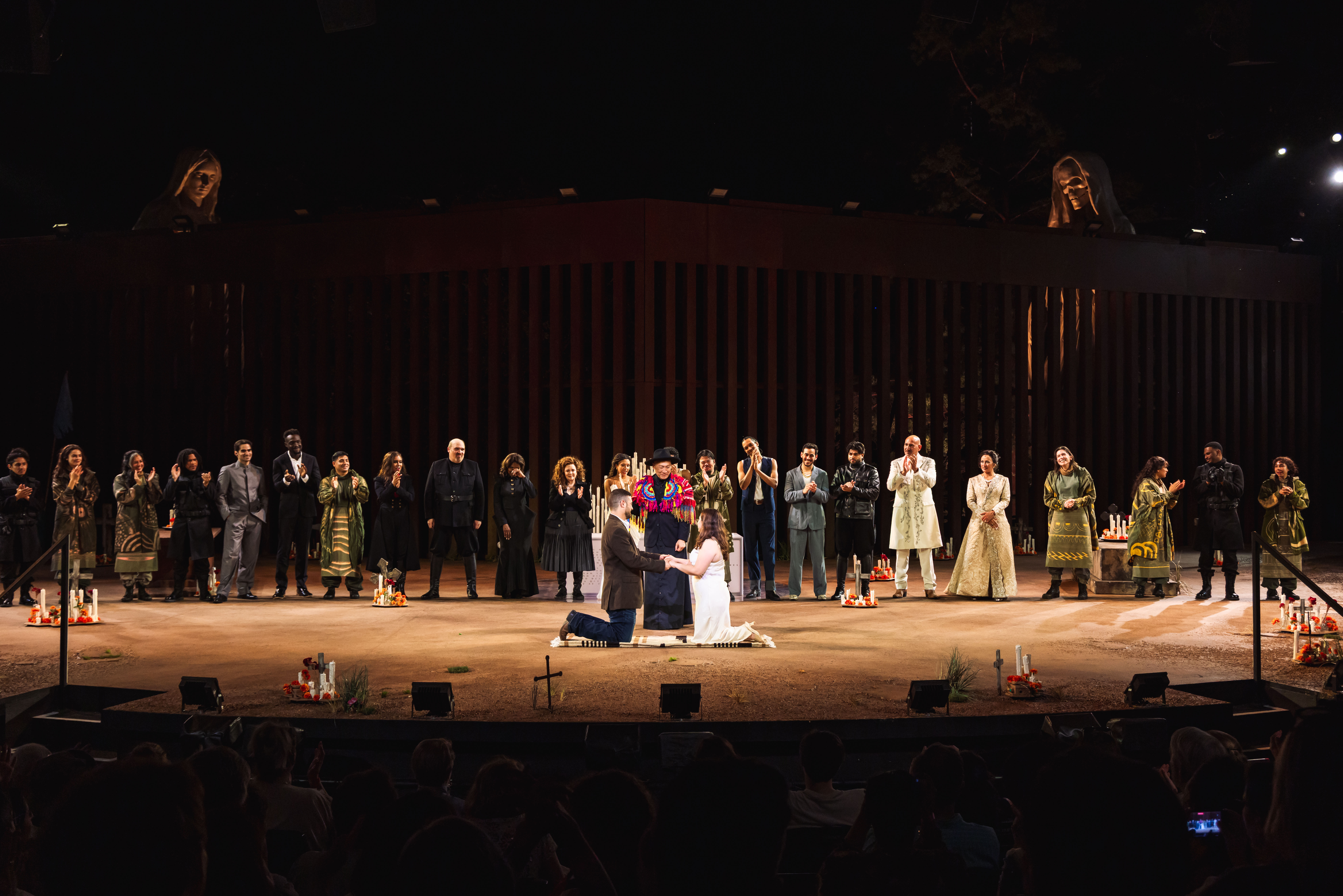
Oscar Diaz, Janelly Mendoza, Francis Jue, and the company at the opening night of Free Shakespeare in the Park Romeo and Juliet
(Rebecca J Michelson)
The energy rockets through the space, elevating the theatrical to the real in a very big way. What is it like for you to essentially be the master of ceremonies of that energy?
One of the great things about theatre, and about being an actor, is that it has challenged me throughout my life to do things and to know things about myself that I never understood that I never knew. This is certainly right up there with any other thing I’ve ever been challenged to do, in life or on stage.
As Friar Lawrence, I try throughout the play to help to solve problems, to have faith that good can come out of whatever is happening in the world. That’s one of the things that I admired about Friar Lawrence when I was 10 years old and first read Romeo and Juliet—that idea that there are people in this world who try to help, who are the helpers, and I take that very seriously as a person, and as a member of any company.
In Romeo and Juliet, especially, I try to take care of these couples who are not playing a part in a play. It’s actually a very important moment in their lives, and I’m so grateful to them for offering that moment to me and our company, and to the audience on any particular night, because they’re willing to share something so sacred, so personal, and in a way it creates that energy that we all feel in that moment. It is really an acknowledgement of how connected we actually all are, if we choose to acknowledge that. It’s a thrilling, huge responsibility to guide that moment.
Will you still be ordained after the end of this run?
Oh, yeah! When the city wrote back to me to tell me that they received my application, and that I was indeed now a minister, it was for life. It’s like when you’re signing your own marriage license, and you’re like, “Oh yeah, that’s right, this is actually a contract for life.” I’m not, like, hanging a shingle out or anything like that, but there is a friend of mine who said, “If I ever thought that I could get married again, the thought of you officiating makes that just a little bit more possible.” Who knows, maybe I’ll use it off stage one day!