
The Venice Biennale often takes time to digest and find a thread—if there is one—that unites the art that has been chosen to sum up the world at this moment. This installment is no different. Titled In Minor Keys, the word minor carries heft; it describes the choices made by these featured artists to offer a soft touch, a light footprint, barely whispering meaning.
In searching for this thread of meaning, I noted something which I don’t remember seeing so prominently in past Biennales. It’s something that I’ve been seeing for quite some time in contemporary art practices: the use of miniatures, either as part of a work, or as the main act. Of course, there is a long tradition of miniature art, from the Venus of Willendorf (who is small enough to nest in the palm of a human hand) (ca. 24–22,000 B.C.E), to portable altarpieces or miniature illuminated manuscripts. Victorians wore tiny paintings of their beloved in lockets around the neck. But there has been a rise in this practice that seems to have been reignited in the last few decades. Think of Charles Simmonds’s miniature “Dwellings” that popped up all over Manhattan in the late seventies. Or Yinka Shonibare’s 2002 dollhouse and Sanctuary City (2024) architectural models. Alberto Burri painted miniatures of his own work in the 1950s, but were only exhibited in the Guggenheim Museum show of 2015-16.
Now the trend is evident in this year’s Biennale. Perhaps because of the fiction I write for young readers, I stopped for a moment at the written introduction in the central pavilion, describing the term “minor key” as not only a reference to music, but the geographical meaning of “small islands, worlds amid oceans,” and that “the exhibition’s composition is formed by artistic practices that open portals.”
Small worlds and portals. But to where? In her book On Longing, Susan Stewart analyzed the use of miniature, throughout history, as a metaphor for human interiority. For instance, dollhouses offer, among other things, a physical means of psychic control over a world of your own making. We may think of them mostly as relegated to childhood, together with dolls, model trains, Lego worlds, small backyard forts. But miniatures are a powerful tool at any age. Who doesn’t yearn for psychic control? Certainly, many of the artists working in this time of worldwide upheaval and displacement display this need. Are miniatures more than a metaphor? Do they work as a physical portal or shortcut to human interiority?
Within the first few steps into the central pavilion, I came across a vitrine of miniature structures, the work of Beverly Buchanan. Standing barely a foot tall, had these structures been built full size, they would be considered shacks or shanties, made with cast-offs and reused bits, some painted stark white, others colorfully painted or covered in a mosaic of buttons and bottlecaps. They are beautiful and vibrant. I watched people in the gallery, smitten and mesmerized by these intimate structures. Raised in South Carolina, she incorporated southern building practices into her work. On the wall nearby hung “legends”—short texts meant to collect the testimonies of people within her community.
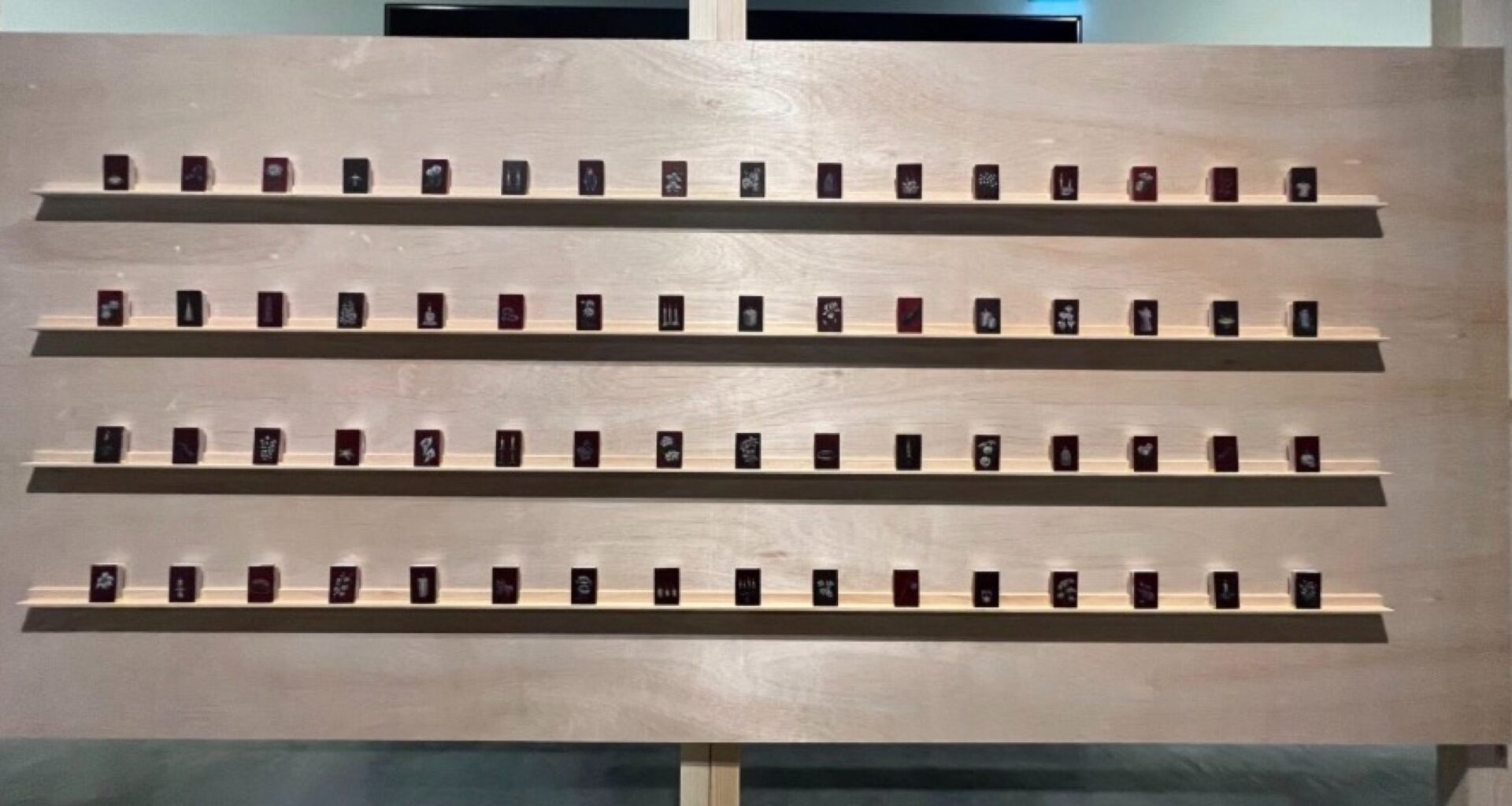
After that, I could not help but see miniatures everywhere I looked, hiding in plain sight. An installation by Mohammed Z. Rahman, titled Lovers’ Vigil (2024), consists of, in part, a large grouping of very small paintings, lined up and spaced grid-like on four rows of simple pine shelves. Looking closely, I realized they were all painted on matchboxes. Rahman—a British-Bengali artist living in London—painted mundane objects that are associated with heartbreak: flowers, candles, a house, a single sock, all in a subdued palette. They worked as a group (much like a childhood collection of Matchbox cars) but you had to come up close to see the subject of each one. Again, a reference to something we thought we left behind in our childhood—the obsessive organizing of a collection. But here it is used as a way to work through trauma, pain, a safe means for reorganizing after the disruption caused by loss.
Larger still is the installation in the Spanish Pavilion, Los Restos, by Oriol Vilanova. The word restos itself is dependent on context, but it can mean “the remains” or “leftovers.” Even in English those definitions can be loaded with meaning. The installation consists of thousands of postcards, wallpapering the entire interior, room to room, floor to ceiling, corner to corner. Like the piece by Rahman, it first reads big, until you realize that its reason for being is the lowly, common postcard. But a postcard is a miniature; it represents a place we’ve been, or a thing we’ve seen that we want to have a picture of small enough to hold in our pocket. The cards were arranged loosely by color, at a distance giving the effect of an almost shimmering tiled surface. In this context, the double meaning of restos is important; the postcard is both the remains and the leftovers. The postcard helps keep your memories—the remnants of experience—in order, safe and sound. Again, the collision of collecting and miniaturizing serve the same purpose.