
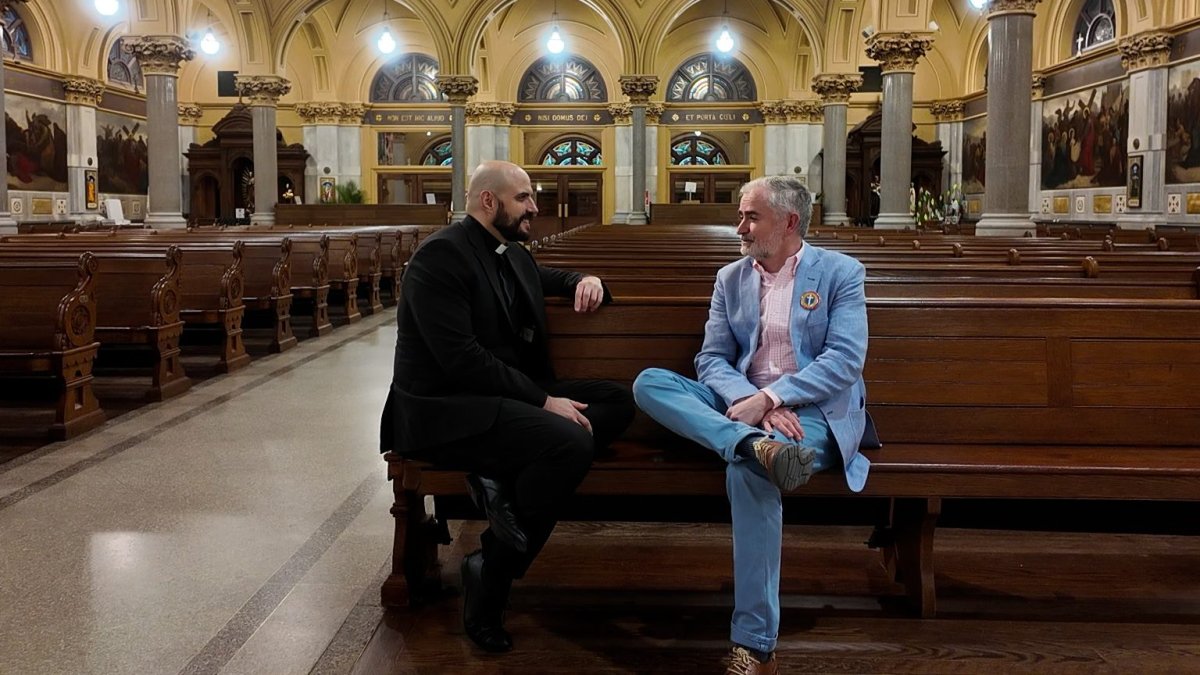
New York City — the root of the modern pride movement — is home to a number of LGBTQ+ friendly Catholic churches, which many people don’t know exist. NBC New York’s Jennifer Vazquez reports.
Pride Month may be coming to an end, but advocacy continues year round.
This sentiment holds truth for a number of LGBTQ+ friendly Catholic churches. New York City — the root of the modern pride movement — is home to a number of these parishes that many people don’t know exist.
These churches have become religious safe havens where LGBTQ+ individuals can be their true, authentic selves while still embracing their Catholic faith.
LGBTQ+ friendly parishes: A lifeline
In the 80s, when Yago Cuesta came to terms with his sexual identity while living in Spain, he thought his spiritual journey within Catholicism had to come to an end, not because he wanted it to, but because he thought there was no room for him or people like him in the Catholic Church.
“I thought really that I could not be a happy person or a good person being gay,” Cuesta said. “When I became aware of my sexuality that was like, kind of a stop on my, journey of faith, because there was a point where I realized, ‘Well, I’m not fully welcome in this community, in this church, the way I am.'”
While he yearned to return to practicing Catholicism, he felt that the Church was at odds with who he is. That all changed when he accompanied a friend to church in 2020.
NBC New YorkNBC New York
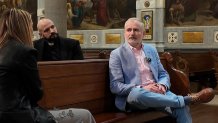
Yago Cuesta, member of Gay Catholics at St. Francis Xavier, right, and associate pastor Ricardo da Silva, center.
“My joining the Church again — and that happened really only six, seven years ago…I came to this church on Easter Day almost randomly and felt immediately welcomed,” Cuesta said in an interview with NBC New York in the pews of St. Francis Xavier — one such LGBTQ+ friendly parish.
This parish has also become a bastion of hope and acceptance for Ellie Crum, a member of the parish’s Catholic Lesbians group.
“I struggled for a very long time with being able to live authentically as a queer person as well as, like, living my faith fully because oftentimes, given the Catholic teaching and the Catholic Church’s stance on LGBTQ+ marriage and people in general, those tend to be at odds,” Crum said.
“For a really long time, I struggled with, ‘How do I maintain both of these very authentic identities in my life?'” Crum continued. “It wasn’t really until recently, until moving to New York City, where I really became empowered and embraced my full self, right? My my faith, my sexual identity, all of who that I am. And the Church of St. Francis Xavier had a huge part in that, because when you walk in those doors, it’s not a choice of being queer and Catholic, but living fully as a queer Catholic individual.”

NBC New YorkNBC New York
Ellie Crum, member of Catholic Lesbians ministry group at St. Francis Xavier Church.
Rev. Ricardo da Silva, assistant pastor at St. Francis Xavier and journalist for America, a Catholic magazine, said that at its core, the church’s mission is simple.
“Our philosophy is basic. It’s, ‘All our welcome,'” da Silva said. Anybody who wants to worship — whoever you are, your racial background, your social background, your political background, whether you are lesbian, gay, bisexual, transgender, queer, intersex, however you identify — you are first and foremost a child of God.”
St. Paul the Apostle Church is another LGBTQ+ friendly church in the city that ministers to all. Rev. Paul Rospond, the church’s head pastor, said that the parish is one that welcomes everyone because “it’s at the heart of our Out at St. Paul ministry.”
“If you’ve been alienated from the church because you didn’t feel welcome — maybe they were, from the parish where a priest would preach against gay marriage or preach against homosexuals — but there’s something there that still draws the person to God and down in their being,” Rospond said. “This is a place where, they can give it a go and say, ‘Yes, I’m gay, but I’m searching God. I don’t have to have all the answers, but I have the questions and people to walk with me.'”
Da Silva said that while the Catholic Church’s central teaching is to welcome all, its practice has not always been applied.
NBC New YorkNBC New York
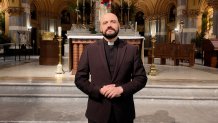
Rev. Ricardo da Silva, associate pastor of St. Francis Xavier Church in Manhattan.
“There is no exclusion. That’s the position of the Church. That’s what the Church teaches in the Catechism of the Church. Sadly, the pastoral, application of that hasn’t always been that way
Rev. Ricardo da Silva, assistant pastor at St. Francis Xavier
“There is no exclusion [at St. Francis Xavier]. That’s the position of the Church. That’s what the Church teaches in the Catechism of the Church. Sadly, the pastoral, application of that hasn’t always been that way,” da Silva said.
“Over the centuries, perhaps millennia, the Scriptures have been used to justify everything: racism, sexism, enslavement,” da Silva said. “They’ve also been used to discriminate against LGBTQ folk. You know, there’s that famous adage: ‘Even the devil can quote Scripture.’ I think ultimately it’s looking at what Jesus’s program was, right? ‘Love one another as I have loved you.'”
Rev. James Martin, a Jesuit priest, editor-at-large of America and founder of Outreach, an LGBTQ+ Catholic news and opinion site, has become a leading voice for LGBTQ+ acceptance and inclusion within the Catholic Church. In a sitdown with NBC New York, Martin further described how some individuals justify their actions against the LGBTQ community by referencing certain Bible passages.
“There are passages in the Bible that are sometimes called the ‘clobber verses’ because they’re used to ‘clobber’ people over the head with statements about LGBTQ people. It’s not a lot. There’s not a lot in the Bible, in the Old Testament, that says it’s an abomination. Saint Paul talks about it. We have to see them in their context,” Martin said.
Martin said that, through his experience, oftentimes, he has come to find that those who justify their anti-LGBTQ views rationalize them by referencing some of these verses while ignoring others.
“The Bible also talks about slavery and it’s okay to own slaves. It talks about stoning women for adultery and stoning people, killing people for taking the name of the Lord in vain. And we don’t look at those the same way any longer,” Martin continued. “I often say to people, ‘Do you think that a woman should be stoned for adultery?’ And they say, ‘No, of course not.’ And I’ll say, ‘Well, why not? It’s in the Bible.’ And they’ll say, ‘Oh, we think about it differently.’ ‘But what about homosexuality?’ ‘Well, that we have to look at literally.’
“We tend to be very selective about which passages we look at literally. So, you know, you don’t want to ignore them, but you want to really look at them in their context and understand them as they should be understood in 2025,” Martin said.
THE TURNING POINT
The start of James’ advocacy work came on the heels of a tragedy that claimed the lives of dozens and brought to light for many the dangers the LGBTQ+ community still faces in modern times.
“After the Pulse nightclub massacre, where 49 people were killed, I was sort of disappointed at the response by most of the bishops in the U.S., and I thought that it indicated a real chasm between the institutional church and the LGBTQ Catholic community,” Martin said. “And so I did a Facebook video, which led to a talk which led to a book called ‘Building a Bridge,’ which led to this ministry. So it was kind of, each step I felt sort of drawn to defend and advocate for the community.”
The attack at Pulse took place in 2016, when an armed gunman rushed the gay nightclub in Orlando killing 49 people and injuring 53 others.
It’s no secret that the Catholic Church has not been welcoming of the LGBTQ+ community throughout the years. However, the late Pope Francis was a vocal proponent of changing just that. One of his most resounding proclamations was giving approval for priests to bless same sex couples — a milestone change in the Catholic Church.
“The Church has always said that all are welcome. That hasn’t always been practiced. Pope Francis made it absolutely an imperative that the church has to practice,” da Silva said.
Through his advocacy work, Martin met Pope Francis a few times during his papacy to talk about the LGBTQ community, the issues the community faces and their role within the Church.
NBC New YorkNBC New York
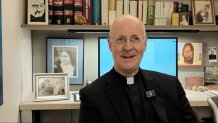
Rev. James Martin, editor-at-large of America — a Catholic magazine — and founder of Outreach, an LGBTQ+ Catholic news and opinion site.
“At the end of our first meeting in September 2019, which was a real highlight of my life, I asked him what else I could do for him, and he said, ‘I want you to continue this ministry in peace. That’s what you can do.’ So I felt that as a kind of mission from the Pope, and I’ve tried to do that ever since,” Martin said, adding: “He was very supportive, and he really did more for LGBTQ people than all of his predecessors combined.”
While Francis’ advocacy for the LGBTQ community has been highlighted and reported, his papacy wasn’t without controversy when it came to the matter.
“Last June, [Francis] used some slurs, some gay slurs in Italian and talked, in a disparaging way about gay priests. And I thought this was very out of character,” Martin said. “So the next time I was in Rome, we met and, we talked about it and he said, ‘Oh, of course, I know gay priests and seminarians who are very holy.’ And I said, ‘Well, maybe you can say that.’ And he goes, ‘You can say that, tell people I said that.’ […] so I kind of put that out on social media. And then, you know, we also talked about that slur he used, which he clearly didn’t understand how bad it was.”
Martin continued: “A couple of days later, I was at an audience in the Vatican with comedians that I helped to set up[…]And then I went to leave and he pulled me back and he said, ‘Thank you for that conversation we had about gay priests. That was really helpful. I really needed to hear that.’ And I thought who does that? Like, who says thank you for a tough conversation? So he was very open to not only meeting people and listening, but learning. That to me was really extraordinary. I’ll never forget that.”
While Martin acknowledged Francis’ mishap, he said that Francis’ actions made a tremendous impact in the LGBTQ+ community.
“People say, ‘Pope Francis didn’t change anything.’ Well, actually he came out against the criminalization of homosexuality. So we have to remember, the Church is universal. In New York, that may seem like ‘Oh, big deal,’ but overseas that is a big deal,” Martin said.
NNeoma Chukwukelu, a member of the Lesbian Catholics ministry group at St. Francis Xavier Church, hails from Nigeria, a country that has a history of human rights violations against those in the LGBTQ+ community.
According to Outright International, an international LGBTQ+ human rights non-governmental organization, same-sex relationships are illegal in Nigeria, with some areas in the country adopting death penalties for same-sex relations. Non-conforming gender norms also face punishment.
Chukwukelu’s religious and sexual identity crisis led her to have suicidal ideologies. Through time, Chukwukelu found peace in St. Francis Xavier, a parish that fully accepts her and where she can practice her faith openly.
If you or someone you know is in crisis, call or text 988 to reach the Suicide and Crisis Lifeline or chat live at 988lifeline.org. You can also visit SpeakingOfSuicide.com/resources for additional support.
FAMILY, FRIENDS AND ALLIES ALSO FIND A COMMUNITY
A number of these LGBTQ+ friendly churches have been advocating for the community for years — if not decades.
The pews at St. Francis Xavier filled up with praying church goers during a mass on the last day of May to celebrate the 32nd year of the LGBTQ+ ministries within the parish.
(Because the church is a safe space, NBC New York was present but did not film the mass or the testimonies shared by the congregation.)
While the LGBTQ+ friendly parishes have become a source of comfort for many in the community, they have also become a place of solidarity for family, friends and allies — including for Ellen Stilwell.
Stilwell said there was never a point where she felt she had to choose between loving and accepting her son and practicing her religion, given that they are both strong, unwavering facets of who she is. However, there was a sense of relief that took over when she came upon St. Ignatius of Loyola, another LGBTQ+ friendly parish in New York City.
“I was going to continue being Catholic and I was going to continue loving my son,” Stilwell said. “But when I did get to St. Ignatius of Loyola and the very first mass, when the priest had said from the altar, ‘We welcome the gay community,” you know, my shoulders fell down. I was just relieved. I could practice my faith and raise my son and not feel awkward coming and going as if I was hiding something […] It was very comforting.”
While her devotion to her religion was deep-rooted, she felt in her heart that the anti-LGBTQ rhetoric and teachings within the Church were “wrong” and antiquated.
“At the same time, I have found such comfort and love and community by going to church my whole life,” Stilwell said. “So I was not going to hang on the ignorance and the tradition of this ignorance to hold us back from finding really a lovely community that helped raise my two children.”
THE FUTURE: BLANKETED IN HOPE
The Catholics NBC New York spoke with for this piece have high hopes for Pope Leo XIV to follow in Francis’ footsteps to continue building the bridge between the Catholic Church and the LGBTQ+ community.
“I have reason — and great reason — to believe and to hope, that Pope Leo will indeed continue, and in fact, increase the Church’s welcome to all,” da Silva said.
Similar to da Silva, Martin also believes that Pope Leo will continue to form bonds with the LGBTQ community within the Catholic Church.
“Pope Leo XIV has already talked about wanting to build bridges,” Martin said. “His first time when he came out on the balcony of Saint Peter’s Basilica, and then in his address to the Cardinals. I think he’s a very open, he’s pretty reserved, but he’s open and he’s a good listener.
“He’s talked about synodality, which means, you know, really listening to people and including them. And I have really high hopes for him. I think he’s a really good choice.”
The idea of synodality is also something that resonated with Rospond when it came to Leo and the Church’s future.
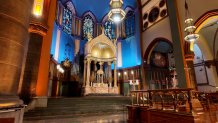
NBC New YorkNBC New York
Inside St Paul the Apostle Church, an LGBTQ+ friendly parish in Manhattan
“Pope Leo has expressed a commitment to synodality, and that’s basically about being a listening church,” Rospond said. “No emphasis on the top down structure.”
Though, Chukwukelu hopes for the best, she shared a more reserved view with NBC New York saying that she feels it is unfair to put so much pressure on Pope Leo.
“Personally I don’t think it’s fair to expect that much change from him because that’s culture and culture does not change in one lifetime,” Chukwukelu said. “It takes 15, 20, 30 years of lifetime. But we’ll see.”
Regardless of Chukwukelu’s reserved optimism, she does hope that Leo helps to continue “building the foundation” of a new era in the Catholic Church, but at the very least, she “prays” that he does not “remove what has already been built” when it comes to LGBTQ policies within the Catholic Church.
“It’s not much to be honest, but it’s better than none,” she said of the policies.
THE MISSION CONTINUES
Stilwell said, as she continues to form part of the LGBT Friends and Family mission group with St. Ignatius of Loyola, she hopes this type of ministry can spread to more parishes across the country and world.
“Our mission with our ministry is to introduce this type of ministry to more parishes,” she said. “Hopefully, it’s going to happen. I mean, it’s more accepted and more accepted and, hopefully, the usage of negative language is not used anymore […] Obviously Pope Francis, who said who was he to judge, and our new pope is an Augustinian, so liberal-minded Catholic, far from the conservative Catholics who still do exist. So there’s hope. There’s really great hope.”
That is the mission that da Silva also hopes to witness.
“I just hope that that message of, ‘All are welcome. The doors are open to all. Welcome home. You are loved,’ is shouted from the rooftops, from every rafter of every church ceiling in New York City and beyond.”
This story was originally published last year.