
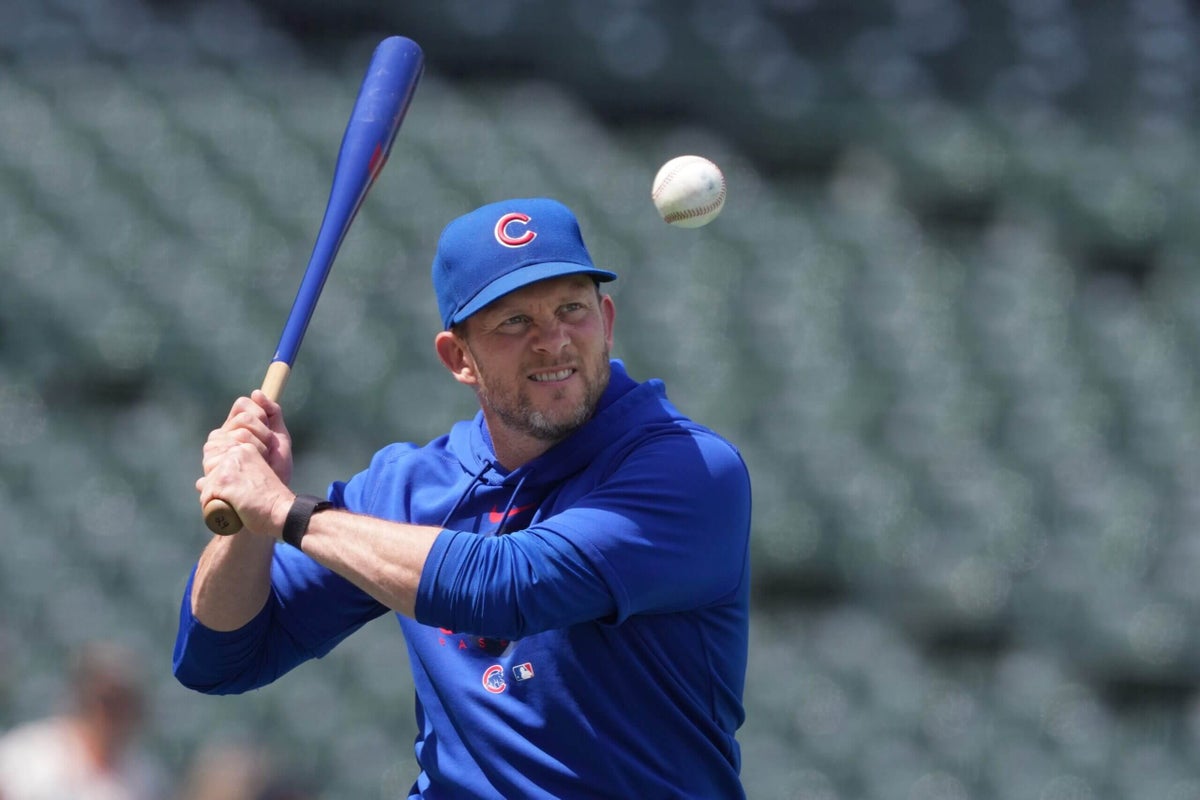
Halfway through a disastrous season, the New York Mets fired manager Carlos Mendoza on Friday, replacing him on an interim basis with player development executive and former San Diego Padres manager Andy Green, who Mets president of baseball operations David Stearns said will return to the front office this winter.
Green won’t continue in the role past this season, Sterns told reporters at a press conference at Citi Field on Friday afternoon. Instead, Sterns said, Green will return to the Mets’ front office.
Taking the job felt “like a responsibility more than an opportunity,” Green said. He said that once he learned the Mets were firing Mendoza, he “genuinely believed, given my life experience, I was best-positioned to help over the next three months.”
Green declined to provide a timeline for when Sterns first reached out to him about potentially taking over as manager, but he texted Mendoza and spoke with him shortly after Sterns told him about the decision.
“Once the decision was made,” Green said, “and you looked around at the people who could talk to (reporters) and talk in front of a team and have some life experience where it wasn’t going to be about that person, I think I was in position to (take the job).”
Who will be the next Mets manager?
Ken Rosenthal
Green, who had been serving as the Mets’ senior vice president of baseball development, might be uniquely equipped for the 81-game challenge that awaits him in the nation’s largest market. Before he managed the Padres from 2016 to his own firing near the end of the 2019 season, and well before he served as Chicago Cubs bench coach over the following four seasons, Green witnessed the Mets’ institutional dysfunction from inside the organization.
In 2009, Green was a veteran infielder for the Mets’ Triple-A club when then-general manager Omar Minaya fired vice president of player development Tony Bernazard after reports that Bernazard had gotten into heated confrontations with players and staff members. In the wake of Bernazard’s dismissal, Minaya publicly accused New York Daily News beat writer Adam Rubin of lobbying for a job in the team’s player development department.
A few weeks later, Green received what would be his final call-up as an undersized utility player. He entered four games as a pinch-hitter before he was designated for assignment by the Mets, who finished that season with 92 losses after opening it as favorites to win the National League East. Green, who returned to the organization on a minor-league deal in 2010, finished his major-league career with a .200 batting average over parts of four seasons with the Arizona Diamondbacks and the Mets.
Green isn’t worried that he’ll be looked at simply as a substitute teacher. He said that as the team’s player development leader, he had never seen it as his “responsibility” to form tight relationships with the stars of the team, and he pointed out Francisco Lindor, Juan Soto and Bo Bichette by name. He indicated that he had closer bonds with former prospects, like Carson Benge.
“I didn’t spend the last number of years trying to win their trust or their respect,” he said. “I will show up every day to do my dead-level best to put them in a position to succeed.”
Green added that his leadership style will be rooted in “authenticity.”
Now 48, Green — whose middle name is Mulligan — is getting a second chance at managing amid what has been an eventful post-playing career.
A former minor-league manager and third-base coach for the Diamondbacks, he joined the Padres as a surprise managerial hire in late 2015, replacing former interim skipper Pat Murphy and beating out a field that included Alex Cora, Ron Gardenhire and Mark Kotsay. He spent the next four seasons overseeing what was mostly a rebuild until San Diego’s ambitions soared with the signing of Manny Machado.
During his tenure with the Padres, Green oversaw a 274-366 record, including a 69-85 mark before his firing in 2019. Known for his intelligence but lacking big-time credentials, he never achieved sustained buy-in from Machado, Eric Hosmer and some other veteran players. Late in the 2018 season, outfielder Wil Myers, apparently unaware he was on a live social media stream while playing the video game “Fortnite,” criticized Green for commissioning extra defensive drills. (Myers later apologized.)
That did not stop the Chicago Cubs front office from hiring Green as bench coach to then-manager David Ross after the 2019 season. According to people around the Cubs, who were granted anonymity to freely discuss the situation, Ross grew to respect Green early in their four seasons together, a period that ended with Chicago’s poaching of manager Craig Counsell from the rival Milwaukee Brewers.
Green subsequently interviewed for the Cleveland Guardians’ and Mets’ managerial openings. Though the latter job went to Mendoza, Green — a finance major who graduated summa cum laude from the University of Kentucky — impressed Mets owner Steve Cohen, who hired him to run the Mets’ farm system as vice president of player development. In that role, Green oversaw the development of Nolan McLean, Carson Benge and A.J. Ewing.
As interim manager, Green’s experience could prove useful for a Mets franchise that has staggered to a 34-47 record and might be turning much of its attention to next season. But, as Green knows well, Cohen and Stearns did not assemble a $360 million roster to undergo a prolonged rebuild. The Mets will at least require more cohesive play over the next 81 games, and a 5-foot-9 former infielder suddenly finds himself under an oversized spotlight.
Green said he had short message for the players while speaking to them in the clubhouse after Sterns spoke to them about Mendoza’s firing.
“You have one game that really matters in the world,” he said he told them, “and it starts at 7:10 tonight.”