
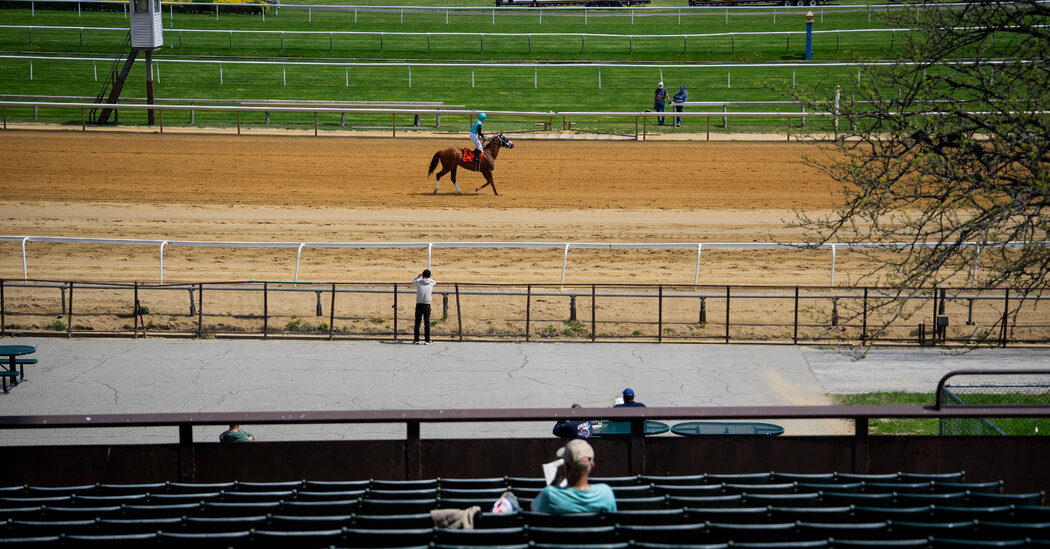
Surrounded by a sea of empty, peeling plastic seats, Frank Lettieri had his Daily Racing Form and nearly the whole grandstand at Aqueduct Racetrack to himself.
“When I was a kid, you had wall-to-wall people here waiting to bet — there were lines out the door, literally,” said Mr. Lettieri, 73, a retired mail carrier from nearby Howard Beach and longtime regular at the thoroughbred track in Queens.
But as has been the case for many years now, the track’s vaulting grandstand was almost entirely empty on a recent weekday, save for the regular gathering of Jamaican immigrants behind Mr. Lettieri. They watched the races through a haze of weed smoke with their own soundtrack of pulsing dancehall music from a personal speaker. Mr. Lettieri puffed on his cigar and focused on his racing form.
Aqueduct has been a cornerstone of New York horse racing from the moment it opened in 1894, and it soon reached its peak after a major renovation in the late 1950s. By the time Secretariat ran there in the early 1970s, the track’s decline was imminent, with New York City having introduced off-track betting so bettors never had to set foot at the racetrack.
The track, whose faded, hulking grandstand looms off the Belt Parkway near Kennedy International Airport, has been out of date for decades, and increasingly playing second fiddle to Resorts World New York City, a slots-style racino that opened next door in 2011.
Now Aqueduct’s time is up. This weekend will be the last days of live racing at the track, though simulcast races will run through Labor Day. Its racing schedule will be moved to the newly renovated Belmont Park nearby, just over the Queens border. But until the ninth and final race is run around 5:45 p.m. on Sunday, the horseplayers were following their routines.
Allan Bedsole — a 74-year-old electrician from Queens whom everyone calls Skip — chomped on a roast beef sandwich and studied his handicapping sheet in Silks bar, an unassuming recess at the track on a recent weekday. Next to him sat Vincent, a retired police officer, and Charlie, a Vietnam vet, part of a group of friends who gather on race days.
Mr. Bedsole toggled nonstop between the bar to a wagering terminal a few feet from his bar stool. After he hit for $50 in the second race, he had to shoo away a man who came by hawking a $100 Rolex of questionable provenance.
“No matter how rundown it’s gotten, I have a lot of great memories in this place,” said Mr. Bedsole, who demonstrated a favorite bar trick, rattling off every Triple Crown winner going back a century.
These memories include a bunch of big scores, including the time he came home loaded with Johnnie Walker Blue and a bundle of cash so big that his wife, Linda, fainted — a claim she confirmed by phone.
Aqueduct, whose Wood Memorial race each April is considered a key prep race for the Kentucky Derby, has been graced by some of the greatest thoroughbreds in racing history. Secretariat first raced here in 1972. When he had his retirement send-off a year later, 30,000 fans showed up.
In 1995, Pope John Paul II said Mass on the track’s infield before 75,000 people. Today, a turnout of 2,000 is a good day, but those regulars are proud disciples.
“I know they’re saying Belmont’s going to be a state-of-the-art track, but it’s still sad to see Aqueduct go,” Mr. Lettieri said between studying the next race’s lineup and listening to sports news blaring from his transistor radio. “It’s a place for regular people to escape to.”
Aqueduct is one of the oldest thoroughbred tracks in the country and the last remaining one in a city that in the early 1900s had six of them.
The New York Racing Association has long run thoroughbred racing in New York as a traveling roadshow rotating among three tracks: Aqueduct in colder months, Saratoga in late summer and Belmont Park most of the remaining months.
Belmont, the home of the prestigious Belmont Stakes, is considered Aqueduct’s upscale cousin, a more family-oriented place that draws from suburban Long Island.
Saratoga retains a high-society luster, especially on big race days, when one can spot women in fancy hats and men in seersucker under the track’s grand old wooden grandstand.
Modern-day Aqueduct was never known for that kind of finery, nor did it have picnic areas, like at Saratoga and Belmont.
What Aqueduct did have was its own subway stop on the A line. It was also free to enter, a big draw for the hardened horseplayers from south Brooklyn and Queens.
They would gather inside the cavernous clubhouse, a fluorescent-lit sanctuary for gamblers who couldn’t care less that the place had all the charm of a bus station, and where there was no shame in scavenging a used racing form from the trash. Fearless pigeons paced indoors, pecking at the losing betting slips that grew thicker on the floor as the afternoon wore on.
Bettors, who appeared to be mostly middle-aged men, scrutinized odds and time sheets and notated their racing forms according to their own handicapping systems. Then they would cluster around wall-mounted screens simulcasting racing from other tracks and indulge in what seemed like primal scream therapy.
“When they’re screaming at the screens, that’s them enjoying themselves,” said Suzie Smith, a veteran teller who has taken cash bets from Aqueduct horseplayers for 20 years.
Track employees rotate along with the seasonal race schedule; all her work will now shift to the tracks at Belmont and Saratoga. Ms. Smith admitted she has developed a soft spot for her Aqueduct clients, whom she described as hardened horseplayers who combine betting acumen with a dash of superstition and often insist on betting in cash.
“A lot of them, once they win with you, they keep coming back,” she said. “I have regulars who will only bet with me. They call me their lucky teller.”
Roy Brown, a Jamaican immigrant from Queens, one of a large contingent of Aqueduct regulars who hail from Caribbean neighborhoods, was hunkered down at his regular spot in the track’s main concourse.
“Whether I win or lose, I love being around here and it’s going to be hard to say goodbye,” Mr. Brown said.
Many like Mr. Brown regard the new Belmont with mix of excitement and wariness.
Belmont is served by the Long Island Rail Road but not the subway. Admission is yet to be determined, but already the new track is touting premium pricing options, membership concierge service and box seating. Suffice it to say, it won’t be free. “A lot of my friends take the A train here,” Mr. Brown said. “A lot of guys don’t drive and will have a hard time getting to Belmont — some say they’ll give up the game.”
Despite its decline, the racing industry is fond of the Big A, as the regulars call it, as the people’s racetrack. It is a place where a top jockey like Kendrick Carmouche has run into the crowd to celebrate with the locals, as he did last year after winning his 4,000th race.
“I love Saratoga and Belmont, but Aqueduct is just a different atmosphere,” said Linda Rice, who is widely known for her dominance as a trainer at Aqueduct. “I’ve had a lot of great moments here. It holds a special place in my heart and I’m going to be sad to see it go.”
As part of its closing celebration this weekend, the track will offer the first 1,000 fans through the door on Sunday a souvenir that seems to fit its devotees’ granular love for the place: a small Mason jar of dirt from the main track.
As for Mr. Lettieri, he is hoping to buy one of the grandstand seats from his regular section.
He watched rapt as the horses roared down Aqueduct’s homestretch.
A chorus of shouts rose from the sparse crowd of railbirds standing trackside. Above it all, one of the Jamaican men began beating a rolled-up racing form into his palm and chanting “Easy money!” as Sports Hero beat out Asked and Answered to win.
A few happy horseplayers rejoiced and headed inside to redeem their winnings. Others tossed their losing stubs on Aqueduct’s cracked asphalt.
“You develop a strong stomach for losing, but you also get moments of euphoria as a horseplayer,” Mr. Lettieri said. “Win or lose, it’s a special place.”
He took a puff of his cigar and said he would miss the “ambience” at the Big A.
“You can be yourself here,” he said. ”You’re in an environment where all your problems go away.”