
Forty million people around the world are living with HIV — a virus that, despite decades of medical advances, still has no cure. Current treatments can keep the virus under control, but the moment a patient stops taking them, it reactivates.
Now, researchers at Albany College of Pharmacy and Health Sciences say they may have found a way to silence HIV for good.
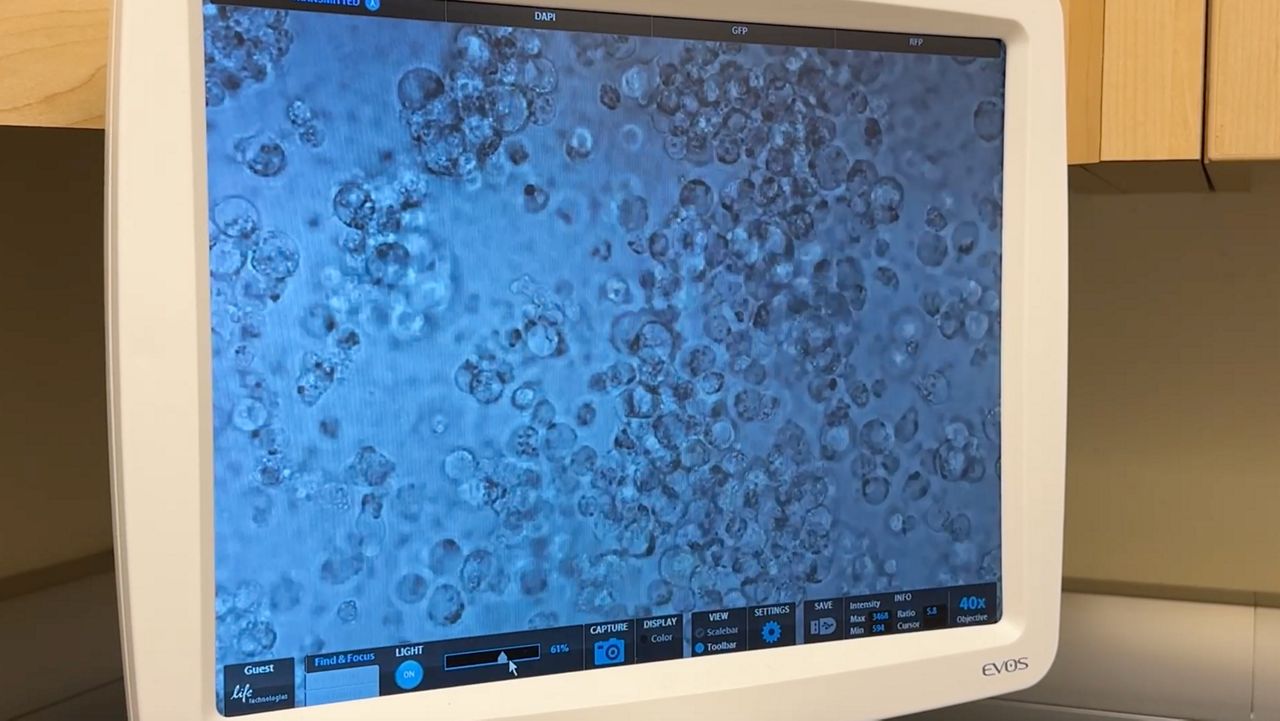
Dr. Vir Singh, an associate professor of microbiology at the college, says his lab has identified a molecule capable of keeping the virus dormant, even after treatment stops.
“What we have done here in our lab is used a molecule that can induce a signaling pathway and by promoting this pathway, we have seen that latent cells become resistant to reactivation,” Singh said.
In other words, if it works, patients could one day stop treatment without the virus reactivating.
Singh’s lab draws researchers at every level, from doctoral and master’s students to high schoolers. Donovan Gioia, a master’s student at the college, said the complexity of the work became clearer the deeper he got into it.
“When I first started here, what felt like a big overarching plan — ‘yeah, we’re just going to stop HIV reproduction’ — but now I actually understand the intricacies of how these molecules are working, what we’re looking at and why,” Gioia said.
Sam Rahsaeed, a student at Niskayuna High School, said the hands-on experience stands apart from classroom learning.
“We’re learning about HIV in a lab, which is really cool compared to what we would do at school, learning from a textbook,” Rahsaeed said.
For pharmacy student Christine Gichigi, the research carries a deeply personal meaning. Gichigi grew up in Kenya, where it is estimated that more than 3% of the population is HIV positive, and said stigma around the disease shaped how people treated those living with it.
“For me, in my experience, it was more of if you saw somebody with HIV, it was like ‘OK, try and stay away from them, it’s too scary,’ ” she said. “We are actually working on ways in order to prevent or even give more people ways that you’re not replicating — in a way, silencing the virus. It doesn’t spread that idea of staying away from people. The virus itself is separate from that individual.”
Singh said immersing students in that kind of research produces healthcare providers who not only understand the science, but trust it — because they helped build it.
“Training them here, at this level, definitely produces much more informed and capable healthcare providers with a better research temperament, a better understanding of how cells work, how our body works, and how we can treat certain diseases,” he said.
The team’s next step is collecting samples from people living with HIV, with the goal of eventually proposing a clinical trial.