
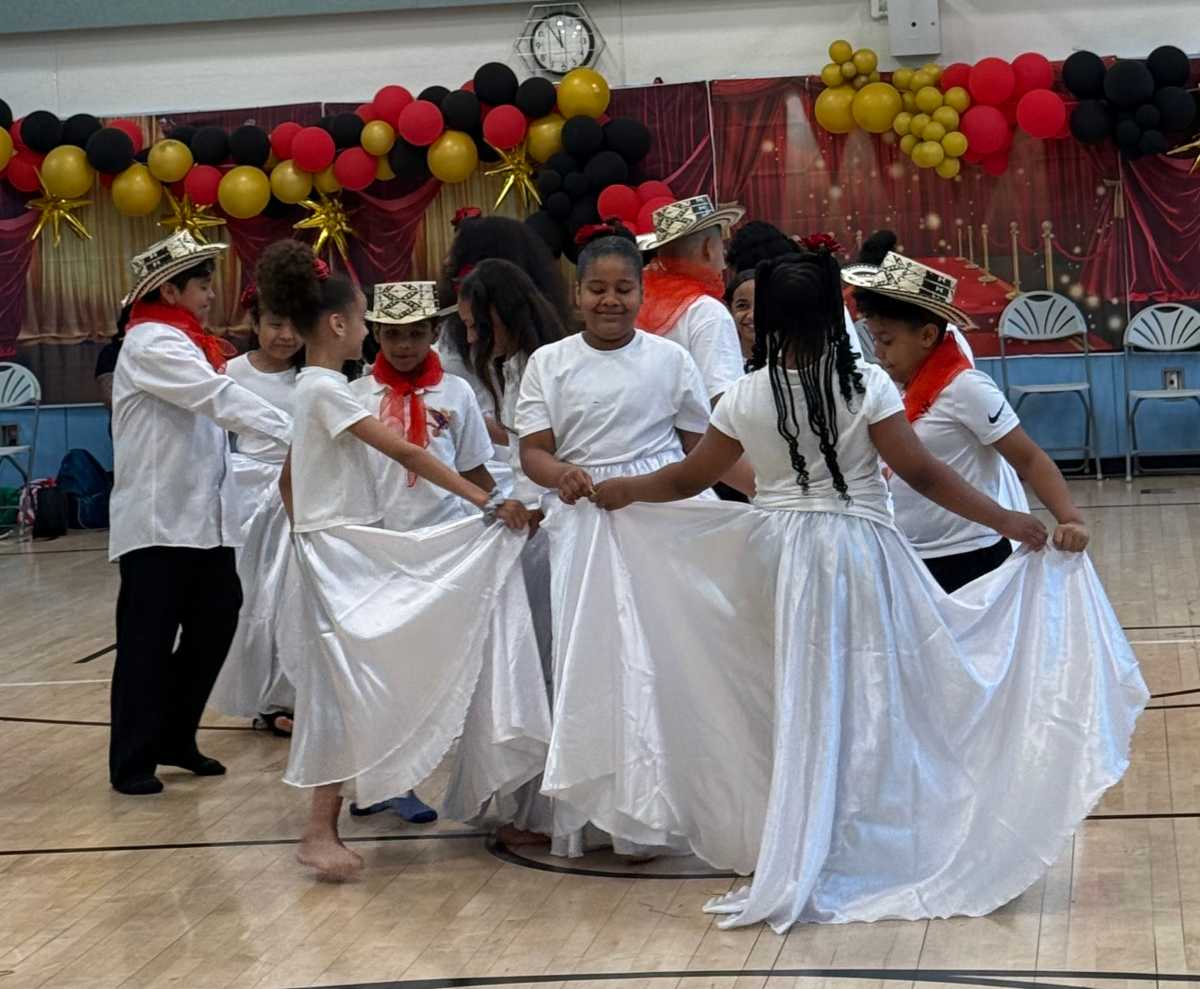
It’s showtime in the South Bronx, as dozens of dancers take the stage, while the audience watches, and a drummer plays, creating the background and beat for dancers who move largely in unison.
It’s a day filled with dance performances, but if the dance may be typical African, Flamenco, Cumbia and Hip-hop, it’s anything but a typical day at PS 246 in the Bronx. It’s a memorable day for students and for a one-time lawyer who founded a dance nonprofit.
Students performed recently, not in a dance class final, but a final, somewhat magical moment as the culmination of a 10-week program at the school led by nonprofit Accent Dance NYC, which goes into schools citywide and teaches dance.
The students got lessons in dance, poise, performance, cooperation, collaboration and culture, while an audience of fellow students and parents saw a fairly polished performance.
For Andrea Zeigelman, it was another day after she went from the courtroom, turning classrooms and gyms into ballrooms.
“We have most of the school performing,” said Ziegelman, a former attorney who founded and is artistic director for Accent Dance NYC. “Parents come in for the performance.”
While many lawyers have other loves, some shift careers and follow their passion, as Ziegelman did as she watched students dance in the PS 246 gym, which doubles as an auditorium.
“How does it feel?” asked Accent Dance NYC instructor Jason Ferber. “I can’t wait for this moment. In such a short time, they learn so much. We get to show what we’ve been doing.”
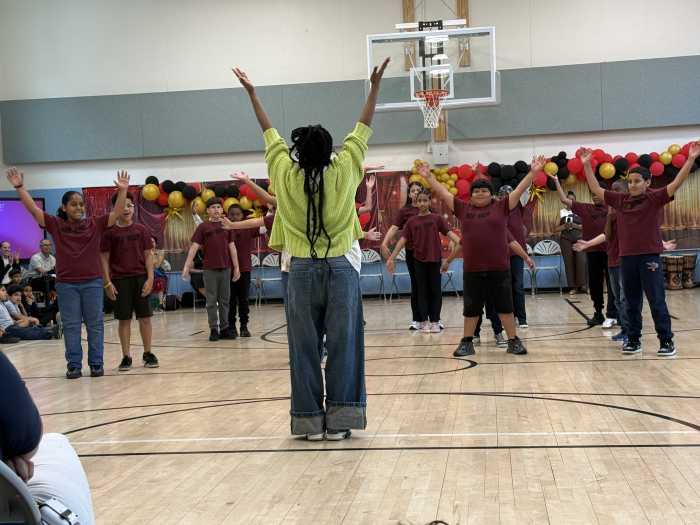 PS 246x 5th graders performing Hip Hop with teaching artist Imani Arrington.Photo courtesy Accent Dance NYC
Accent Dance NYC, which Ziegelman founded after practicing law for decades, has worked with around 30,000 students across 26 partner schools in every borough since 2018 ranging from eight sessions to full academic years.
They recently completed a residency at Central Park East High School in East Harlem and after a ballet and Latin dance residency, taught by Sofia Ferero, presented 21 third to fifth graders from PS 132 in Washington Heights at United Palace.
“This is all the classes, both genders,” Ziegelman said of the PS 246 sessions and show. “The boys too, because of cultural connections. We’re very specific about dance styles. The boys feel connected to the African dance, Hip hop. We have Flamenco, which can be very masculine.”
Principal Andrea Johnson called the day “an amazing show,” adding she was happy for the “beautiful artistic involvement.”
Kim Johnson, Accent Dance NYC’s director of educational programming and assistant artistic director, talked about instructors’ and students’ work “to make it all happen” from the youngest to “fifth graders bringing it home with Hip Hop.”
The Flamenco started with music joined by clapping hands, stamping feet and choreographed movements.
“Flamenco is always a big ensemble. Normally, you’ll have at least one percussionist,” Flamenco instructor Ricky Santiago said. “They had the skirts, the boys had their pañuelos on.”
Ferber said students are educated through experience, learning to trust themselves as they build confidence.
“They’ve been doing West African dance, learning the culture and tradition,” he said. “They’ve been learning how to build community and work together.”
Dance instructor Elisa Toro Franky, near a wall adorned with red, black and gold balloons, provided an additional educational element about the Cumbia dance.
“We combine cultural roots, African, Spanish, and indigenous. All of them together make the Cumbia,” Franky said. “This choreography has contributions from our students.”
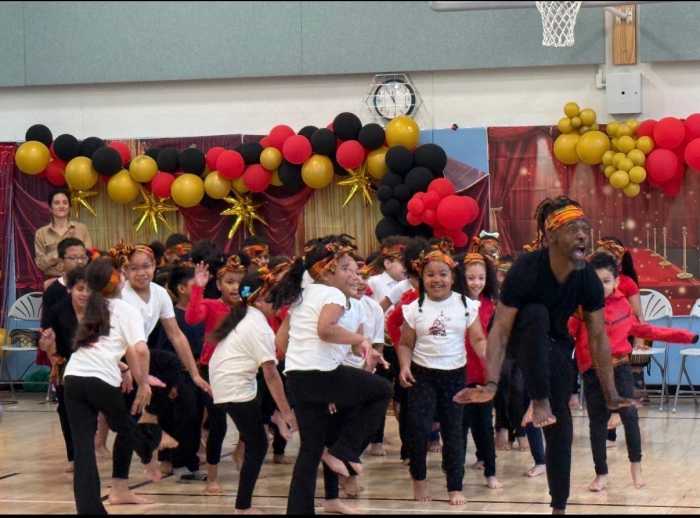 Accent Dance NYCPhoto courtesy Accent Dance NYC
Imani Harrington, Hip Hop instructor, threw in a few words about the Bronx’s history as the home where Hip Hop began.
“A fun fact about Hip Hop is it was born and raised in the Bronx,” she said. “They will be doing today the dances of the 1990s and 2000s.”
If the program, funded by a grant, was designed to entertain, it was emphatically educational in a way students, teachers and parents seemed to enjoy.
“This is not a typical day at school, but it is typical for the school to incorporate arts programming in the curriculum,” Ziegelman said. “I’ve been connected to the dance since I was a little girl. For me, this is coming back to something I love.”
Fourth graders said they practiced on their own and together. “I practiced all the time, at lunch time,” one student said, while another added. “I also practiced at home.”
They talked about cultural connections to well-known singers whose music they danced to. “I felt a connection with the music,” one student said. “It was really special for me to dance to the song of Celia Cruz. She was the queen of Salsa.”
Ziegelman founded Accent Dance NYC, named due to cultural as well as dancing connection, in 2018 after practicing law for 30 years.
“This is one of our first school partners. We’ve been here every year since we started,” she said. “I was a children’s advocate as a lawyer, so there is the connection to helping kids.”
She said “we’re made to dance from the time we’re little,” making young age a perfect time to teach and learn dance.
Ziegelman, who grew up in Detroit, believes her background as a lawyer comes in handy. “I think it helps to be a lawyer in terms of running an organization, a nonprofit, and growing one,” she said. “As a dancer, I can connect to the dance.”
Four teaching artists worked with students during the 10-week PS 246 residency that was an example of knowledge in motion.
PS 246 Community Coordinator Patricia Smith said Accent Dance NYC provides “meaningful experiences that extend beyond the classroom” with a “lasting impact.” “When we’re open, they’re open to learn,” Assistant Principal Vanessa Prince said.
Instructors said students stepped up as well as learning steps. “They did great,” Santiago said. “This was their first time in the gym and they did fantastic.”
Ziegelman beamed after the show, someone who found a way to combine a love of dance with a desire to help children.
“It’s education through an understanding and appreciation of culture that goes to the heart of who we are, and our humanity,” Ziegelman said. “It’s the essence of what we teach.”