
To describe Dean’s as a British pub is to invite dispute.
The Britishness is certain. Jess Shadbolt, the chef, was born in London, raised in Essex and Suffolk, and weaned on Marmite, the extravagantly salty, glossy brown goo invented in England in the early 20th century using yeast left over from brewing beer.
The pub part is where things get tricky. The chummy space on the western border of SoHo — next door to the breezily elegant, Mediterranean-leaning King, run by Ms. Shadbolt and her partner at Dean’s, Annie Shi — is neither Victorian in bones nor equipped with a moldering carpet, broken jukebox, dog napping in a corner or drippy tap in the loo. You do not have to place your order at the bar; servers come to your table.
Points in favor: a dartboard without darts. Curtains at half-mast, to afford privacy from nosy parkers in the street, while still letting in light. Pewter tankards hanging on the wall. Two-part, two-minute pours of Guinness, in imperial pints. Blood-red bottles of Sarson’s malt vinegar, the essential sloshing for fish and chips.
Because of course there’s fish and chips, no-nonsense and close to faultless. The fish is hake, soft and flaky, still succulent inside its golden coat. The batter gets a slug of Old Speckled Hen pale ale, for a biscuity tinge, and crisps up into nubby frills, every tiny crag and nook another crunch.
The chips are the same shade of gold, all fracture and fluff. Ms. Shadbolt has had to adapt to American potatoes, which, she told me, she finds sweeter than their starchy British cousins. She cooks them three times — blanch, confit, deep-fry — to heighten the final crackle while protecting the tenderness within.
Mushy peas are a chip-shop staple, traditionally made with marrowfat peas aged and dried on the vine, then boiled to near-obliteration. Ms. Shadbolt goes with fresh peas, for a version that’s as green as the playing fields of Eton. If a dish could be the song of the summer, this is it.
Nothing strays too far from its origins. A plate of boiled ham (really just gently poached, with the warming sweetness of star anise) comes with lashings of a parsley béchamel that vies in richness with the mashed potatoes below: unbeautiful and fortifying. Quail Scotch eggs are not some twee miniaturization but the Scotch egg perfected, the smaller scale permitting a finer calibration of pork to egg.
Some British delicacies do not quite survive translation. In pork scratchings, the skin is cut into long skinny strips and roasted under a weight. This is meant to be hard, the opposite of puffy chicharrones — but surely not so hard that it’s inedible?
Crisps in brown paper bags turn out to be game chips, wafers of parsnip and beet meant to accompany roasted grouse (sadly not currently on the menu). They are pleasant, if unmemorable.
Ms. Shadbolt originally conceived of Dean’s, which opened in March, as a fish-focused restaurant. Growing up, she spent holidays on pebbly Aldeburgh Beach in Suffolk, and as a teenager befriended one of the last dayboat fishermen in the area, Dean Fryer, for whom the pub is named.
The menu is broader now, but still leans seaward, with scallops that would be a standout on any menu, pub or not, ornamented by chunky salt bombs of lardons, and plump oysters, genial vehicles for a mignonette of English sparkling wine, racy and sharp.
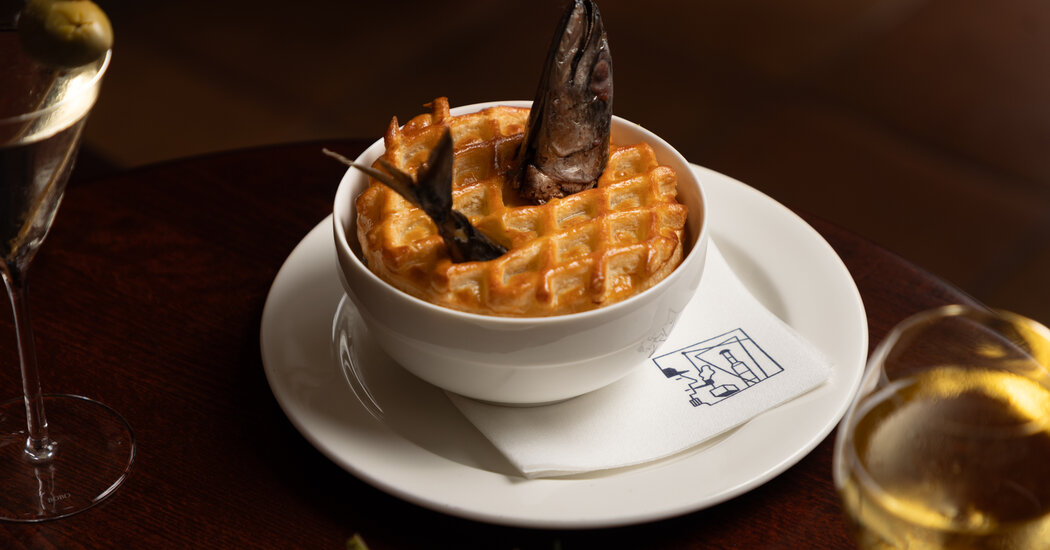
There must be pie, and here it comes, with the startling head and tail of a mackerel breaking through the crust, eyes white as pearls. This Cornish wonder, called stargazy pie — the real thing would have multiple fish heads, tilted up to accuse the heavens — is a fakeout: The crust is just a roof and the fish below is mostly scraps from the fish and chips, simmered with carrots, leeks, potatoes and a douse of English cider. The flesh of the hapless mackerel is in there, too, confited and flaked to tame a little of its oiliness. I only wished there were a proper crust at the bottom, to soak up the lovely stew.
British food has long been maligned as soul-crushingly mild. Ms. Shadbolt puts paid to that, delivering smart jabs, like the inky brined unripe walnuts — a pub staple — bringing verve to blushing panels of cold roast beef.
And the glory of Marmite! It appears as a dark ripple through butter, its dregs-like savor barely mellowed, frank as Stilton cheese. This is paired with porous but hearty slabs of whole-wheat bread, made in the style of Ballymaloe Cookery School in Ireland, where Ms. Shadbolt trained, with big, chewy seeds studding the crust. Her addition to the dough: a spike of Guinness, lending a roasty bitterness. Not bad at all.
Bubble and squeak is one of the world’s great onomatopoeic dish names, if a bit of an overpromise for what is in fact cabbage and potatoes, chopped and pressed in a hot pan. Ms. Shadbolt livens it with leeks and rutabaga for sweetness, binds it all with English Cheddar, then seals it inside an expertly crimped pasty.
The filling is steamy and vivid, and tastes better than cabbage has any right to. You might understand why, in the classic children’s book “The Wind in the Willows,” the scent of bubble and squeak is enough to revive the languishing Toad, persuading him that “perhaps life was not such a blank and desperate thing.”
Desserts are light: lacy brandy snaps rolled around chocolate crémeux and whipped cream; a steam pudding possessed by ginger; and best of all, a palate-restoring posset (a Middle English word for something curdled) of nothing more than heavy cream, sugar and lemon, naturally set, under a shivery-clean elderflower jelly, harking back to England’s hedgerows.
My grandfather ran a pub in Liverpool; the family lived upstairs. This food should be my birthright. But I grew up in Hawaii, half a world away, and encountered the cuisine only on visits and in my father’s regularly replenished stocks of Lea & Perrins and frozen peas. So I recruited a British friend to dine with me at Dean’s and offer the view from across the pond.
She approved of the Marmite butter, the mushy peas and the fish and chips. Still, Dean’s struck her as more restaurant than pub. It hasn’t yet attained the communal feeling of a true public house. How could it, as the latest hot spot in town, so clamorous some nights you can’t hear the person across the table?
But eventually the novelty-seekers will move on, and the regulars and locals will be left, racking up their pints of Guinness. There’s a running contest for who will reach 500 pints; the prize, your name engraved into a pewter tankard. (Ms. Shadbolt said she wanted to set the goal lower, at 100, but was advised that “the Brits could get there in an afternoon.”) Someday the bartender might even call you “love.”
Ms. Shadbolt has plans to introduce Sunday roast and more pub fare. She recalled a spot back home where she was once served cubes of cheese on a mound of Mini Cheddars, coin-shaped cheese biscuits riddled with holes. One nation’s comfort is another’s exotica, or even weirdness. “I think it would scare New Yorkers,” she said.
Well, shouldn’t we be scared, every now and then?
Ligaya Mishan, our chief critic based in New York City, writes starred reviews of restaurants in New York and beyond. Tejal Rao, our chief critic based in Los Angeles, writes starred reviews of restaurants nationwide. Briefer starred reviews of New York restaurants are written by our contributing critics Mahira Rivers and Ryan Sutton, and first appear weekly in the Where to Eat newsletter (subscribe here).