
Miniature
My visit to LACMA coincided with a Charles Ray show at Jeffrey Deitch where Firetruck (1993) was on view. A toy firetruck scaled up to the familiar size of a real fire truck. But it is not a real firetruck, rather it is an absurdly large miniature. This scalar abstraction separates form and image from absolute size. When a familiar miniature grows to the size of its parent object, it emphasizes an ambiguity of size. Scalar instability is its form of abstraction. LACMA shares precisely this quality, a scaling up of the model that renders the experience unfamiliar and abstract. This kind of strategy allows the new LACMA building to feel non-reactive to the messy specifics of any given moment.
In all of my encounters with the new building, the architecture models produced by Zumthor’s atelier kept coming to mind. Few architects really design with models, most just produce models to express general ideas about form and organization. Zumthor said in our interview, “If we make a model and show it to the client they will inevitably say, ‘Aha, a model.’ But if we show the client a photograph of the model—a good model, that is—even if you can tell it’s a model, the client will say ‘Is this real?’” The translation from model to building is typically an evolution, where the executed building expresses more detail than the model that came before it. But at LACMA’s new building, the model becomes the ambition of the executed building. This is one of the building’s great successes, a type of abstraction related to the scaling of a model making process and the preservation of the qualities of a miniature at full scale.
The experience of the building emphasizes its absolute size, but its construction details illuminate its blown-up qualities. The glass and mullion construction is simplest to elucidate the point: all of the window assemblies appear as simple glass panes between regular brass mullions. They do not open, they don’t have vents, they feature very little hardware. But their actual size is shocking, at the base 7 feet wide by 25 feet tall, approximately. This is terribly impressive when you consider it is in earthquake territory, but at LACMA they appear casual and obvious. This is the self-similar logic of scaling up from a model. The building is formally complete and internally consistent, but scale-indeterminant. Big buildings have lots of functions, small ones are object-like. This is neither. It holds its form through scaling, the model made real. The building’s size becomes fluid and its effect is a suspension of reality—that you are occupying something that only exists at a distance.
Art
How does the building and the institution handle its most precious occupant, the art? The entire collection is on a single continuous floor, presenting an encounter that is extreme and impressive. I’m sure the two decades of conversation between the Michael Govan, Zumthor, and the museum’s curators has been a fascinating one. One way to make art accessible to an audience is to trust them. From Govan: “I have always been skeptical of describing history.” Under this agenda, LACMA shows real confidence in the artifact being interesting on its own. Every work is presented in a field. I expected the building to feel linear, but instead it is a constellation of radiating spirals.
The organization of the encyclopedic collection is simple: four oceans organize the entire history of art: the Pacific, Atlantic, and Indian Oceans, and the Mediterranean Sea. Zumthor said in our conversation, “Since encyclopedic collections only contain a small portion of work from each time and place, the work has to be so archetypically strong that it conveys to us something of that time and place it ostensibly represents.” This is a complete faith in objects without needing to describe or even situate them in broad contexts such as dates, movements, or regions.
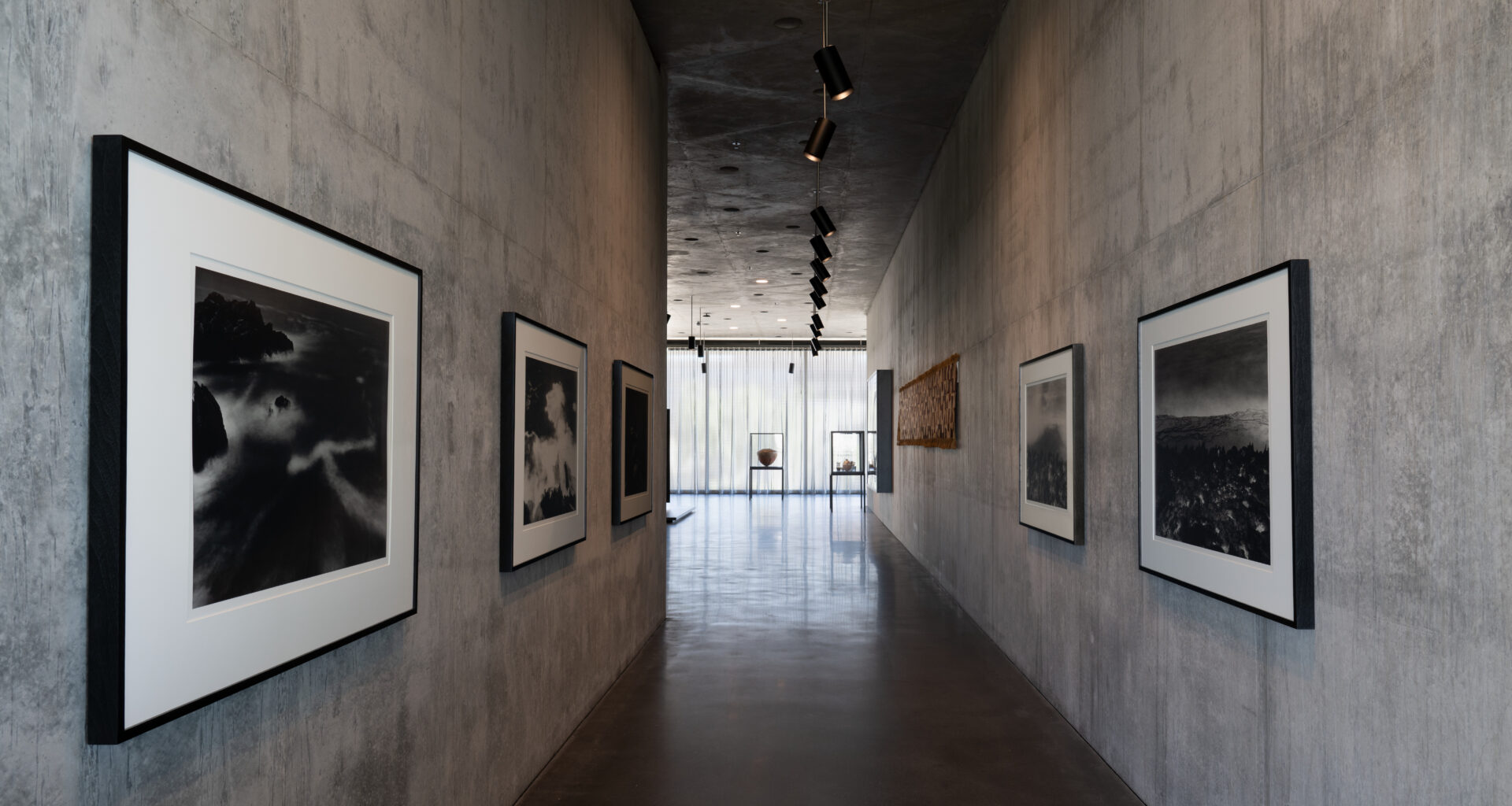
The openness of the museum and its display creates an alchemy between works. You can see great distances through the museum, noting to yourself how to find your way to a piece later. You’re gravitationally attracted from one thing to another based purely on their color, silhouette, material, frame, or image. Groupings of similar objects provide material context: first you find an object and only later a minimal wall text. The act of mediation creates a void between object and viewer. Objects are there for you: you are not told what draws you, but instead you choose. This museum provides self-fulfillment (self-determination) to both artwork and viewer. Exploring the museum you find your idealized self, unbounded and free, grounded in the artworks that prove such freedom is possible.
Distance
Just as the David Geffen Galleries have faith in their artwork, LACMA as an institution has shown faith in architecture. It is a defense of architectural form in a time when museums rarely discuss architecture as such. For this, I would like to evaluate this building in the most profound ways possible, philosophically rich, spatially immediate, fulfilling its functions. This evaluation summons important questions outside of contemporary platitudes and symbols. What is a museum? What is museum architecture? Can architecture be a medium itself or is it constructed of many mediums? What is at stake when we build?
At stake here is nothing less than all of architecture. As an attempt at a monumental work, we must come to terms with the state of the contemporary. The surprise is that LACMA’s new expansion has none of the contemporary dialectics we might be familiar with—no overt presentation of problems, program, crisis, community, nostalgia, urbanism, or complexity. This LACMA building cannot be understood simply by description or experience. It offers the medium of architecture itself as the answer. It demands to be called new by summoning its own confidence to stand still. Its success is that it is not present, or at least it’s somewhere far off. Mediation becomes its encounter. Size its pleasure. Distance is its leading gesture, creating an expansive space between now and then, between art and ourselves, between architecture and society, between Los Angeles and its museum. It makes the continuous present available to us by making room for it.