
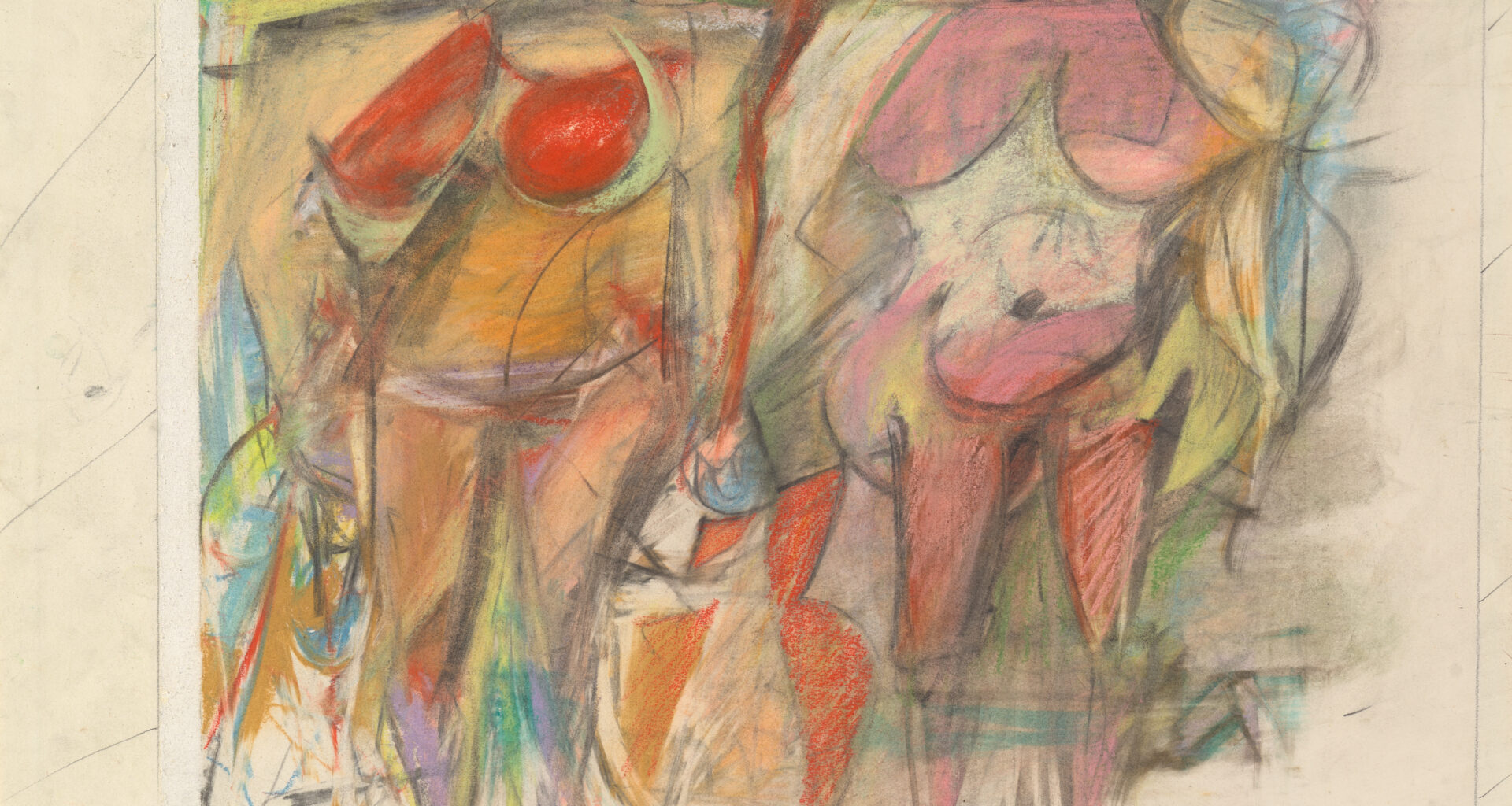
Willem de Kooning Drawing
Art Institute of Chicago
June 14–September 20, 2026
Chicago
The timeliness of this exhibition, Willem de Kooning Drawing, at the Art Institute of Chicago is profoundly prescient for one simple reason: the presiding notion of hard-won freedom, being the most essential among human virtues, which must be earned through, or achieved by, courage. That is, in the words of Aristotle, “He is courageous who endures and fears the right thing, for the right motive, in the right way, and at the right times.” It seems at the outset of his career de Kooning was determined to mediate his own monumental anxiety. Insofar as de Kooning consistently confronted his own anxiety, he also knew that once properly harnessed, it could heighten the awareness and emotional sensitivity that he used to fuel his work with boundless vitality. Again, from his famous declaration, “the desire to create a style beforehand is a mere apology of one’s own anxiety,” one can only suspect that de Kooning must have felt that instead of fleeing from his own anxiety, he instead deemed it necessary to embrace it as an indispensable part of his whole realm of life experience. For in confronting each of his works, be it a drawing, a painting, or a sculpture, it simply meant that he had wholeheartedly accepted his own perpetual feelings of desperation, uncertainty, and, above all, failure.
Like the landmark de Kooning: A Retrospective at the Museum of Modern Art (2011–12) that was curated by John Elderfield—and included nearly two hundred works, across multiple mediums, approximately one hundred and twenty paintings among them, spanning over six decades of the artist’s career—this retrospective, curated by Kevin Salatino and an ensemble of extraordinary associates, including Mel Becker Solomon, Charlotte Healy, and Margaret Holben Ellis, gathers one hundred and seventy drawings, along with eleven paintings and twelve sculptures. Through the impressive execution of this collective vision of curation, the exhibition shares the evolution of the artist’s lifelong practice of drawing and how it relates to his painting and sculpture. Together, the curation generously guides our viewing experience as we traverse through the exhibition chronologically. Not only do we get to witness firsthand the conceptual and emotional significance of drawing to de Kooning’s pictorial thinking, but we also see and feel how visible the anxiety was and the role it played in his search for form, content, and matter. Which is to say, de Kooning’s perspective on his own artistic success was inseparable from his attraction to failure. To remain allusive and evasive from his made objects, be it drawing, painting or sculpture, seems to be the philosophy of his truth.
Like good writing, which aims to convey what the writer has discovered in their subject matter to both the writing community and general readers, this exhibition has achieved a similar and rare balance between the hermeticism of art historical scholarship and the generosity of viewership’s accessibility. Namely, it is neither spoon-feeding nor condescending to any viewing experience. This, of course, requires a curatorial strategy that necessitates considerable time, resources, and thinking, which can accommodate both the larger concept of what the exhibition desires to attain for the artist’s legacy, and the precise detail that is needed to enhance such an objective. The exhibition, with the Willem de Kooning Foundation’s unwavering support, is the result of over five years of rigorous labor—including research, field work, conservation, and collection studies—which is evidenced in all its viewing aspects. For example, upon entrance, de Kooning’s landmark painting Pink Angels (ca. 1945), although in the second gallery, is purposefully installed with a direct line of sight to the painted wall segments throughout the exhibition that are accentuated with the artist’s famous pink color. Then, installed between Seated Man (ca. 1939), and Queen of Hearts (1943–46) in the first two galleries, are his early academic drawings, such as the exquisite Dish with Jugs (ca. 1919–21). The drawing took the young de Kooning two years to complete, and it is shown alongside seven illustrations that are here displayed for the first time, of various social interactions that are each rendered in a variety of styles (1924–25). They at once reveal both the artist’s infinite studiousness and his humorous nature.
It’s worth mentioning that when de Kooning arrived in New York City in 1926 at age twenty-two, the artist already (between 1916 and 1925, from age twelve to twenty-one) had gained apprenticeship with a commercial art and decorating firm, and a year working in the field. At this same time, he was attending night classes at the Rotterdam Academy of Fine Arts and Techniques where he was studying drawing and the applied arts. Whatever skill and discipline the artist gained in these formative years seemed to continue as a lifelong mediation of his capacity for self-restraint, which he balanced with his appetite for expressive freedom. However, the latter would only fully manifest at his second solo exhibition at Sidney Janis Gallery in 1953 when the artist was forty-nine years old. I discovered how fascinating it was to see the equal care and attention de Kooning had invested in the most subtle yet forceful linear deployment in both his drawing of the figure—as seen in several examples, including Working Man (ca. 1938), Elaine de Kooning (ca. 1940–41)—and his abstraction, such as Study for “father, Mother, Sister, Brother” (ca. 1937), Study for Mural in Hall of Pharmacy, New York World’s Fair (ca. 1937). Leading to the years between 1938 and 1945, some of the most compelling drawings and mixed media on paper were made in the service of overcoming the fear of his own dogma. Similarly, we can see the breadth of his range in the two versions of Seated Woman (1941) and Seated Woman (ca. 1943). In the former, a choreography of lines was carefully orchestrated to achieve his ideal of asymmetry in human form, without either the systematic fracture of Cubism or the literal distortion associated with Surrealism. This reflects that while de Kooning was deeply invested in the flattening of form, he sought a way to do it without rupturing his sense of traditional modeling. The exact same can be said of these two paintings, except that the velocity of impulsive lines is used to contradict his aspired classicism. It’s clear that the artist knew he had to make a concession, insofar as he understood that the speed of his gesture could reach certain degrees of consistency and fluidity within the networks of his curvilinear flourishes, which could expand them while filling the picture plane frontally. In other words, what appears in both Still Life (ca. 1945) and Study for “Pink Angels” (1945) is his unrelenting search for maximum freedom. Here within the shapes that he deployed, de Kooning demonstrated that they could evade literal translation while proving efficacious in creating the iconographic images that genuinely evinced his own style in-the-making. It was during this period that de Kooning seemed to have achieved one of the most original pictorial inventions in the modernist idiom: namely, his technique of drawing charcoal onto the oil-painted surface. In addition, de Kooning’s so-called whole-arm gesture exceeded the late drawings of Henri Matisse that led to his cutouts, which were being made at approximately the same time.