
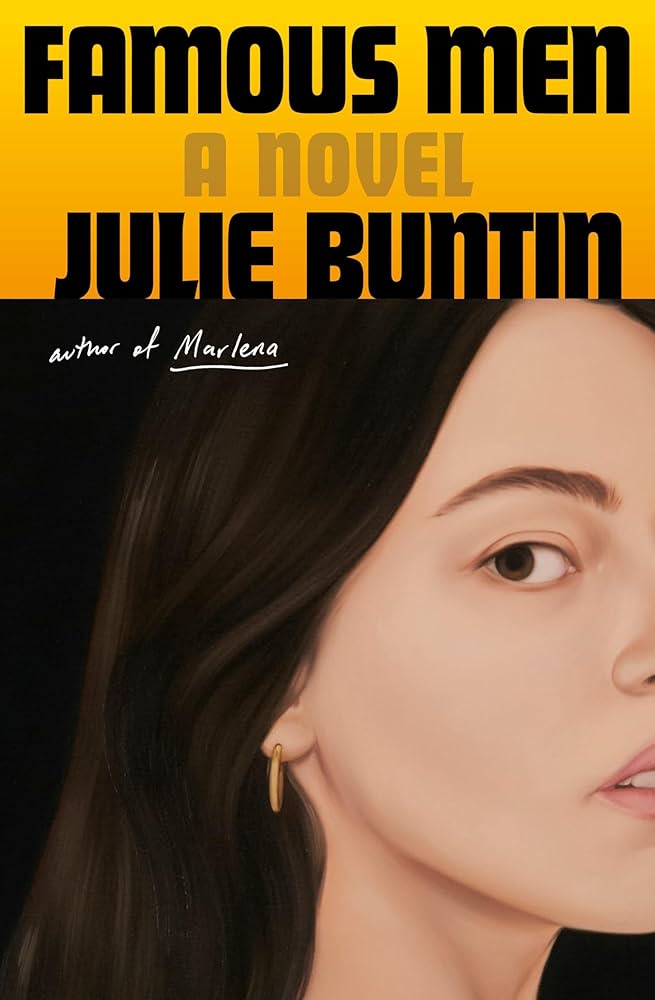
Julie Buntin
Famous Men
Random House, 2026
Will Miles is a young girl from Northern Michigan that is used to stories being told about her. She is a meek wannabe-writer, starting fresh in New York. She is a young woman that finds herself malleable in the hands of Nathaniel Fellow. Of course she is, she has read his work—every printed word. Famous Men tells the story of a woman committed to becoming a writer and finding her voice in the #MeToo era. Talking with Julie Buntin about her characters felt like talking about our mutual friends. We also chatted about Phoebe Bridgers, parasocial relationships, the way time moves in New York, and breaking the rules in storytelling.
Hannah Burns (Rail): So I need to talk about the second epigraph as a Phoebe Bridgers fan. I’m starting from the very beginning, the quote from “Scott Street”: “Do you feel ashamed / When you hear my name?” I’d love to know why you picked it and how you felt like it resonated.
Julie Buntin: Yeah, it’s funny. Epigraphs are kind of magical, right? I work with MFA students in my day job, and sometimes students will say, “I’m looking for my epigraph,” or “I’m trying to find an epigraph for my book.” And I always get a little tingle of anxiety when they say that because in my experience, you don’t go looking for your epigraph, you experience your epigraph in the world, and then experiencing it makes you realize something about the project that you’re working on. And I liked that question, at least for the characters in the novel. It can apply to a lot of different characters and a lot of different moments in the novel. It very straightforwardly speaks to maybe one relationship, but it also can kind of speak to other relationships too. So, yeah, part of the thrill of writing a novel for me is that moment when your epigraph finds you and you’re like, “Oh, there it is.” And also now I know a little bit more about what I’m doing and how I can get to the end of it.
Rail: Yeah, I think that’s totally true, that it finds you and becomes incorporated in the work. I think that’s how you know it’s a good epigraph.
Buntin: It felt tonally appropriate too. I also do have a soft spot for epigraphs. Well, most people say one is enough, but I like when there are two and they’re sort of different registers.
Rail: Hell, I even like three. If you put four epigraphs in, I’m eating that up. I could take one in the beginning of every chapter actually. Yeah. I’d be a fan of that.
Buntin: I also think it’s one way of knowing if you’re stylistically aligned or aesthetically aligned with the writer in advance. If you open up a book and see an epigraph that tickles you or that is something you too like, you can have a sense of like, okay, maybe we’re on the same page here in some manner…
Rail: Continuing the Phoebe Bridgers thread just for a moment, I want to talk about the part of the book where Will meets Nathaniel for the first time. You write: “Here he was, not a character I’d invented, but a man, a person I knew nothing about except for what he’d made publicly available. I felt, in a word, mortified.” This exchange really made me think about the concept of being a punisher, and this initially parasocial relationship between Will and Nathaniel. I wondered if you have resonated with this fan behavior or devotion, you know, in a personal way.
Buntin: I feel like the conversation about parasocial relationships was kind of bubbling up in culture during the time that I was writing this book. It surely did seep into my awareness of the novel, but I also feel like I wrote this book at a time of great isolation from the culture. I started this book just before COVID. I wrote a lot of the first, early drafts during deep COVID times when I was also living in a new city where I knew nobody and also had no ability to make friends. And then I was also pregnant or postpartum for the rest of it, two different times. So I was sort of only distantly aware of things, yet still, in my way, taking stuff in.
But I was not, growing up, a person who had really intense sort of fandoms around musicians or actors or things like that. But I did, I have always, and still probably, maybe I don’t know if I want to admit this on the record… sometimes I still have this feeling of reading a book, discovering a text and feeling a really strong sense of connection or intimacy with something about the book, which can kind of extend to the writer a little bit. A sense of like, I know who you are, or we understand something about the world in the same way, or you said the thing I’ve always wanted someone to help me understand, and now we are connected forever. I have had a very powerful kind of relationship with texts like that. And I certainly was kind of drawing from some of those feelings and thinking about Will, and thinking about just how intense that can feel, especially if you don’t have any kind of mitigating factors in your life to keep you from pursuing that all the way.