
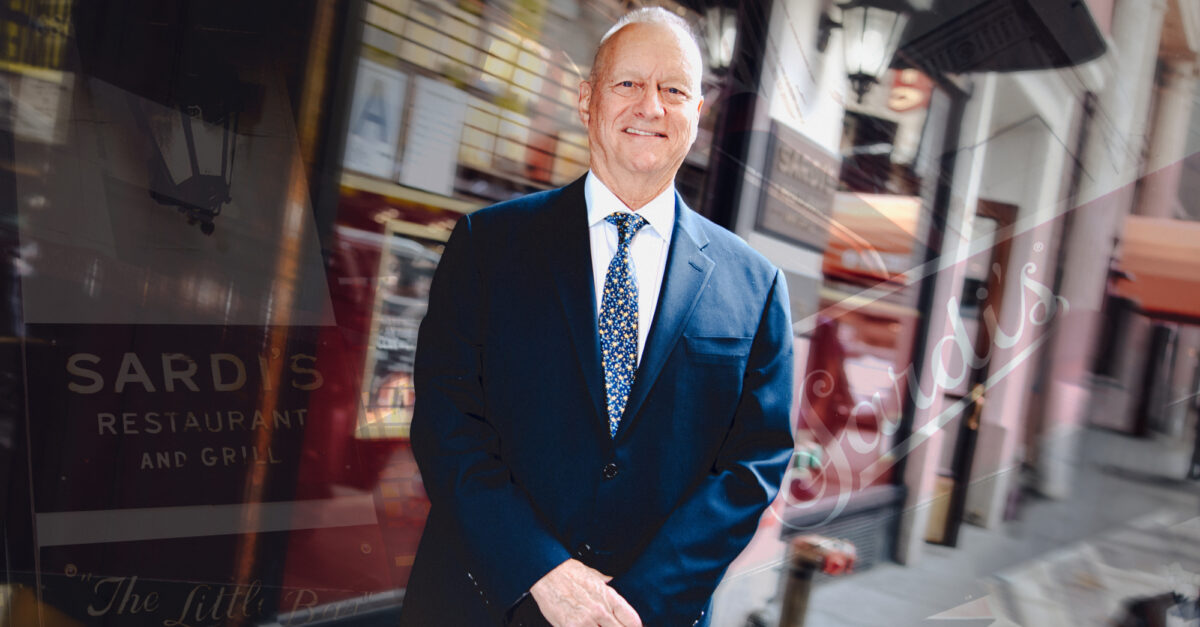
In 2020, Sardi’s owner Max Klimavicius almost died. It was the early days of the COVID-19 pandemic, before anyone knew how it spread or how to diagnose it. “I was very ill with COVID, it was touch and go for me,” recalls Klimavicius, who added that his wife kept him at home, fearful that if he went to the hospital and was put on a ventilator, he would not come back out. “We lost a number of workers here.”
But Klimavicius’ near-death experience made him realize life was short, and since 1974, he had spent a lot of it at Sardi’s—visitors to the restaurant regularly saw him in his white uniform surveying the dining room (and in conversation with Sardi’s regulars). But as the longtime restaurateur puts it, “I’m 72 years old, and I realized that life can change in a second.” In other words, it was time to stop missing birthdays, weddings, and other family events—it was time to live his life. So earlier this year, Klimavicius made the decision to sell Sardi’s to Broadway producers/landlord The Shubert Organization, who are now the new owner of the restaurant (with La Masseria Group as the operator).
Sardi’s is a Theatre District institution that first opened in 1927 by Vincent Sardi, Sr. and his wife, Eugenia. From then, it was a frequently attended spot by theatre workers and luminaries—the opening-night party for Rogers and Hammerstein’s Oklahoma! was held at Sardi’s, and it was at Sardi’s that the Tony Awards was dreamt up. Its walls of portraits and caricatures is New York’s answer to the Hollywood Walk of Fame, immortalizing the many stage stars who have graced Broadway and sat in the red plush seats of Sardi’s. Vincent Sardi, Sr. was a recipient of a 1947 honorary Tony Award for his service to the theatre community.
And to this day, Actors’ Equity union members working two-show days on Broadway can stop at Sardi’s for a half-priced meal (that policy is expected to remain under the new ownership).
After Sardi, Sr. and then Sardi, Jr. passed away, the person who took charge of maintaining Sardi’s legacy and ties to the Broadway community was Max Klimavicius—who was hired in the kitchen in 1974 and then worked his way up to eventually become a partner with Vincent Sardi, Jr. in 1991. Then in 2007, Klimavicius took sole ownership of Sardi’s after Jr.’s passing. Said producer Brian Moreland at a Sardi’s event June 23: “Max has not only managed Sardi’s, he has protected it, he has preserved its rituals, its warmth, its sense of welcome, and its deep abiding relationship with the theatre community.”
June 24 was Klimavicius’ last day on the job, before the Shubert Organization took over the restaurant and closed it for renovations—the restaurant will reopen in the fall, in time to celebrate its 100th birthday. But before he handed off the keys his longtime castle, Klimavicius sat down with Playbill in the bar area at Sardi’s and reflected on his own career in the theatre. Below, Klimavicius reveals how he didn’t know what Broadway was when he was first hired at Sardi’s, how he chose the celebrities for Sardi’s caricature/portrait wall, what is part of the renovations of Sardi’s, his retirement plans, and why “so long as there is theatre in New York, Sardi’s will be alive and well.”
This conversation has been edited for length and clarity.

Max Klimavicius
(Heather Gershonowitz)
Max, why are you retiring?
Max Klimavicius: It’s time. I’m 72 years old, and I realized that life can change in a second. The restaurant is at its highest that it’s been since I’ve been here, in 52 years—higher in notoriety, everything. Everybody’s back at the restaurant in this time, it’s a good time. And the fact that the Shubert Organization has acquired the restaurant gives me great happiness, because that ensures the continuity of the legacy of Sardi’s into the future. So this place will be here for another 100 years.
What would you say is the legacy of Sardi’s?
Well, Sardi’s is a theatrical institution that was founded by two immigrants that opened the restaurant in 1921, and in 1927 it moved to the present location [at 234 West 44th St., in a building owned by the Shubert Organization]. They treated their guests as family, and there is the connection between Sardi’s and the industry, the theatre industry. Vincent Sardi, Sr., who was the founder of the restaurant, was a vagabond. He left home at a very early age, he never had a family. So, when he opened the restaurant, this was his home, and he welcomed everybody as family, and that is a tradition that we still continue to today.
And you came here in 1974 from Colombia.
Yes, I was born in Colombia. I finished high school, and I came here to go to school. When I came to the United States, I didn’t know the language, so I had to learn English first, and eventually went to college. So, I found this job out of necessity, because I could work at night and go to school during the day. I got a degree in business administration.
What made you stay here?
Well, I have to say that the first time I ever walked through these doors, I had no idea what Sardi’s was about. I had no idea what Broadway was about. And I fell in love with the place. And it’s a love affair that stays strong today.
I’ve had just every job here. I started as a kitchen help. And then from the kitchen, I moved to the dining room, and eventually I became the manager, maître d’. I became a partner in 1991, and eventually I was able to buy out the restaurant.
What made you want to buy the restaurant?
Well, I was in love with the place, and this is an opportunity that is very rare. I had the great fortune that I had a very good relationship with Vincent Sardi [Jr.], who was sort of my surrogate father. Eventually, he allowed me to buy the restaurant out of earnings, which is something that doesn’t happen today.
What do you think has made this restaurant last, because so many family restaurants have closed?
It’s the marriage to the theatre; it is a marriage that is very strong today. And so long as there is theatre in New York, Sardi’s will be alive and well. We’ve had our tough times when COVID happened, we were closed for almost two years because there was no theatre. But our business is like a revolving door, where every season there is new shows—shows go, shows come, but people keep coming. It’s a perfect location, and a perfect marriage.
And I didn’t know what theatre was about when I first came here. So I came to appreciate what live theatre is; there is nothing like live theatre.

Jonathan Groff and Max Klimavicius
(Heather Gershonowitz)
What’s your favorite Broadway show?
I would have to say that Phantom of the Opera is, because of the whole package: music, staging, the whole package together. To me, it’s the best show ever. It was a groundbreaking show, because the chandelier coming down from the ceiling was a spectacle that was never seen before, and they broke the mold. And after that came Miss Saigon with the helicopter, and so on, and so on.
Can you tell me the history of the portraits, which used to be caricatures?
So, the tradition started in 1927, as a way to try to drum up business. Vincent Sardi made a deal with an artist [Alex Gard], a Russian caricaturist that would draw the caricatures of the famous people that came to the restaurant in exchange for two meals a day. And at the time, they were true caricatures, they were not flattering, and many of the subjects didn’t like him. Back in those days, the artist chose the subjects, and we had nothing to do with who went up on the wall. It was up to him. Even after the restaurant started doing better, Vincent wanted to pay him for his work. But he didn’t want to change the agreement, so that’s the way he did it until he passed away.
After he passed away, we had three other caricaturists. The last one has been doing this work for us since 1975. His name is Richard Baratz, and he just retired. He worked for the government his entire life. He was an engraver for the Treasury Department, so he worked in the steel plates, the bonds, and the money. When he first started, those were true caricatures as well. But then we decided to evolve more into a portrait, because we didn’t want to get people upset. A lot of them were upset as to the exaggerated features that were added to the drawing. We felt that since it’s such an honor and people are looking forward to this, we decided to evolve into a portrait.
How do you determine who gets them now?
Well, they have to be friends of the house. The main criteria is they have to come in. And so then, we approach them and ask them if they want to be part of the collection.
Do you go to a show and think, “Oh, I want their portrait on these walls?”
No, they have to frequent the place. They don’t necessarily have to be a star.
How many times do they have to come here before they get one?
Well, there is no such a thing as how many times they have to come. They have to frequent the place. Once you come to this place, you can’t stop coming back. Because of the ambience and the treatment that you get from everybody that works here.
Do you think you’ll get a portrait here?
I’m not looking for a portrait. That’s not my craving now.
How do you determine who gets to be down here [on the first floor]?
We switch out, we move some around. First of all, we have started retiring the very old ones that people don’t recognize anymore. Don’t forget, we’ve been doing this since 1927, so we have approximately 1,300. We do about 30 a year. So we need the wall space.
Where do they go?
They go in a vault. They’re now going to reside at the Shubert archives.
For Blue Moon [the 2025 film starring Ethan Hawke playing Lorenz Hart, and which took place entirely in a recreation of Sardi’s], did you consult on the design of the set?
Yes. What they were able to accomplish was to recreate the Sardi’s of 1943. And to do that, they had to copy caricatures that are at the Billy—you know, I must say that the first 230 caricatures that were made, Vincent Sardi donated to the theatrical museum at Lincoln Center, the Billy Rose [Theatre Division], that’s where they are today.
And it was very challenging because, as you know, Ethan Hawke is 6’3,” and he’s playing a five-foot-tall man. So, they recreated the set in Dublin, and they had trenches on the floor—so when Ethan was walking with people, or was talking to people, standing up, he was five feet tall. It was an incredible undertaking, but they came very, very, very close to the Sardi’s of then.
But if you notice, the portraits in the movie don’t have the color—back then the caricatures were dull, they weren’t as vibrant as these are [in the film].
READ: Ethan Hawke and Richard Linklater Share Blue Moon’s Easter Eggs for Broadway Fans

Ethan Hawke in Blue Moon
(Courtesy of Sony Pictures Classics)
What were the conversations like to have the Shuberts acquire Sardi’s?
It belongs with them, because the Shuberts will treat this, not as a restaurant but as the institution that it has become. And they will preserve it the way I preserved it. That’s why I say to you that this place will be here for the next 100 years.
Do you know how long Sardi’s will be closed for renovations?
Three or four months. They’re going to do a lot of renovation, especially in the back of the house. The infrastructure needs upgrades—I’m talking about plumbing, ventilation, electric. And they’re going to change the kitchen equipment, as well. Don’t forget, our kitchen equipment is practically new because we renovated the equipment after COVID. But our kitchen is an old-fashioned kitchen, so the new operators are going to change the layout of the kitchen, and they’re going to change everything. Listen, nowadays kitchens have air conditioning, we don’t have air conditioning.
As far as the front of the house, the dining rooms, they’re going to remain pretty much the same—with the exception of the portraits, they’re going to be lit up. Ken Billington, who is a lighting designer, is in charge of lighting up the portraits. [Gestures to a portrait of Santino Fontana next to us.] You see that reflection [on the glass]? They’re gonna change all the portraits to museum glass, so they won’t have that reflection. It’s going to be good all around.
Was that the stipulation when you sold it to the Shuberts?
Oh, they know that better than me! They’re buying the iconic nature of this place. That’s so rare these days. These places don’t exist anymore.
How much did you buy it for, and how much did you sell it for?
My transaction with the Shuberts was not driven by money, but by the fact that this is going to be preserved. That’s my main intention, the preservation of this place, because this has been my life. So, money is not what drove me to sell to the Shuberts. I had other suitors [with more money], but not the preservation that the Shuberts are going to give the restaurant. That’s my legacy, as well.
What will you do now?
Well, I have a lot of plans. I’m going to do a lot of traveling. In July, I’ll be going to Scotland to play golf, in London to see a few shows, and Portugal as well.
This has been my home for all my adult life. It’s a lot of hours. It’s a dedication that not everybody is willing to do, that’s the restaurant business. And I’m fortunate that my family understood that and they have been supporters of what I do. And now, it’s time to enjoy my family.

Max Klimavicius
(Heather Gershonowitz)