
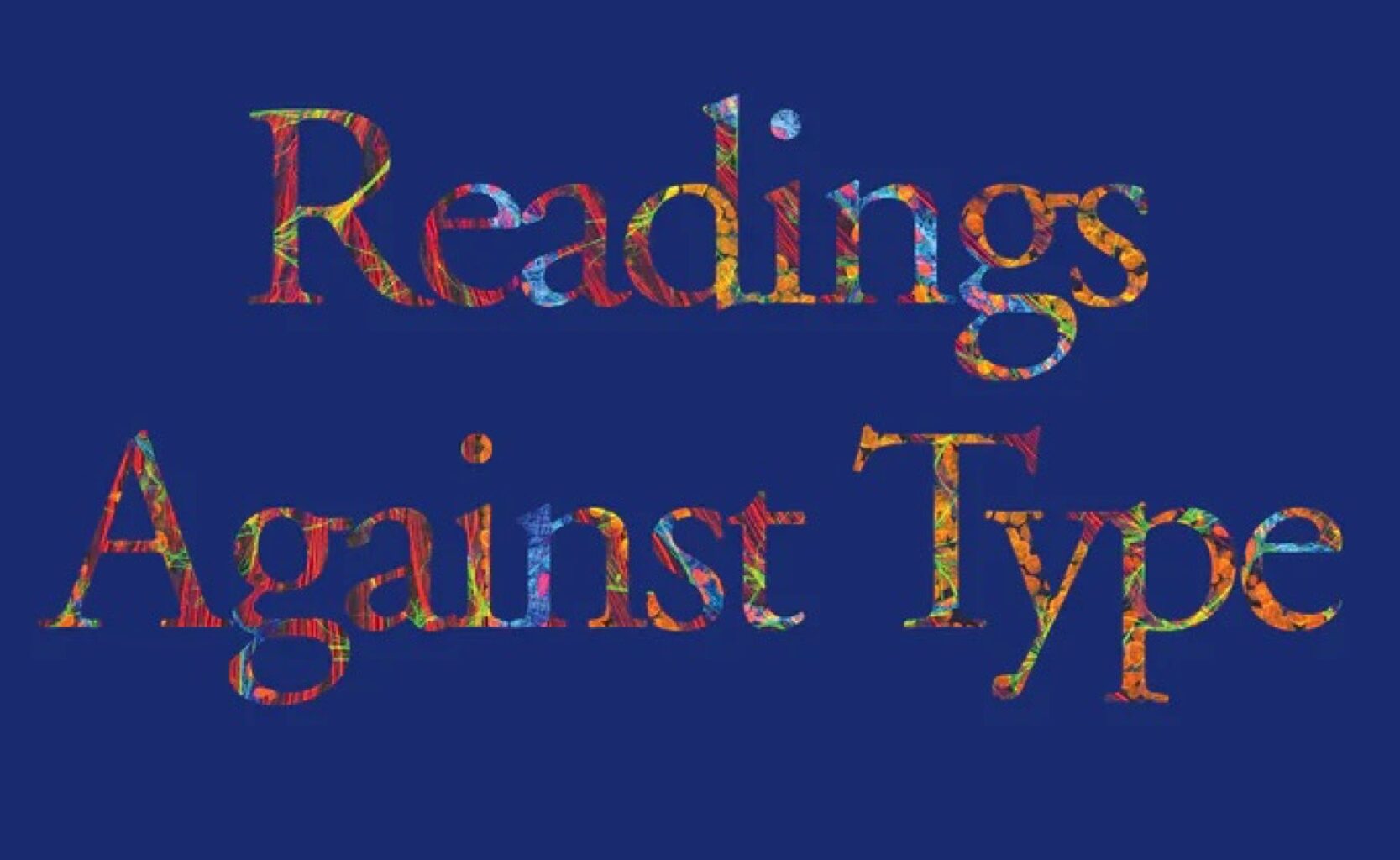
Albert Mobilio
Readings Against Type
MadHat Press, 2025
The strangeness—the thrill—I wrote, while reading Albert Mobilio’s Readings Against Type, of writing a literary review on a book of literary reviews. Though isn’t criticism indebted to exactly this interactivity and self-reflexive connectivity, the potential of a reading that is so up close that it pushes inwards, aiming, like a reverse-angle camera, on the body of work that now necessarily includes the reader’s, this iterative aerobics of reading? And to open up analysis, to treat our lives with/in the texts that pass through us—often in the very moment of interpenetration—is also to change what it means to read. Mobilio’s Readings Against Type, like its title signals, demonstrates how one might undergo the task, the invitation, of recalibrating not only how to read but what can be read, a hermeneutic intervention that questions the literary system itself.
Readings Against Type is as eclectic as it is extensive, gathering work from a thirty-seven-year period beginning in 1988 from a range of literary venues—The Village Voice, Hyperallergic, Tin House, Harper’s, Bookforum, the Paris Review—including a recent talk delivered at the Louisville Conference on Literature and Culture. In order to accommodate a reading against type, Mobilio introduces an organizational framework that smuggles in a novel typology of literature that feels especially relevant for an age of data aggregation, transmediation, and hyper visibility: “Collectors,” “Unreadables,” and “On Camera.” The text’s thoughtful arrangement intimates Mobilio’s actual prose, which rims the borders of experiential and intellectual in order to dissolve any line separating the two. Remember, this is a book that doubles as instructions on how readers might engage the genre of literary criticism anew, but far from being didactic or clinically diagnostic, Mobilio explores and explodes his subjects through keen observations and personal ruminations, harnessing intimacy and vulnerability alongside philosophical insight. Examples abound in the collection’s very first essay, “For Keeps: The Christian C. Sanderson Museum,” which, in fleshing out the provocative thesis that to save is not to stave off loss but to welcome it, as memorial, into our lives—to make loss more bearable in its retroactive apprehension—could serve as a leitmotif for the essays to follow and, more broadly, for the act of writing reading that nurtured them. “For Keeps” also employs Mobilio’s swift shift from analysis to theory, the fluid movement of subjects and positions that implicates both “we” and “I.” We see this critical-creative progression play out on the page as Mobilio’s gaze restores his potentially unfamiliar subjects to the private sphere of everyday ritual.
But Sanderson wasn’t pathological; the tenor of his collecting mania was domestic and pedagogical, not rabid.
Every day, we make dozens of decisions about what things we want to keep and what things should be discarded. We sit in judgment over our material domain: the postcard from an old friend that’s been on the kitchen counter for a month, toss it; the set of unidentifiable keys, keep them just in case; assorted Post-its with various numbers and illegible names, keep for now; a coffee mug given by office mates, goodbye. It’s an unending and often perplexing chore. Most decisions we make automatically, appraising the relative utility of things—does it work? do I need it?—but other decisions are more fraught. I have a birthday card signed by my mother. Generally, I would keep these cards for what I believed to be a respectful period of about a month and then consign them to the trash (with a small but nonetheless manageable pang). There’s nothing special about the inscription on the card I have kept for several years, except that she wrote the words “Your loving mother and father” two weeks before she died. I keep the card, for what reason, I’m not sure. It’s standard-issue Hallmark, individuated only by a dash of her penmanship, but I cannot bring myself to throw it away; the pang is not manageable. Sanderson, it’s clear, couldn’t endure even the hint of such a pang.
Mobilio, who has published four collections of poetry—most recently, 2020’s Same Faces (Black Square Editions)—imbues his analyses with lyrical interiority and compression but also the plenitude of displacement, mobilizing the wandering fascination of a flâneur without their characteristic detachment. Reciting a line by John Ashbery (“Art House: On ‘John Ashbery Collects’”) indulges the conditions for absolute absorption, the giddy fantasy in which reader becomes writer becomes subject: “and I remember that night in Hudson years ago: among these things, amid their thingness, I realize that I’m standing inside one of Ashbery’s poems.” Antecedents of Readings Against Type’s commodious architecture and malleable lens include the essay collections My 1980s & Other Essays (2013) and Figure It Out (2020) by Wayne Koestenbaum, another cross-genre polymath whose work reprocesses the essay through its affinity with poetry, a commingling that destabilizes the assumed authority of the former with the open-minded density of the latter; both of these writers, perhaps taking a cue from Theodor W. Adorno in “The Essay as Form” (1958), show us that to write an essay is to treat its form and scope as nothing less than a zone of pleasure, of chance and play, occasioning the childlike conditions to “make the transitory eternal.” Likewise, each of these essays seem to offer Mobilio the occasion, not necessarily to extract but rather intensify and expand his subject’s “meaning” with sensitivity, wit, diversion, and lucidity.