
Avanti!
Paula Cooper Gallery
May 2–July 17, 2026
New York
A dulcet, murmuring clang of steel kissing steel met me upon entry to Paula Cooper Gallery, reverberating from somewhere within the gallery’s depths. A capricious soundtrack to Mark di Suvero: Avanti!, the occasional chimes provided a somatic thrum felt in the chest, though there seemed to be no pattern to the jangle, no attempt to harmonize. But such are the pleasures of encountering di Suvero’s sculptures: the warmth and humanity he manages to tease from ostensibly cold, hard metals never fails to delightfully surprise.
That di Suvero is a master of his materials should come as less of a surprise, given that his long and remarkable career has entered its seventh decade. The four sculptures on view span four of those decades; three are making their New York debut. A small selection of ink drawings from 2004 and 2007 is also not to be missed. Though di Suvero is famous for his behemoths of steel, he is equally capable when working in two dimensions. In these works on paper, his modest gestures provide the suggestion of forms that he materializes in metal, without ever explicitly rendering his sculptures verbatim. While his sculptures sing the song, the ink drawings provide the score.
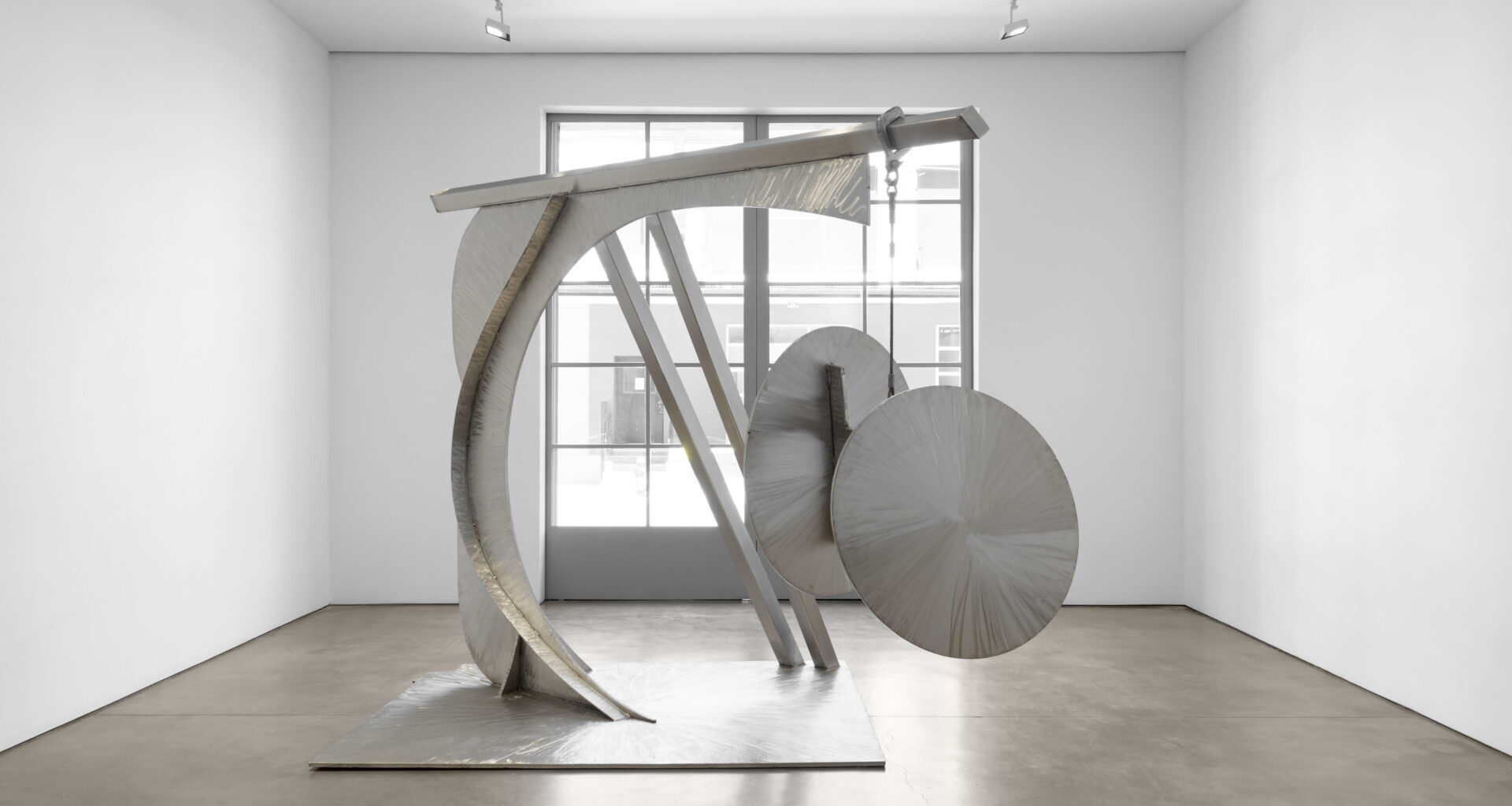
In the front room, before a large window, sits the kinetic sculpture, Tables Turn’d (2004). An 11-foot-tall cantilever emanates from a base flat to the floor. Two substantial cymbal-like discs hang from the beam, swaying ever so gently with the air currents. Completed entirely in stainless steel—typically regarded as an antiseptic medium—Tables Turn’d, with its burnished surfaces, eschews sterility. Bathed in the natural light pouring through the gallery’s window, the sculpture takes on a soft glow that correlates with its serene motions. In lesser hands, the mass of steel might seem hulking; in di Suvero’s, it feels imbued with equanimity.
The other three sculptures are installed beneath the soaring skylights of the gallery’s cavernous main space. Unlike Tables Turn’d, this trio is made from steel, unalloyed with the chromium that gives stainless its silver sheen and also its resistance to corrosion. Each sculpture has been allowed to rust, which also makes them a set of timekeepers. Nelly (1986), the earliest work in the exhibition, is a static sculpture of the sort one might conjure when thinking of a “classic” di Suvero sculpture. A tall I-beam juts through the air, its sharp angle supported by additional plates of steel and another, grounding I-beam that acts as a base. A smaller, untitled, table-top sculpture (2018) is mobilesque: a twist of spider-armed steel that spirals around a pointed fulcrum. One is tempted to reach out and give it a spin, as per the artist’s original intent for these more human-scale works. In both cases, whether walking around and beneath Nelly, or contemplating the kineticism of the untitled sculpture from all angles, it is one’s own body that ends up snapping into focus. The viewer, almost without realizing it, soon finds themselves engaging in a playful, poetic dance with the steel forms. The imposing essence dematerializes and sprightliness replaces it.