
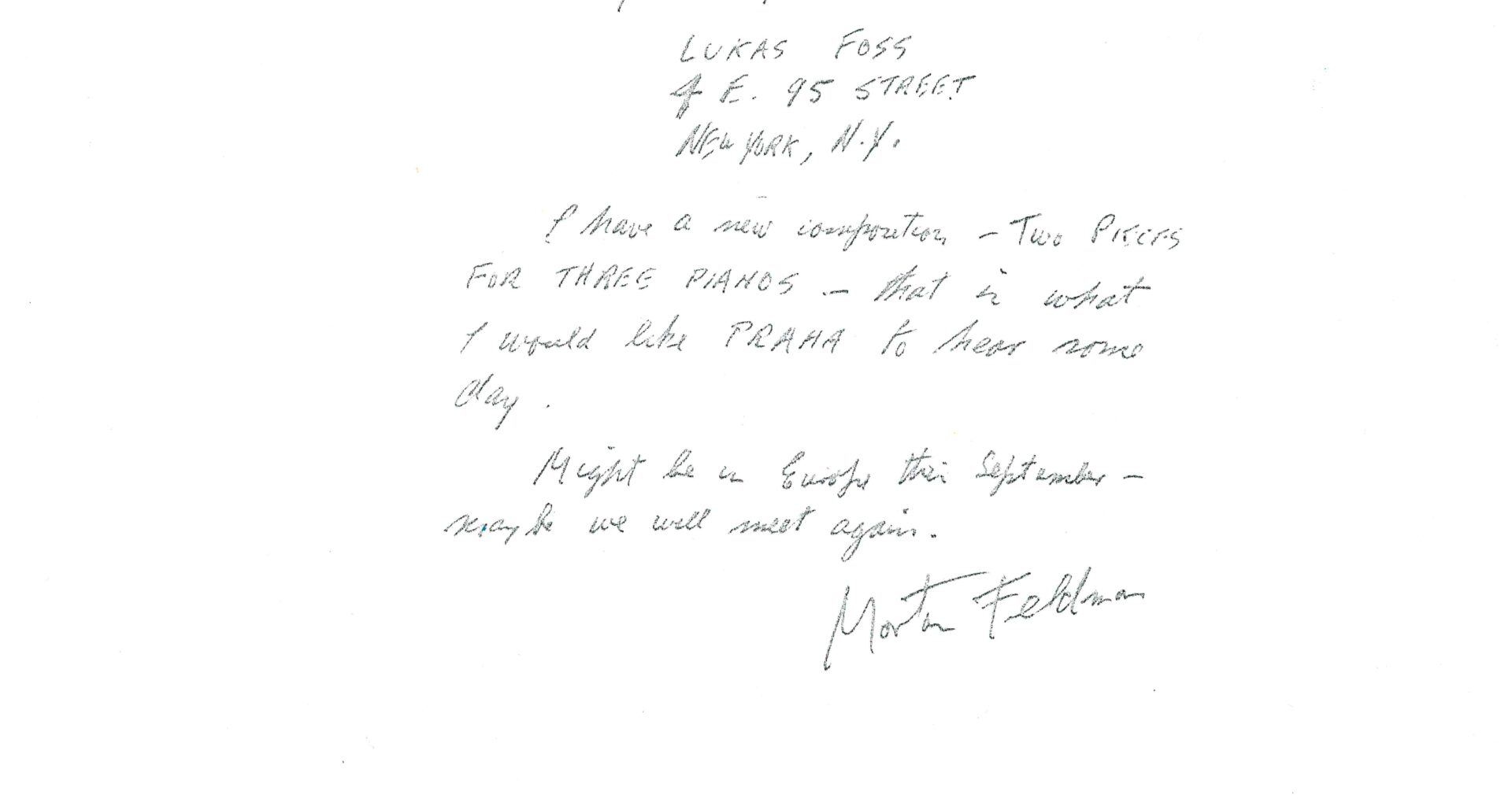
I never met anyone with greater respect and admiration for fame and money than Morton Feldman. Yet, there is not a single measure in Feldman’s music or sentence in his writings that he composed to help him getting rich or famous.
I first met Feldman in the spring of 1966 in London. I traveled from Birmingham to Vienna, where I studied, and stopped in London for a week to see my friends Cornelius Cardew and John Tilbury. One evening, Cornelius suggested that we go to hear Feldman’s lecture. This is how we met for the first time. A handful of people were in attendance and afterwards we talked—Cornelius, Feldman, and myself. Feldman knew who I was because of the performances of his music that I did in Prague since the early sixties. There, I founded and directed two ensembles, the Musica viva pragensis (1960–64) and the QUaX Ensemble (1966–69). We exchanged addresses when we met, and Feldman sent me suggestions for his pieces to be performed, but they were beyond our possibilities.
When I came to the US in November 1969 to become a Creative Associate at the Center of the Creative and Performing Arts at the State University of New York at Buffalo, my colleague, the soprano Gwendolyn Sims, asked me to help her with the program for her solo recital. I suggested Feldman, four ensemble pieces with a soprano. At the end of December, we both traveled to New York City, and I called Feldman. He asked me to come to the Studio School on 8th Street where he was the dean. He was very happy about the program and invited Gwendolyn and me to return the same evening for an end-of-year party at the school.
When we arrived, still in the door, I waved my hand in a greeting to Feldman. He was standing a few feet away and didn’t react at all. Only when we came closer, he recognized who we were. I will never forget this moment. I realized then how poor his vision was. He wore very thick glasses, and it was clear that only from a few feet away could he recognize whom he was looking at. Despite his poor vision, he had a sharp eye. His ability “to see” had nothing to do with his inability to look. Feldman’s writing about visual art, be it about Caravaggio or Jackson Pollock, is among the most eloquent by any standards. He demonstrates a deep understanding by someone who can see (and think, of course). This proves that seeing is not the same as looking, as much as hearing is not the same as listening.
On January 28, 1970, I conducted Gwendolyn Sims’s recital at Baird Hall, SUNY/Buffalo. The program included, among other pieces, Feldman’s Journey to the End of the Night, Vertical Thoughts III, Rabbi Akiba, and For Franz Klein. Shortly after this concert, together with Gwendolyn Sims and Jan Williams, I started the S.E.M. Ensemble. Julius Eastman joined us soon after.
In 1971, the University at Buffalo invited Feldman to teach, soon changing his status from visiting professor to the Varèse Professor of Composition, a chair specially created for him. We saw each other very often, and in 1973, I commissioned Feldman to compose a piece for the S.E.M. Ensemble. Feldman wrote Instruments I (flute, Petr Kotik; oboe, Nora Post; trombone, Garret List; percussion, Jan Williams; and celeste, Julius Eastman).