
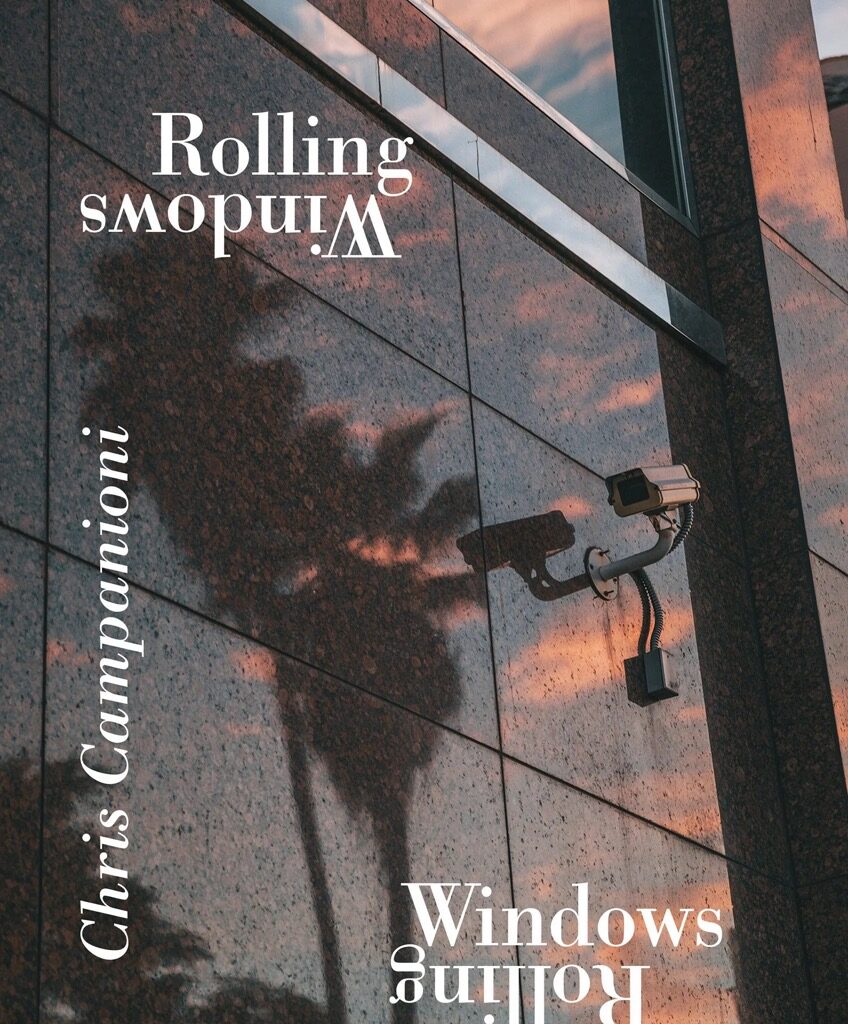
Chris Campanioni
Rolling Windows
Roof Books, 2026
A Book in Which to Burrow
In the interim period between the publication of Chris Campanioni’s Windows 85 (Roof Books, 2024) and his second poetry collection, Rolling Windows (Roof Books, 2026), punctuated by the appearance of three additional books (VHS, from CLASH Books; north by north/west, from West Virginia University Press; and Drift Net, from Lever Press), I prepared myself to engage with his poetry through a series of encounters at diners, coffee shops, and cash-only Chinatown haunts. As I read Campanioni’s growing body of work, I maintained a latent journal of thoughts on his world; such annotations, like the ones that follow, are now grist for this new milling:
Note how the poems, when recited, resist singular narration. To read Windows 85 aloud is to invite the mouth to error; among the points this book probes, then, is mediation, the problem of it. The formal and performative conditions in which glitch might emerge. Consider the craft behind Campanioni’s shimmering networks of words and images, which seem to both threaten and eagerly await de- and reterritorialization.
Moreover, I reflected further on his work in dialogue with a spate of independent art documentary films I saw at theaters in New York City. These process-oriented pictures, which include Bogancloch (dir. Ben Rivers, 2024), Afternoons of Solitude (dir. Albert Serra, 2024), Collective Monologue (dir. Jessica Sarah Rinland, 2024), and The Seasons (dir. Maureen Fazendeiro, 2025), present steady focus on singular characters at work. Rivers shows a hermit cooking food and bathing in the wintry forests of Aberdeenshire, while Serra follows a Spanish toreador as he squeezes into his flashy jumpsuit, rides with his entourage to and from matches, and kills bull after bull in the arena to unceasing cheers. Rinland shadows Argentine zookeepers at work caring for flamingos, monkeys, and turtles, and Fazendeiro weaves the labors of contemporary Portuguese agricultural workers with historical accounts of the prehistoric dolmens that dot the green countryside. These films-cum-essays recall other, similarly lyrical forms of documentary, like Agnès Varda’s The Gleaners and I (2000), in which the auteur focuses her gaze on rural and urban practices of productive salvage while reflecting on the poetics of reuse that go into her own work. But Campanioni, in Rolling Windows and beyond, inverts the paradigm. For him, the poem is not merely a visual medium, but a filmic medium. As he writes, he traces the threads of creative labor that go into his work. In his sequences of words, we are to see the labor of movement, and to be moved by his craft.
Trans-/Trance
Campanioni’s poems reveal his interest in writing across media. He writes of his desire to transcribe, translate, and transpose his immediate reality into the written moment. In “maybe she’s born with it,” the collection’s opening poem, he recalls a “Dream of a cameraperson entering the frame to install a second camera on top of the first; a second camera,” which, he continues, “has prior access to the discoveries of the first & is free to arrange them into bits of celluloid appropriate for every use. Repeat: for every use, & for everyone to use.” The work of the poems (and the poet) is to take those discrete moments and abstract them into an endearing and challenging form. Campanioni employs an organic shunting between short, staccato stanzas and longer prose digressions. For him, the poem is a vehicle of thought rather than a standardized form; what is important is not what happens, but how “what happens” happens on the page. (It helps here to think of film editing.) The camera and cameraperson (further disembodied as “the eye”) are seeing machines. “Our methodology,” he remarks, is “clocklike transcription / seeking to transfer the common texture / of digital words & their printed kin.”
Another flutter of trans/-cription/-lation/-position in “a mouth (that can’t be)”: “what you’re witnessing is a video being copied to a vhs tape, that tape being digitized, & then that digitized video being copied onto the tape again (the process is repeated a total of sixteen times).” And, in “hypothesis of the leather jacket”: “Since meaning is revealed if & when the words are copied out, since to author is to transfer, since to transfer requires a witness to consecrate the text; drama of being alive or of becoming living.” I remind the reader of everyday situations: taking photographs of photographs; filming the live security camera footage in the doorway of the pharmacy or at the self-checkout kiosk; taking the words of people passing by on the sidewalk and twisting them, figuring them in terms more familiar, or more useful, toward one’s intended ends. Campanioni, donning a technician’s hat, affirms the above in the poems “l’eclisse” and “the juxtaposition of foam”: “I want to remind myself (by repeating it here) that to author is to transfer; to move words and images around”; “I write words by clicking, photographing sensations as I alight upon them in my viewfinder.” Seeing, in short, is believing.