
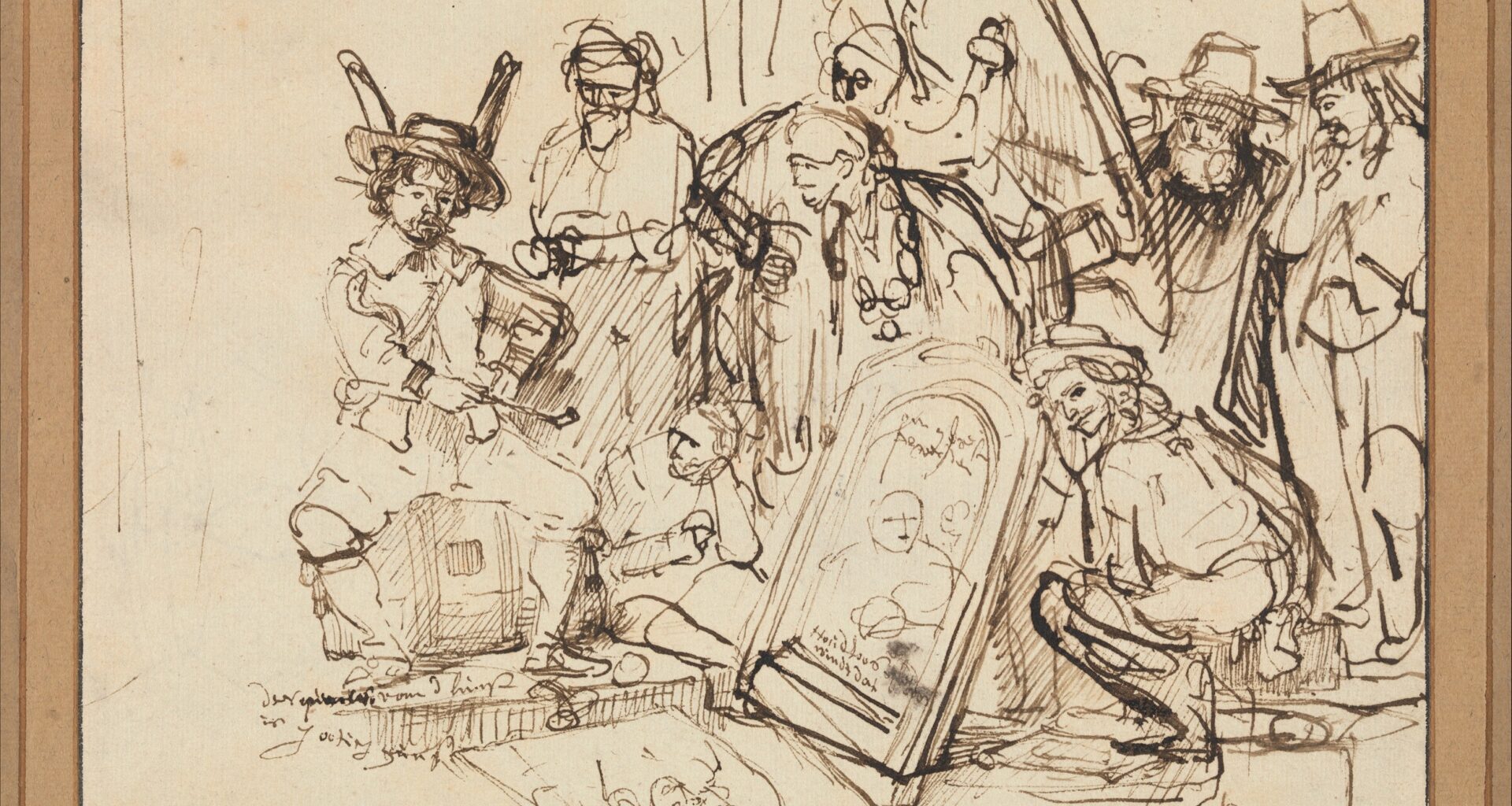
One art lover might imagine the object deserves attention for the visual pleasure it provides because of its “beauty.” Another might suggest that what matters is in fact the object’s skill at mimicking the look of things in the world, or at expressing its maker’s deepest feelings. Others might say that the object’s most important virtue lies in how it raises questions about what ought to count as art, or in how it opens a window into ancient religion.
But when an object is functioning as a work of art, what matters is not that it offers up any one of those single virtues, but that it affords us the chance to ask the open-ended question that got the whole process started: “What kind of thing is this, and what might I ask it to do for me?”
And the open-ended questioning inevitably triggered by art, in the very act of being art, is not there just for the pleasure this questioning admittedly brings, especially to the more talkative among us. Rather, it allows us, or compels us, to rethink and then re-rethink, ad infinitum, the world and our attitudes to its many parts. If, in its open-endedness, art causes confusion and even cognitive stress, that’s on purpose, Noë says, “so that we may reorganize ourselves in order to comprehend it”—reorganize, that is, our standard, habitual ways of thinking or being or acting, so as to achieve new insight into all of those habits we’ve fallen into, even in a field as local and parochial as picture-making and picture use.5
Another observation of Noë’s, which comes almost as an afterthought in his writings, is for me one of his most important claims: that the anti-habitual insights we garner when we deploy certain objects as works of art don’t arise in one person’s silent meditation on a work, but “in the setting of conversation and criticism,” as Noë puts it. “Aesthetic experience, insofar as it is a unitary phenomenon at all, is essentially a critical or discursive phenomenon—that is, it unfurls in a space of thought and talk, a space of criticism.”6
Noë’s insights contain the seeds of a new discursive theory of art, which would go more or less as follows. Art is at hand when an object is being deployed toward the very particular goal of triggering open-ended discourse. In a quite peculiar tradition that has flourished in the West since somewhere around 1500 CE—and in other places, at other times—objects get classified as “art” by virtue of their ability to trigger a series of discussions about what precisely we might want to do with them, or how they ought to be considered.7
*
The term “art,” as commonly and carelessly used (even by professional art critics and historians) causes confusion and incoherence because it refers to many quite different, even incommensurate functions that something like a painting or sculpture might serve.
A Byzantine icon, for instance, might prove suited to calling down Christ’s favor, or decorating a Fifth Avenue mansion, or it might make the perfect cover for a historical novel. An African carving might be used to ward off evil spirits, or to brain someone who is trying to steal it. A portrait of Theodore Roosevelt by John Singer Sargent might help establish your blue blood, or it might sit in a vault as a nest-egg for your golden years. And all three of those objects might have one other important use that is different and independent from the ones cited so far: all three also offer that peculiarly discursive function that makes us describe them as “art.”
In some recent teaching, I’ve found it useful to speak about the varied “affordances” that an artifact offers, borrowing a term from perceptual theory that’s been influential in recent philosophy.8 Thus a Chippendale chair might make excellent firewood, in certain dire circumstances, and in others it might, unburnt, be perfect collateral for a loan. It might also be rather useful for sitting, as one of the chair’s “affordances”—one of the uses it offers up to humans, and maybe the central and most obvious one. Other kinds of objects—fallen logs, beach balls—might also have sitting among their affordances, even if other uses might seem far more central to their identities, most of the time. (For people with bad backs, however, a beach ball’s sit-ability might turn out to be its most important affordance.) And of course, once placed in a museum, the chair offers up the “discursive” affordance peculiar to it and other objects when we class them as “art.”
That “art” affordance, with its invitation to discourse, has become so powerful, appealing, and prestigious, at least in today’s post-industrial cultures, that artifacts like the Christian icon, the African carving, and the Sargent portrait continue to bear the title of “art” even at those moments in their lives when their affordances as ritual objects, or weapons, or investment vehicles, are the only ones in play. Through a kind of linguistic contagion, the word for the object in its affordance as discursive “art” comes to be the standard label for the object itself, regardless of what affordance its users might be attending to. Just as we’d never be tempted to confuse the word “ball,” used to describe a bouncing toy, and the “ball” that’s a baseball pitch thrown outside the strike zone, so we need to avoid confusion between “art” when it’s used, say, for investment and praying, and “art” when it’s used to trigger talk and thought.