
Șantier
/SAC @ Malmaison
April 22–August 1, 2026
Bucharest, Romania
Dumitru Gorzo’s (b. 1975) Șantier refutes all notions of settlement. The viewer enters /SAC’s Malmaison Bucharest space and confronts a wall of red: a mural spanning the full width and height of the main gallery, built from twelve large painted panels pressed flush against the gray walls. The ground is undiluted, saturated crimson, and across it Gorzo has distributed figures in varying states of resolution. Some are densely configured, thick with paint. Others are barely there: charcoal outlines of forms that emerge from the red or retreat back into it. Each image operates based on its own internal rules and degree of finish, and together they make not a unified composition but a site, exactly and literally a șantier.
In Romanian, the word șantier—central to curator Alex Radu’s framing—denotes “construction site,” but to anyone who came of age in post-Socialist Romania, it summons something deeper than scaffolding. Here, it suggests the arrested promise of transition and cities pockmarked with half-finished buildings. Gorzo draws from a cultural inheritance where incompletion is not a temporary condition but a defining one, and that inheritance gives the exhibition its backbone. The unfinished figures on the red mural enact what it means to exist in a context where the finished thing has long been deferred.
Before the exhibition opened in April, one of the featured works on paper rested on the floor on sheets of plastic, while a ladder was propped against the wall, paint cans lined up in a row, a backpack left on the windowsill. The building, at that point, was still a place where things were being made. This is what Gorzo calls being “hooked in the present moment,” a practice structure that has moved with the artist through Brooklyn, Bucharest, Timișoara, Râmnicu Vâlcea, Bistrița, and Reșița, each iteration carrying physical traces of the previous ones: tools, unfinished works, objects that function as witnesses. Each location produces a temporary fixation with a different character, different material pressures, all of it accumulating like sediment. Gorzo built the main mural in the room on a ladder, drawing directly onto the panels while the show took form around him. The show is a record of the artist experimenting and pivoting, the residue of a process that includes breakdown as a working condition.
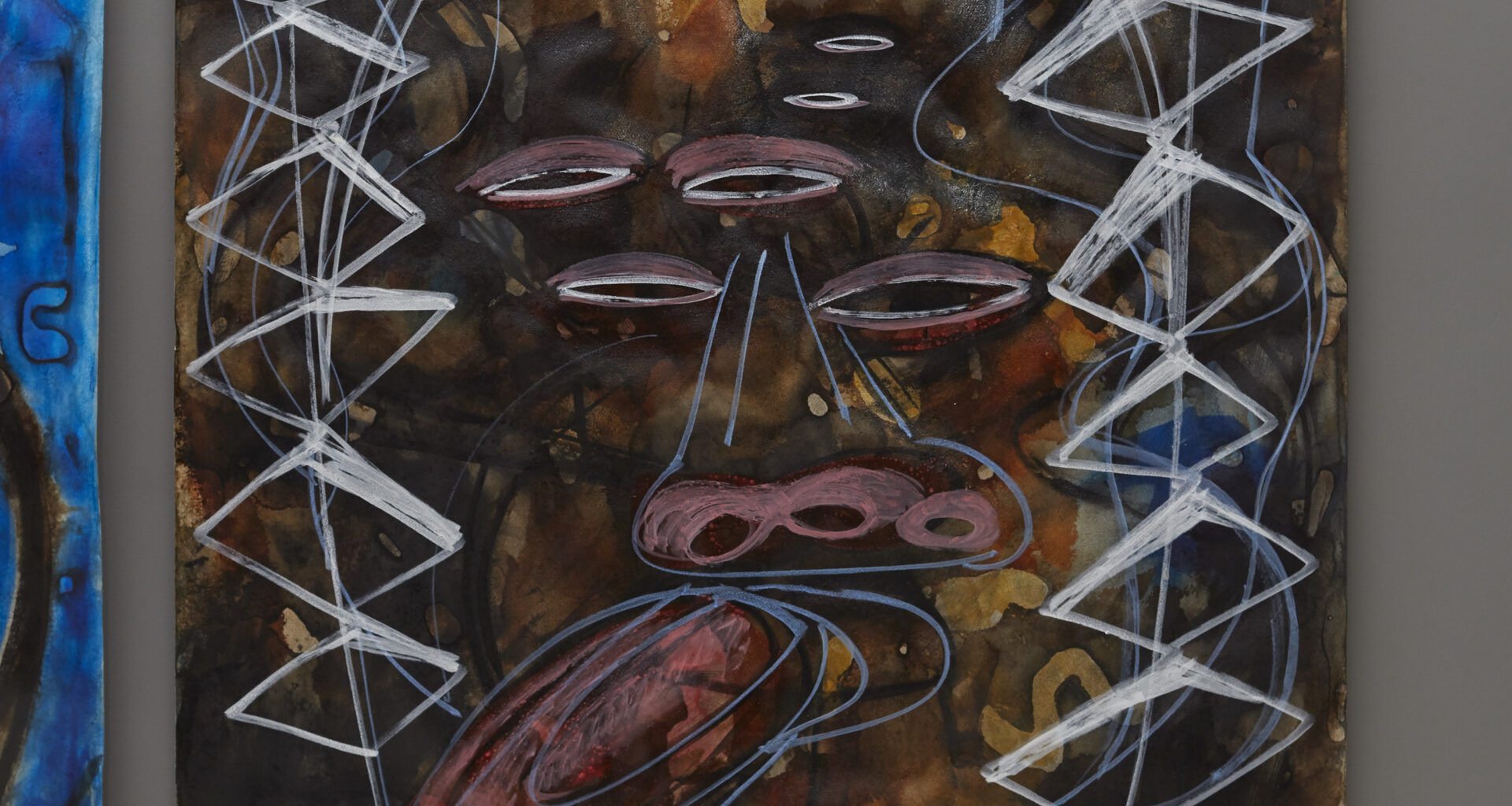
The space reinforces this. Malmaison exhibits its own construction history: exposed timber joists overhead, industrial strip lighting running across the ceiling, a tile floor gridded by dark grout lines. Among the large, unframed works on paper lining both side walls, Red rider (all works 2026) is the most dissolved, with deep crimson figures barely holding their form against a stained ground. In Port Ensor, two orange-red lobed forms flank a central dark face, radiating black armature and carrying the carnivalesque charge of the work’s namesake, James Ensor. Nearby, Together we’re more powerful features a horned dark figure holding a smaller bird-like form against a blue and brown ground, while Endless head depicts a dark mask face surrounded by white zigzag lines. In Stained glass, meanwhile, a head submerged in deep blue is wrapped in serpentine forms with devotional associations. Two fishermen, with crowned figures on brown and blue with white drips throughout, completes the group. In these works, the body functions as a pressure point over portraiture. Like Willem de Kooning, Gorzo treats the figure as a site of force; like Philip Guston, he reaches for the grotesque as a vehicle for psychological charge. But where de Kooning dissolved the figure into gesture and Guston rebuilt it as cartoon, Gorzo’s forms hover in a more unstable register: present enough to unsettle, incomplete enough to resist being read.