
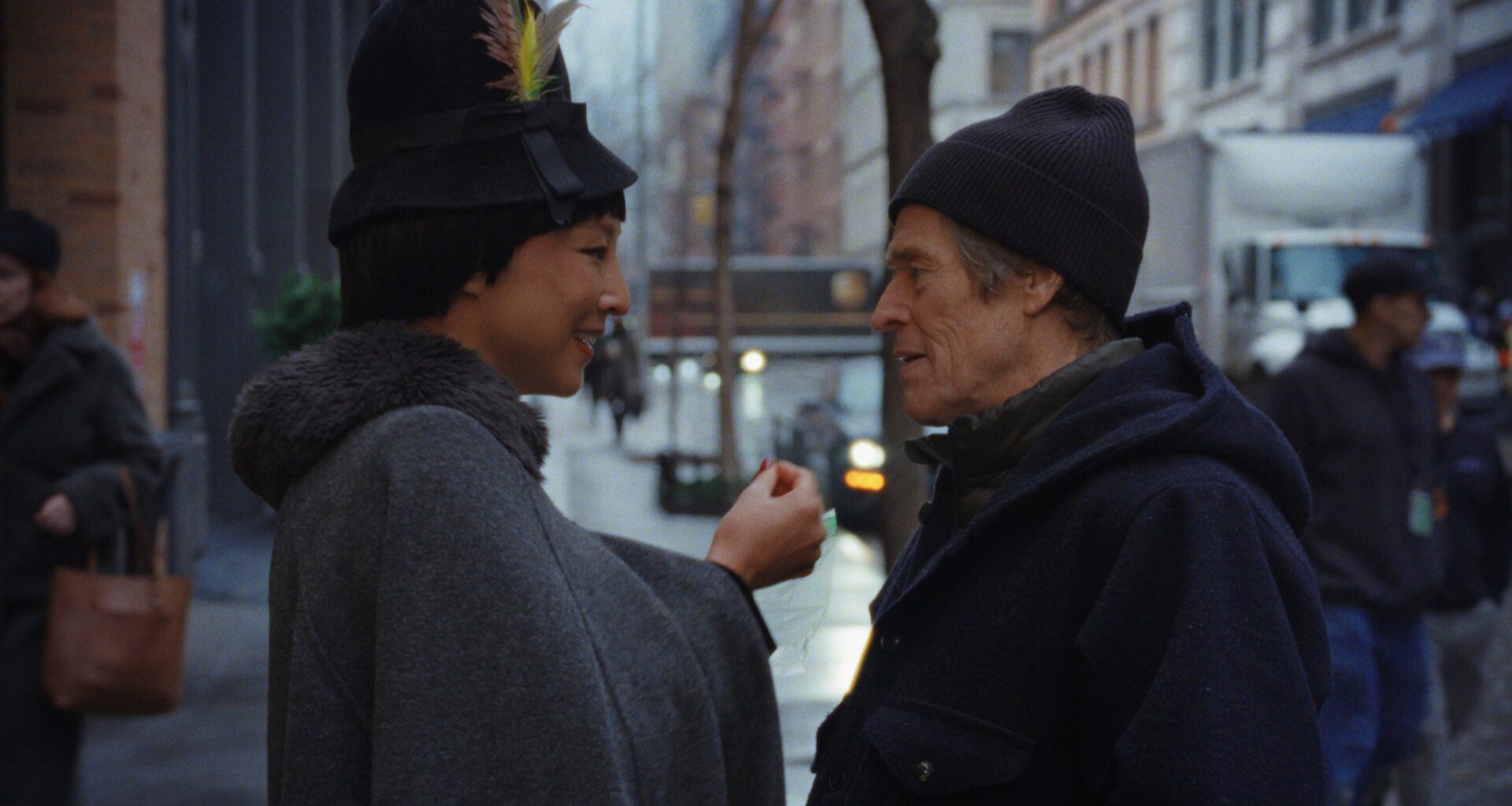
Anthology Film Archives had done a retrospective where Willem and Martin Scorsese had a conversation about The Last Temptation of Christ (1988). Willem said, “When I’m giving a performance, I’m trying not to be an actor.” His face and physique tell their own story.
Rail: What about Greta? How did you find her for the role of Gloria?
Jones: Greta and I share the same agent, Houston Costa, who has exquisite taste. I love her in Past Lives (2023), too.
Originally, Sandra Hüller was going to play the role, but then she got very busy. So we started going through that tedious process where everyone debated whose name means more while the clock kept ticking. Then somebody suggested, “Greta Lee would be good. Her name means something.”
Greta was completely game. My wife Carisa Kelly, the film’s costume designer, really connected with her, too. For me, it’s also important for actors to have a grounding in comedy, like Greta does in Russian Doll (2019–22).
Rail: Comedy is the hardest thing to do. And casting is everything in this character-driven film.
Another actor I want to talk about is Edmund. Meyers might not seem like the most challenging role to play because he can feel almost caricatured on paper. But Edmund makes him feel incredibly specific, and at times, very comedic. There’s something theatrical about Meyers thanks to Edmund, who leaves so much room for imagination.
Jones: You clocked that Edmund has a huge imagination. Every choice he makes feels grounded in a larger story.
Early on, he asked me, “Do you think Meyers should be odd?” I said, “One hundred percent.” Then, about the end where Meyers leaves the group, he asked again, “Do you think Meyers should lose it here?” And I said again, “One hundred percent.”
When he improvised Meyers’s line for that end—“What the fuck do you believe in? Nothing?”—that was gold.
Rail: The film hit close to home for me. I saw it just yesterday to prepare for this interview, and I lost sleep over it—which I didn’t expect. It felt eerily personal. Maybe it’s because I relate to the confusion of pursuing something you care about while also getting pulled in so many different directions.
Jones: Did you go to NYU?
Rail: No, I went to UCLA. [Laughs] But during my first year in New York, I met younger friends who had just graduated from NYU. And I have writer, filmmaker, and artist friends around my age, in our late twenties and early thirties. Creatives really do form these collectives with names like “Enthusiasm Society.”
The script makes it clear that these boys come from money, which also rings true.
Jones: Because that particular delusion isn’t really possible otherwise. I think you need a fair amount of money for it to exist.
Rail: It’s interesting that you used the word “delusion.” What particular delusion? To be in art?
Jones: To have an idea of being an artist.
Art, whether poetry or filmmaking, can become more an idea of the thing than the thing itself. The boys see the Enthusiasm Society as a collective—“We’re in this together”—but of course they’re not. They imagine themselves as eschewing social media, but of course they don’t. As Gloria and Ed join in, the group consists of three intersecting delusions.
That’s a vestige of Schnitzler’s work. How he looked at people was savage. The novella Late Fame is not unlike his other work Dream Story (1926) that Stanley Kubrick adapted into Eyes Wide Shut (1999): you thought you were penetrating some inner circle, but by the end, you realize you’re nowhere near it.
Rail: Is there still meaning in what Ed, Gloria, and the boys built together, even if the group inevitably falls apart? Or does the film suggest something more nihilistic?
Jones: Nihilism is the last thing on my mind. I’m not interested in making grand statements like that in general. There’s no condemnation in my Late Fame. I think finding some measure of peace within yourself amongst all the branding and discourse matters—and that’s what Ed arrives at in the end. His answer to all of this is simply: I’ll go back and take my walk.