
Officials from the Riley County Police Department appeared at Tuesday’s city commission meeting to address common questions about their automated license plate readers, but were met with security concerns from commissioners and the public.
These plate readers (ALPRs) are high-speed, computer-controlled camera systems mounted on squad cars, poles or overpasses, and include Flock cameras. RCPD credits the use of ALPRs for over 150 positive outcomes in recent cases.
RCPD deputy director Erin Freidline said the system takes still images of license plates on the rear of vehicles.
“That door to data is stored for approximately 30 days in our systems,” she said. “You know, this has been a technology that’s been in use for decades. It kind of ebbs and flows on how people want to view it, but it is newer to our community, just in the last couple years.”
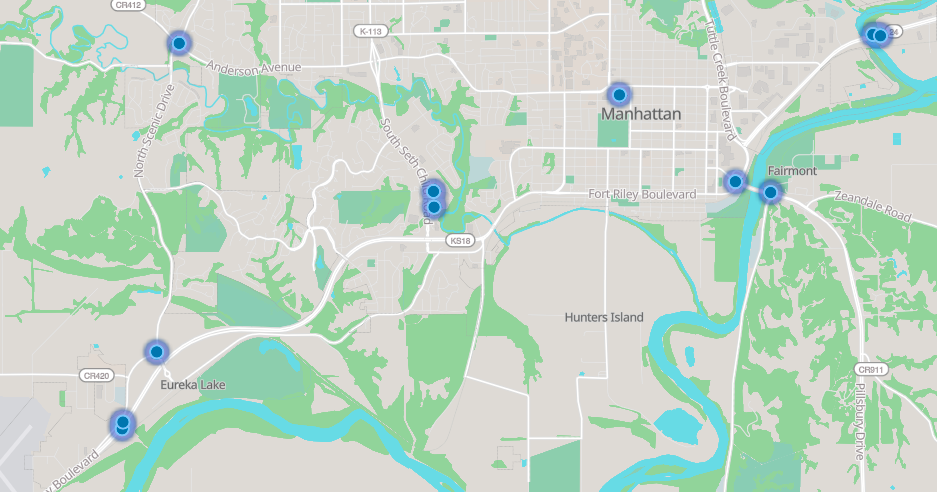
There are 11 Flock cameras installed in and around the edges of Manhattan.
“There is no facial recognition in a license plate reader that is taking a picture of a license plate tag, and there’s no demographic,” Freidline said. “If you were to try and get occupants of the vehicle, if that picture is taken, there isn’t the technology to do demographics across those ALPRs as well.”
Sgt. Michael Dunn with the criminal intelligence unit said he is the administrator for most of the ALPR systems.
“This analytical software allows us to connect data across cases, identify patterns and provide patrol and detectives with actionable intelligence much earlier in the investigative process,” Dunn said. “These tools are producing real outcomes, for example, faster case resolutions and improved ability to identify and intercept suspects before crimes escalate.”
Dunn said Flock automatically creates an audit trail when searches are conducted, and RCPD’s policy requires an audit of all ALPR systems twice a year.
Still, some residents have expressed privacy concerns regarding the cameras. During public comment, former city commissioner Peter Oppelt highlighted portions of Flock’s terms of service that he found worrying.
“Section 4.1 reads, quote, ‘Customer hereby grants Flock a limited, non-exclusive, royalty-free, irrevocable, perpetual worldwide license to use and disclose customer data to provide the Flock services, and to use customer data to support and improve Flocks products and services,’” Oppelt said. “In plain English, we pay Flock, which is an $8.4 billion company, a yearly subscription for the right for them to use our community’s data to grow its surveillance network and build new products, such as drones as first responders.”
Flock talks a lot about transparency and safeguards, but those safeguards stop at our police department use. They say nothing about how Flock uses our data internally with footage and metadata collected here in Manhattan.
Oppelt said Flock’s safeguards stop at RCPD’s use, and the company says nothing about how it uses Manhattan’s data internally.
“Flock can combine that with public DMV records and data purchased from companies like Google and Meta to build comprehensive profiles of our residents, and we have zero control over that use,” he said. “It’s also worth noting what has been removed. Flock’s previous terms proceeded flatly: ‘Flock does not own and shall not sell customer data.’ That sentence is now gone from the terms of service — it is mentioned on a blog post, but that is not legally binding.”
Oppelt raised additional concerns including RCPD’s contract with Flock possibly being considered debt, and a history of false positives and potential for stalking or harassment during police investigations. He asked the commission to consider removing all Flock cameras.
Commissioner Jim Morrison, who is also a member of the Riley County Law Enforcement Agency Board, said terminating the cameras will be unlikely, but shared some of Oppelt’s concerns.
“Certainly, I’ll be asking the question to see the agreements between the RCPD and this organization, because as far as I know, the law board didn’t sign any contract with them,” Morrison said. “So I agree, Peter, they don’t have authority to sign contracts, but I’m not telling you I’m going to get them out of town. I think there may be a basis for putting some guardrails up.”
Morrison said there are “legitimate questions for public information and safety” and requested RCPD to be more transparent about its policies with the police board and the public.