
The Amazon Labor Union’s Historic Breakthrough
How did a scrappy group of organizers without institutional backing prevail over the second-largest employer in the United States?
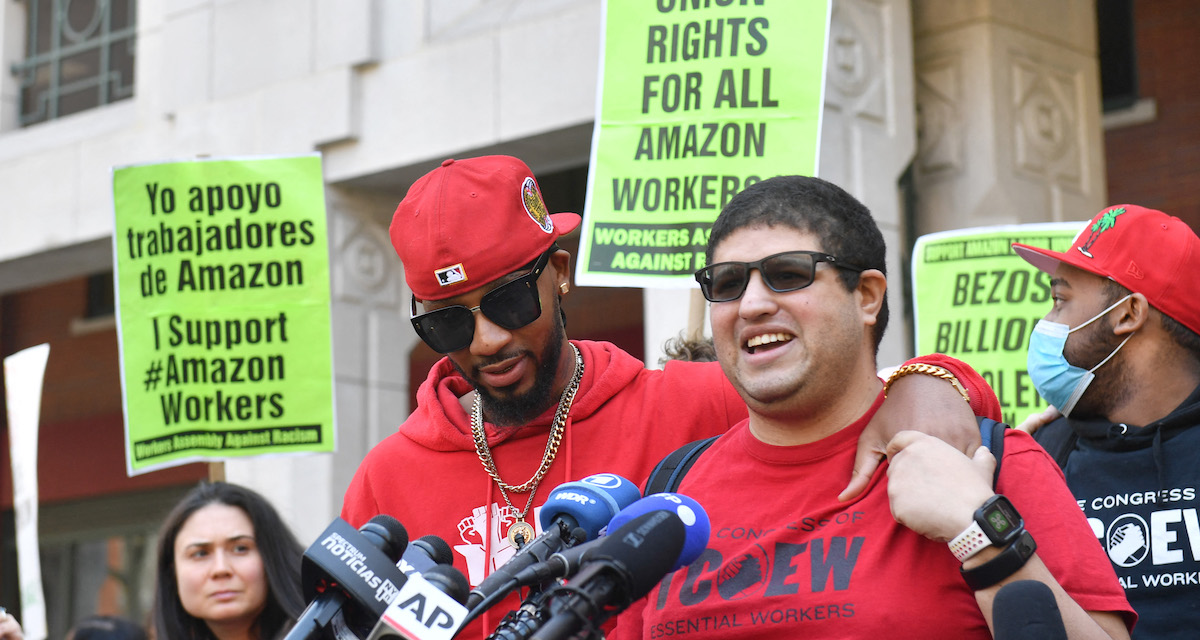
ALU members, including Chris Smalls, left, celebrate their win on April 1, 2022. (Andrea Renault/AFP via Getty Images)
This article was updated on 6/30/2022.
Until its stunning victory on April 1, just about everyone thought the Amazon Labor Union’s year-long effort to organize the giant Staten Island “JFK8” Amazon warehouse was a hopeless—if noble—quest. Unlike the union drive led by the Retail, Wholesale and Department Store Union (RWDSU) at Amazon’s facility in Bessemer, Alabama, which was constantly in the media spotlight, the ALU’s campaign seemed like such a long shot that it was mostly ignored.
In an April 2021 union representation election in Bessemer, Amazon defeated the RWDSU by a more than two-to-one margin, but in November the National Labor Relations Board (NLRB) ordered a second election after it determined that the company had flagrantly violated the law. With its deep pockets and intransigent opposition to the RWDSU drive, most observers predicted that Amazon would prevail in the March 2022 do-over as well. It did, but by a much smaller margin than before, and with enough contested ballots that a reversal of the outcome is still possible.
Meanwhile, in Staten Island, the ALU won by a comfortable margin, in a 2,654–2,131 vote with only sixty-seven challenged ballots. (There were seventeen void ballots, while a plurality of the 8,325 workers who were eligible chose not to vote.) When I first saw the final tally, I thought I might be hallucinating. Many others were equally shocked, including some of the ALU’s own leaders. ALU President Chris Smalls instantly became a media celebrity. The blitz of coverage even included a New York Times piece on his fashion choices, and President Biden invited him to a meeting at the White House with other labor leaders.
Organized labor has suffered devastating defeats in the past few decades; today only 6 percent of private-sector workers are union members—the lowest share in a century. U.S. labor law has tilted increasingly in favor of employers, and repeated efforts at legislative fixes (like the PRO Act, now stuck in limbo in the U.S. Senate) have gotten nowhere. Since the 1980s, businesses have perfected strategies for defeating union drives, exemplified by Amazon’s recent efforts in Bessemer and Staten Island. The United Food and Commercial Workers faced similarly intransigent opposition during the decade it spent trying to organize Walmart, and it eventually abandoned the campaign. That was a cautionary tale for union leaders contemplating the prospect of organizing Amazon. None of them were eager to take on that gargantuan task, until a group of Bessemer workers approached RWDSU for help. In Staten Island, workers themselves created the ALU.
How could a scrappy group of activists with no institutional backing prevail over this towering…
Online Only
For just $19.95 a year, get access to new issues and decades’ worth of archives on our site.
Print + Online
For $35 a year, get new issues delivered to your door and access to our full online archives.