

A Brooklyn Republican primary for state Senate separated by just seven votes is now the subject of a court fight, as the city Board of Elections argues it should be allowed to finish counting ballots before a judge steps in.
The Board of Elections, in a July 1 filing in Kings County Supreme Court, urged the court to dismiss a lawsuit brought by candidate Bernard Vaiselberg, who trailed opponent Nachman Carl Caller, 513 to 506, in unofficial election-night results for the Republican nomination in the 22nd Senate District.
The Board said no winner has been declared, ballots are still being canvassed, and certification is not expected until July 14.
The BOE’s filing lists the unofficial results as 513 votes for Caller and 506 for Vaiselberg, along with 39 blank ballots, 16 voids and 151 write-ins. Its public election-night results page showed that 98.93% of scanners had been reported as of 11:46 p.m. on primary night.
“Currently, the Board is in the process of canvassing all ballots for the Republican Primary contest in Senate District 22,” Assistant Corporation Counsel Kendra Elise Riddleberger wrote on behalf of the BOE. “As such, no winner has been declared.”
Vaiselberg sued last week, two days after the primary, asking the court to order a full manual recount, preserve election records, allow his team to observe the recanvass and block certification until the recount and any judicial review are complete. His petition argues that the narrow margin triggers a mandatory full manual recount under state Election Law.
But the BOE said the case is premature because it is still canvassing absentee, affidavit and other ballots. The filing says mail ballots may still be undergoing the cure process until July 10 and argues that court intervention before the Board completes its work would “hinder and delay” it from carrying out its statutory duties.
The Board also argued the court lacks jurisdiction at this stage to determine the validity of ballots or direct how they should be canvassed before the BOE has completed its own review. At this point, the Board said, any court relief should be limited to preserving election materials for potential later review.
Under the New York election law, a manual recanvass is required when the margin of victory is 20 votes or fewer, one-half of 1% or less, or, in contests with at least 1 million ballots cast, fewer than 5,000 votes. The current unofficial seven-vote spread in the 22nd Senate District Republican primary would fall within the 20-vote threshold if it holds after the canvass.
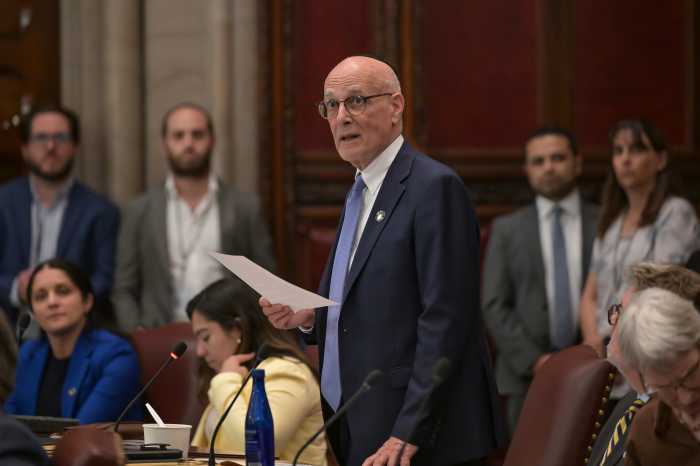 State Sen. Sam Sutton is expected to face the winner of the Republican primary for Brooklyn’s 22nd state Senate District.Photo courtesy of NYS Senate Media Services
BOE rejects scanner-failure claim
Vaiselberg’s dispute also centers on an allegation that a ballot scanner at a poll site in the 45th Assembly District failed early on primary day, causing voters to cast emergency or paper ballots.
Vaiselberg’s petition says a “substantial number” of ballots from that area were not counted in the unofficial returns and argues those ballots could change the outcome because he was leading Caller there by roughly two-to-one, 121 votes to 64.
The BOE pushed back, saying Vaiselberg’s claim was based on information and belief and was “wholly insufficient” to justify a court order requiring the testing and inspection of voting machines, ballot-marking devices or scanners. The Board also argued Vaiselberg had not alleged that the BOE would fail to take appropriate steps if a machine had malfunctioned.
Vincent Ignizio, deputy executive director of the city’s Board of Elections, told amNewYork that the Board did not use emergency procedures and that all voting-equipment memory sticks were read properly.
He said election-night results transmitted online can sometimes fail or come in incomplete, which is why they are unofficial, but that the Board later reads the hardware memory sticks for all election and assembly districts.
“The canvassing procedures are continuing citywide and if hand counts are required as prescribed by law, we will send out the notice and do so,” Ignizio said.
Caller, in his own June 30 response to the challenge, also asked the court to dismiss Vaiselberg’s petition. He admitted that a manual recount may be required under Election Law, but denied that Vaiselberg had shown an irregularity warranting broader court intervention or discovery beyond what the Election Law provides.
Caller’s filing also said that, after 10 provisional ballots were counted, his lead had grown to nine votes. The BOE’s July 1 filing, however, still listed the unofficial candidate totals as 513 for Caller and 506 for Vaiselberg, the same seven-vote spread that appeared on the BOE’s election-night results page.
After oral arguments on Wednesday, Justice Peter P. Sweeney issued a narrow order allowing observers to watch the ballot count from four feet away, over the Board’s objection
Ezra Glaser, an attorney for Caller, said the BOE was “doing what they normally do in this process” and rejected the idea that the board was favoring his client. He also pointed to the judge’s order allowing observers closer access to the counting process.
“I think we are a fair amount ahead, in consideration of the small number of votes still being counted,” Glaser said. “I frankly believe it is only fair that both sides be given access to the vote-counting process, but I do expect this to resolve in favor of my candidate, and the very questionable allegations regarding the BOE will not ultimately be a serious consideration in this case.”
The winner of the Republican primary is expected to face Democratic state Sen. Sam Sutton, who won the seat in a May 2025 special election after former state Sen. Simcha Felder left Albany for the City Council.
Sutton defeated Caller in that race by a wide margin, even as the district has favored Republicans in recent presidential elections. Vaiselberg also ran as an independent candidate that year but failed to break the one percent mark.
The 22nd Senate District includes parts of Borough Park, Midwood, Homecrest, Gravesend, Sheepshead Bay, and Marine Park, and is home to a large Orthodox Jewish community.
Vaiselberg did not respond to a request for comment at the time of publication.