
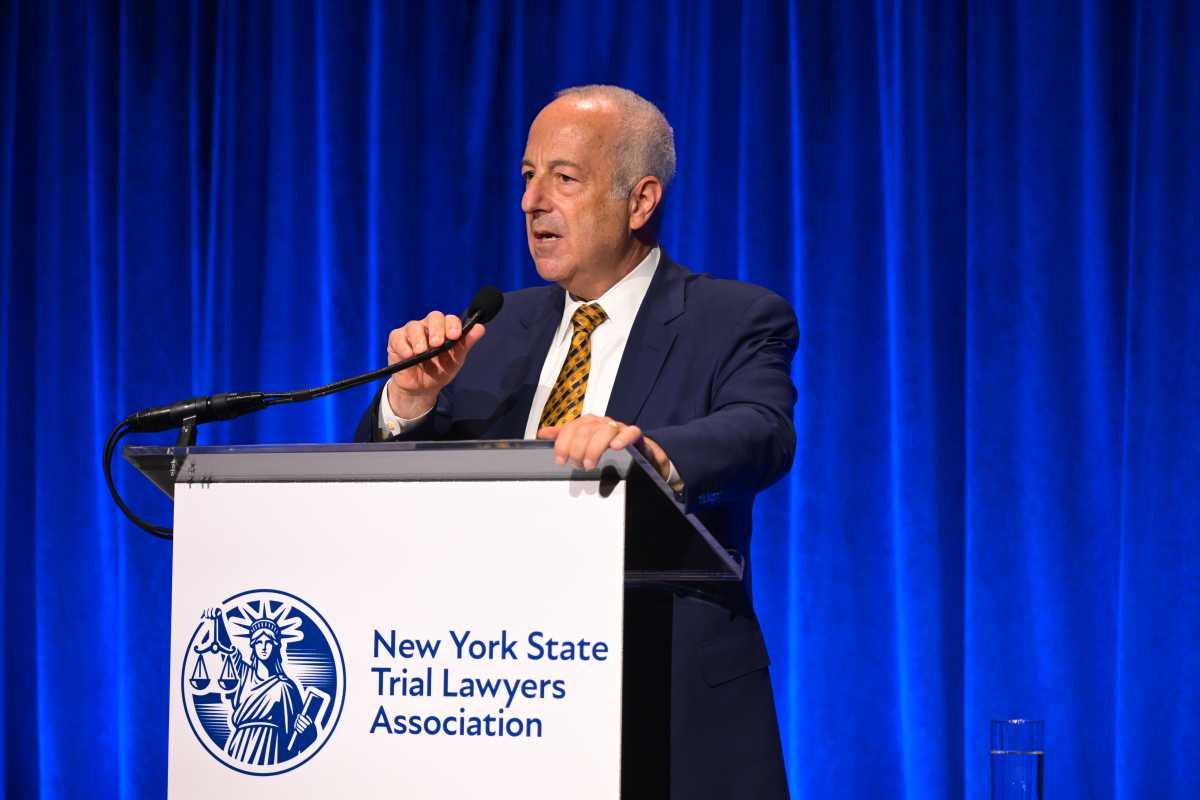
The New York State Trial Lawyers Association’s (NYSTLA) president used the group’s annual gala on Tuesday night to address Gov. Kathy Hochul’s auto insurance reforms, which were included in the state budget — arguing that they limit justice, encroach on people’s rights, and threaten the independence of the civil courts system.
The reforms in question narrow the definition of what constitutes a “serious injury” after a vehicle crash — a necessary requirement for a crash victim to be able to sue for damages — while also capping payouts for pain and suffering at $100,000; and altering the way injury compensation is determined, holding that if an injured person is over 50% responsible for the crash, they can’t recover anything. Hochul said this is intended to make it harder for “bad actors” to sue in bad faith and scam insurance carriers out of money, and that it will trickle down to mean lower insurance rate payments for everyday drivers.
Those claims have faced intense criticism for months, as attorneys and victim advocates say the reforms will make it harder for injured people to recover compensation after crashes that were not their fault. Critics like NYSTLA President Andrew Finkelstein further say they are not convinced the car insurance companies will even pass on the savings to consumers.
“The only outcome of the purported reform is to narrow the courthouse doors, limit recoveries for the injured, create greater immunity for wrongdoers, and create a system that becomes less accessible to the people it was built to protect,” Finkelstein said at the June 30 gala. “This civil justice system should not be rewritten as a budget line item. The rights of the injured should not and must not be considered a bargaining chip.”
Finkelstein accused Hochul of being swayed by powerful, well-financed auto insurance and rideshare lobbyists (Uber alone poured $10 million into pushing the budget bill) over the interests of the court system and general public, suggesting that those outside interests had deceived her by disguising a self-serving proposal as a positive reform. He was critical of the fact that the reform altered the way personal injury cases were handled without comprehensive public debate or sufficient input from the attorneys and judges handling them.
“When proposals that affect fundamental rights are placed inside a state budget, when major changes to legal rights are moved not through the ordinary legislative process but through the pressures and the speed of budget negotiations, something larger is at stake,” Finkelstein said. “This is not just about one statute, this is not just about one type of case, this is not just about personal injury law. It is about the process, it is about power.”
When reached for comment on Wednesday on Finklestein’s remarks, Hochul, who was not in attendance Tuesday night, said the reforms were in New Yorkers’ best interests.
“The Governor’s reforms will hold bad actors accountable and drive down the cost of auto insurance in the process,” Hochul spokesperson Kristin Devoe said in a statement. “While some are interested in lining their own pockets, Governor Hochul’s only interest is in doing what’s best for New Yorkers.”
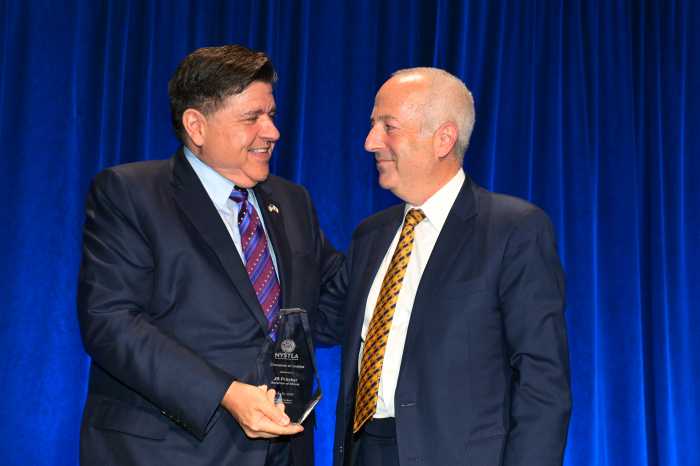
Illinois Gov. JB Pritzker accepts an award from Finklestein on behalf of the NYSTLA.Photo by Ramy Mahmoud
Finkelstein’s comments created a bit of an awkward political situation for Illinois Gov. JB Pritzker. The remarks about auto insurance came during Finkelstein’s speech introducing Pritzker to the stage.
“Governor Pritzker comes to us from Illinois with a record that speaks directly to the values of this organization,” Finkelstein said after criticizing Hochul’s record. “At a time when too many leaders see access to justice as something to bargain away, Governor Pritzker has chosen a different path. He has shown that protecting injured people and protecting the rule of law are not competing priorities.”
Pritzker has signed legislation protecting the rights of injured people to recover prejudgment interest, or compensating victims for delays in personal injury and wrongful death cases when the court process drags on, allowing punitive damages in wrongful death cases and preserving civil remedies for workers with latent occupational diseases, recognizing that people should still be able to sue if the disease appears years after exposure, all of which Finkelstein highlighted.
“Those are not technical legal reforms,” Finkelstein said of the laws Pritzker supported. “Those are moral statements. They say that injured people count, they say that accountability matters, they say that civil justice is not a loophole, it is a pillar of our free society.”
When Pritzker made an offhand comment about “loving” Hochul during his speech accepting the organization’s Champion of Justice award, he received a chorus of boos from the over 500-person audience, a reaction from which he quickly tried to pivot.
“I don’t know if you’re booing her or me,” the Illinois executive told the crowd hesitatingly. “She’s my fellow governor.”
Pritzker’s office did not respond to a request for comment on Hochul’s car insurance reforms before publication time.
His acceptance speech primarily focused on the importance of upholding the principle of equal justice under the law, as he said, the Trump administration makes daily attacks on the country’s judicial and legal systems.
“Equal justice under the law should not be a political slogan,” Pritzker said. “It must be a fundamental tenet of our constitutional republic; it must be able to withstand partisan actors who reject the separation of powers. When that tenet is shown to be weaker than we thought, when it must be propped up on a foundation that is crumbling before our very eyes right now, we must have the bravery to fortify it for the future.”
One way to fortify it, the Illinois governor said, would be to pressure the U.S. Senate not to confirm any more of Trump’s U.S. Supreme Court appointees, a possibility he acknowledged was a real one as Justice Samuel Alito and Justice Clarence Thomas are 76 and 78, respectively, and frequently floated as potentially retiring during Trump’s time in office.
“If that turns out to be the case, I think that it will be critically important that those of us in this room and across the country who care about fortifying our democracy and resisting the authoritarian creep of this administration send a clear message to those senators in Washington who will vote to fill that vacancy,” Pritzker said. “You must fight against Donald Trump’s corruption of the court with everything that you have.”
The remarks came at NYSTLA’s annual gala, an event at Cipriani Wall Street for trial attorneys to network and celebrate those who have had an outsized impact on the profession and the legal system as a whole.
This year’s three honorees included Pritzker, Court of Appeals Associate Justice Jenny Rivera, and civil rights attorney Ben Crump, known for representing victims of police violence in high-profile cases across the country like Breonna Taylor, George Floyd, and Trayvon Martin.