
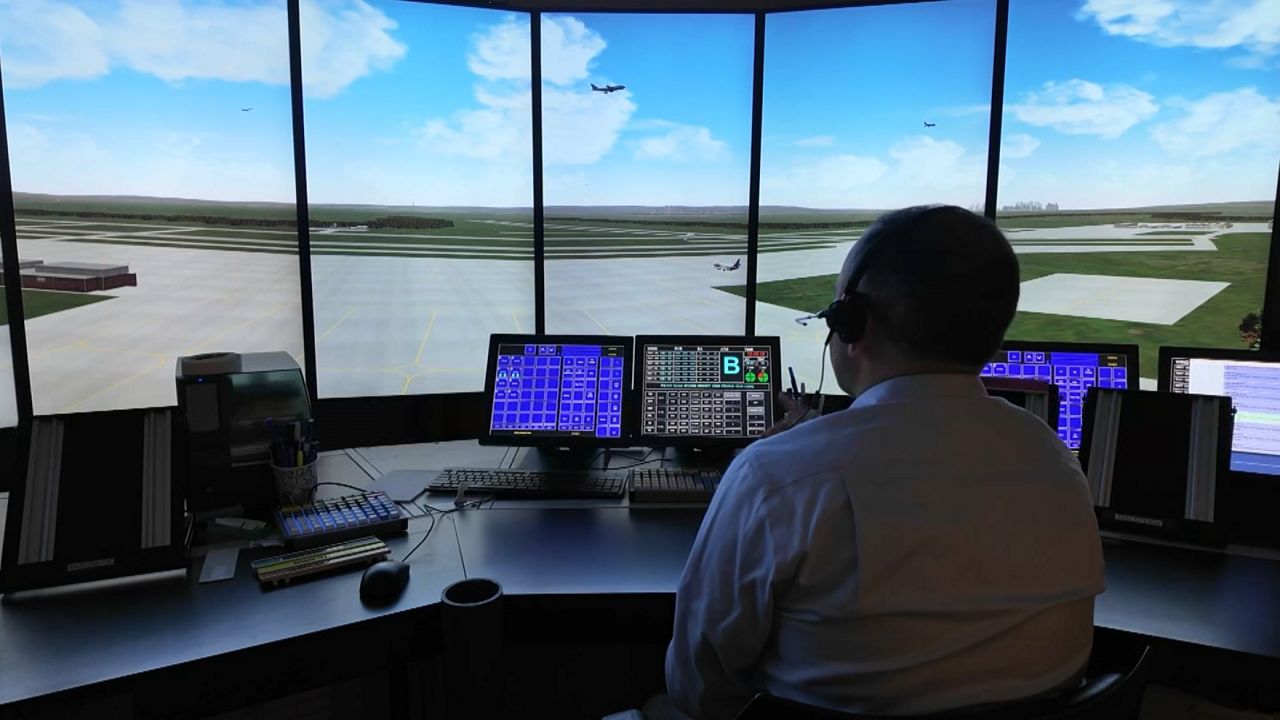
Adam Kutscera says he always looked to the skies for his future, and this past school year, he trained on an air traffic control simulator at Vaughn College of Aviation in Queens. Soon he will be off to a real control tower.
“My grandfather was in aviation. He was in World War II, in the Air Force, and we just kind of started, kind of started like that. I used to go to LaGuardia, look at the planes sometimes,” Kutscera said.
What You Need To Know
In Queens, Vaughn’s Enhanced Air Traffic Collegiate Training program, or AT-CTI, allows students to bypass the FAA’s Oklahoma City academy and go straight to a control tower
The COVID-19 pandemic and a mandatory retirement age created a nationwide shortage of controllers, and the academy’s limited capacity couldn’t handle the needed influx of trainees
U.S. Transportation Secretary Sean Duffy allowed nine aviation colleges to provide the same training to facilitate more controllers coming online, including Vaughn
The FAA says around 4,000 controllers are in the pipeline
Kutscera is one of nine students who graduated in June as part of the inaugural class of Vaughn’s Enhanced Air Traffic Collegiate Training program, or AT-CTI, which allows students to bypass the FAA’s Oklahoma City academy and go straight to a control tower.
The COVID-19 pandemic and a mandatory retirement age created a nationwide shortage of controllers, and the academy’s limited capacity couldn’t handle the needed influx of trainees — so U.S. Transportation Secretary Sean Duffy allowed nine aviation colleges to provide the same training to facilitate more controllers coming online, including Vaughn.
“It’s because of what’s behind me, simulation, that we can actually recreate exactly what happens at the FAA academy at places like Vaughn,” Sharon Devivo, president of Vaughn College, said.
Instructors say the curriculum and the tests that follow are rigorous, and that it takes a lot of skill and dedication to succeed.
“The amount of time it takes and their ability to multitask and do more than one thing at a time. One of the simple things is to write and talk at the same time. Sounds easy, but it’s not so easy,” Steve Fanno, a retired air traffic controller and instructor, said.
Although Kutscera says he’s ready, “I feel like I could walk into any tower and basically get a good grasp of what’s going on.”
He must continue training in a real tower for about two to three years. Kutscera is one of 4,000 controllers the FAA says are in the pipeline.
Currently, he’s trying to decide which small airport to complete his training.
“As they get more experience and become what’s called a certified professional controller (CPC), they can transition to major airports like LaGuardia, JFK, Newark,” Devivo said.
The FAA says the shortage has eased between the expansion of training and the offering of bonuses for controllers to keep working past the retirement age.
As of April, there were about 11,000 certified controllers at 300 towers around the country, according to the FAA.
The plan is to hire 2,200 by the end of this year, and the federal government says it’s more than three quarters of the way there.