
Photo: Adam Gray/Bloomberg/Getty Images
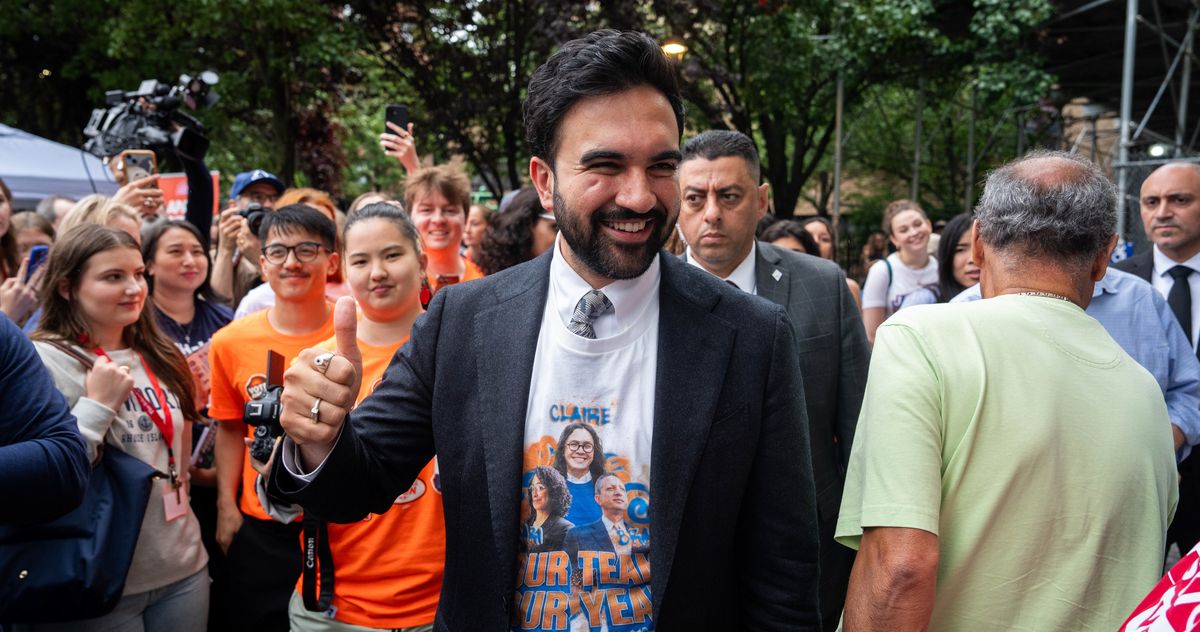
Nobody, not even the co-chair of the New York City chapter of the Democratic Socialists of America, anticipated the depth and breadth of the group’s success in last Tuesday’s primaries. “If we were to elect all of our candidates tonight, we would almost double our cohort in the State Legislature,” Gustavo Gordillo told me a few hours before the polls closed. “I’d be happy if we won a majority of our races.”
Gordillo and the DSA did a lot better than that. They carried nine out of the ten seats they went after, in some cases with blowout margins, defeating longtime representative Adriano Espaillat and three incumbent state legislators along the way. Much of the credit properly goes to Mayor Mamdani, but the political muscle came from energetic DSA volunteers who ran circles around New York’s aging, creaky network of traditional Democratic clubs and candidates.
Now comes the fight over what it all means.
The jubilant winners, naturally, are claiming a victory for their ideology. “NYC-DSA is not even close to reaching the ceiling of what the Left in this city can achieve,” columnist Liza Featherstone crowed in Jacobin, a socialist publication. “AIPAC money, racist attacks, and other evil and formidable facts of American life proved weaker than the superpower of thousands of sweaty and smiling volunteers committed to a vision of a better world.”
At the other end of the political spectrum, New York Post columnist Michael Benjamin rejects the notion that the DSA has won a contest of ideas. “Tuesday’s Democratic Socialist romp can’t be blamed on outside factors like inflation or Israel or the national party’s mad obsession with countering President Donald Trump’s every move,” he wrote. “No, it’s the result of 15 years of New York Democrats’ single-party rule — and the monstrous ego of Andrew Cuomo.” Benjamin, who once served in the State Assembly, believes that while Cuomo was positioning himself for a presidential run, “the state Democratic Party developed sclerosis as establishment leaders grew lazy, fat, comfortable and corrupt.”
“In business, we’d call this a hostile takeover,” said political analyst J.C. Polanco, a former president of the city’s Board of Elections, attributing the DSA victory to New York’s system of closed primaries, which give outsize influence to small, organized groups of Democrats and exclude the large and growing number of centrist voters who choose not to enroll in any party.
Whatever else happened, we know that the DSA out-organized mainstream Democrats by adopting the door-to-door, community-based approach that was once the pride of New York’s Democratic machine. “Having let its own turnout operation and neighborhood roots decay, the establishment couldn’t even manage to motivate non-fanatic voters to turn out Tuesday to stave off the Marxist Wave,” concluded an unsympathetic Post editorial board. “It got fat, then got eaten.”
In the Black neighborhoods of Central Brooklyn, traditional Democratic clubs were outworked and hopelessly outnumbered by waves of mostly white newcomers to the area, according to activist Mark Winston Griffith. Central Brooklyn — including Clinton Hill, Bedford-Stuyvesant, Crown Heights, East New York, Brownsville, and Flatbush — has incubated a sizable chunk of Democratic leadership, including former mayor Eric Adams, Public Advocate Jumaane Williams, Attorney General Letitia James, House Minority Leader Hakeem Jeffries, and Kings County Democratic chair Rodneyse Bichotte-Hermelyn. But the same area, where Shirley Chisholm made history as the first Black woman elected to Congress, is undergoing a rapid demographic transformation: Between 2010 and 2020, according to Census figures, 30,000 white residents moved into Bed-Stuy while 22,000 blacks moved out, and the numbers have accelerated ever since. Three-quarters of Bed-Stuy households were Black in 2000; that number has fallen to 38 percent.
Central Brooklyn has approximately 4,000 DSA members, the largest local contingent of the group’s citywide enrollment of 14,400, according to Griffith. “These are not passive card carriers but a highly activated, vast reservoir of volunteers who flood the zone with social media, knock on doors, and animate campaigns at every administrative and mobilization level,” he wrote.
By contrast, Vanguard Independent Democratic Association, a storied, 50-year-old political club started by the late Al Vann, claims approximately 150 members. The lopsided numbers explain why VIDA’s slate went down in flames, with Assemblymember Stefani Zinerman losing her seat to DSA candidate Eon Huntley.
DSA’s tendency to promote Black and Latino candidates backed by a mostly white organization has created tension in the community and within the DSA itself. “Although it’s understood across the chapter that our membership doesn’t reflect the race and class diversity of the communities we seek to organize, there’s evidently little will to proactively address this problem,” wrote Brooklyn DSA activist Maya Meredith in a 2024 Medium post. “The reality is that NYC-DSA fails to recruit and retain working class people of color because we’ve failed to build trust with these communities.”
The best outcome for New York would be for traditional Democratic organizations to up their game, get back to basics, and compete with the DSA. It used to be common for Democratic organizations to launch voter-registration drives in the months leading up to an election year, then stay in touch with those newly enrolled voters through regular canvassing with volunteers knocking on the doors of registered Dems to see how people are doing, ask about local concerns, and remind them to vote.
Mamdani and other DSA activists, who boast about how many thousands of doors they’ve knocked on, may not realize how old school the technique is. As far back as the presidential election of 1800, Thomas Jefferson won thanks to the relentless, innovative campaigning of his running mate Aaron Burr in the old Sixth and Seventh Wards stretching across what is now the Lower East Side.
“Our organization was completed by dividing the city into small districts,” wrote a campaign observer, “with a committee appointed to each, whose duty it was to canvass the district and ascertain the political opinion of each voter by going from house to house.” This was considered crass and unheard-of in an age when candidates tended to issue printed manifestos and let voters decide. The Jefferson-Burr ticket narrowly carried the city and won the presidency with Burr boasting to an opponent, “We have beat you by superior management.”
More than two centuries later, the DSA can make the same claim.
Sign Up for the Intelligencer Newsletter
Daily news about the politics, business, and technology shaping our world.
Vox Media, LLC Terms and Privacy Notice