
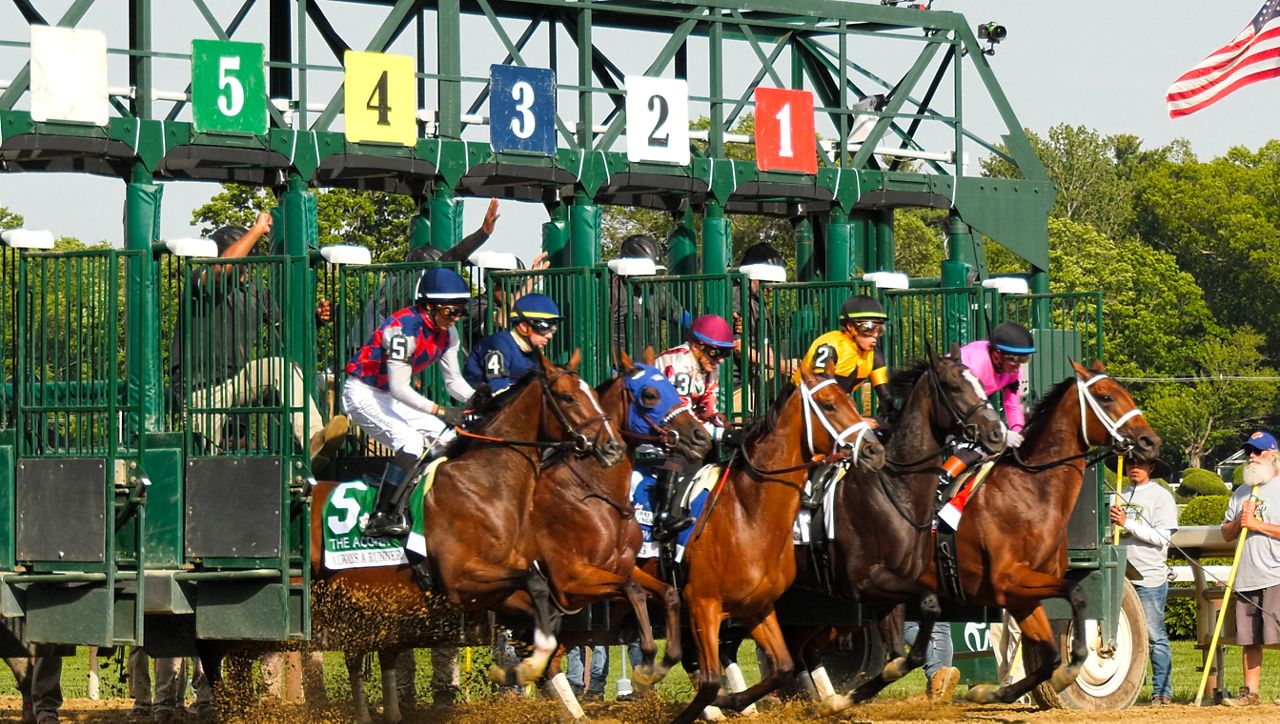
Legendary sportswriter Red Smith once wrote: “From New York City you drive north for about 175 miles, turn left on Union Avenue and go back 100 years.” Simple directions to the Saratoga Race Course.
“I think it’s probably one of the best venues for racing there is in the entire country, maybe the world, for that matter,” said Bill Mott, a thoroughbred trainer.
It’s one of the oldest sports venues in the United States. Built during the Civil War, the place is filled with history beyond just horse racing.
“If you’re a horse racing fan, this is Mecca with all the history and the quality of the races here,” said Tom Durkin, a former track announcer at Saratoga. “The atmosphere is unlike any other racetrack in America.”
The story of Saratoga started across the street in 1863. The first four-day meet was organized by John Morrissey, next to what is now the Oklahoma training track. It attracted 5,000 fans.
“It was so successful that they built a racetrack across the street in 1864, and it was a big hit right after that,” Durkin said.
As the popularity of Saratoga grew over the next 163 years, so did the number of days. The meet jumped to 24 days in 1962, then 30 days in 1991, 40 days in 2010, and this year a record 51 days.
“The town was a big resort with gambling prior to the Saratoga Race Course, and then the race course just became, over the years, the greatest race course in America,” Durkin said.
Over the decades, it’s earned the nickname “The Graveyard of Champions.” Upsets included the 1919 Sanford Stakes, when a horse named Upset beat then-undefeated Man-O-War. Many believe this is where the word “upset” entered the American sports lexicon.
“It is unique in the professional sports entertainment world in that it’s an authentic Victorian building, for starters, and there’s a tradition here,” Durkin said.
The course has a tradition of drawing the best horses in the country to upstate New York — thoroughbred Triple Crown winners like Secretariat, Seattle Slew and American Pharaoh. The venue allows visitors to have a close encounter with these athletes.
“The horses actually walk right through the crowd to get to the paddock,” Durkin said. “If you could, you could almost reach out and touch them. You can see the spirit in their eyes and the muscle and sinew and their attitudes and really up close.”
From its quiet begin to recently being the temporary home of the Belmont Stakes, Saratoga has seen it all. It’s a place that hasn’t changed much over the last century, and that’s just the direction horse racing fans want.
The summer racing season at the Saratoga Race Course begins Friday with the July 4 Racing Festival.