
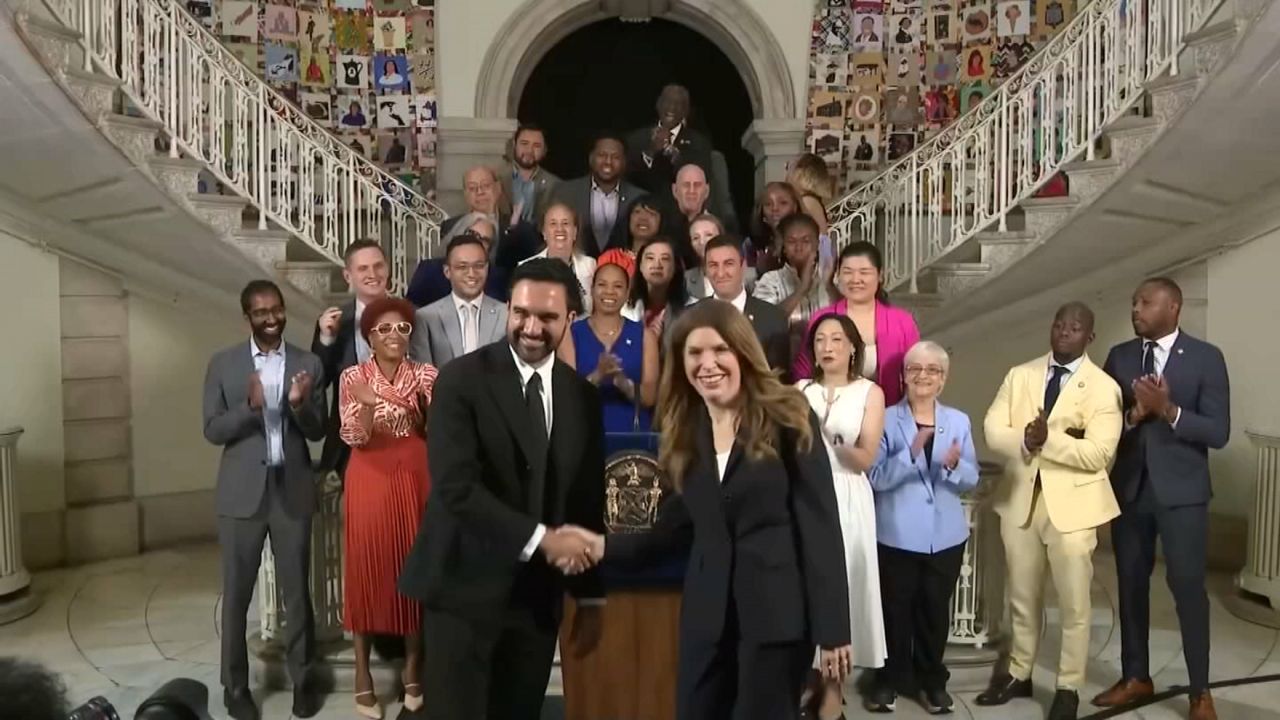
Mayor Zohran Mamdani said this upcoming city budget will give New Yorkers the information some have long been seeking on city records after 9/11.
“New Yorkers who have become sick have had to fight for information that should have been theirs from the very beginning,” he said.
What You Need To Know
In his handshake budget agreement, Mayor Zohran Mamdani announced $34.2 million will be allocated to create a public portal of all 9/11 documents
A day before the budget announcement, lawyers for Mamdani in state court argued it didn’t have certain 2001 records that weren’t saved
$4 million was separately earmarked for the Department of Investigation to complete its examination on what the city knew and when regarding the air quality in Lower Manhattan after the terrorist attacks
He said $34.2 million of the $125 billion budget had been set aside to create a public portal of documents about the city’s investigation into the air quality in Lower Manhattan after the terrorist attacks nearly 25 years ago.
“We will provide the transparency that New Yorkers living with post 9/11 health concerns deserve,” said the mayor.
However, the funding came as a surprise to the woman whose hand he shook just minutes before to mark the preliminary agreement: Speaker Julie Menin, according to one city council member NY1 spoke with.
A Menin spokesperson told NY1 he didn’t have details when asked for specifics about the portal funding. He noted that her finance team would respond. NY1 is waiting for that reply.
Menin wasn’t the only member of the City Council unaware of the portal funding.
“The $34 million I know nothing about,” Council Member Gale Brewer told NY1 Thursday.
Both knew the city’s corporation counsel, Steve Banks, had promised to create a portal, according to a press release from this spring. Multiple sources, including from City Hall and a public records lawyer, told NY1 they could not believe how much money was being committed to create this online portal of city files.
A spokesperson for Mamdani said the portal will have millions of documents, and they will need to ensure all personal information — such as addresses and social security numbers — is redacted.
When asked how the mayor’s office arrived at more than $34 million for the portal, NY1 never heard back.
“It’s easy to get used to inflated numbers if that’s the water that you swim in, if you’re in the civic sphere,” said Daniel Golliher, a cities and AI fellow at the Manhattan Institute. “Typically, these numbers are highly inflated. They’re not normal. It is very worth looking into them.”
Also in the budget is $4 million for the Department of Investigation for an ongoing inquiry to find out what the city knew and when regarding the toxins in the air in Lower Manhattan.
That investigation was launched after the City Council passed a resolution, sponsored by Brewer, mandating the DOI examine this issue.
That DOI investigation has required city agencies to turn over their records, although in the past, a spokesperson for the city’s inspector general had declined to elaborate beyond that. Brewer said the $4 million will fully fund the work, as DOI leadership had relayed to her during the budget negotiations.
The funding for the city investigation is nearly one-ninth the amount to create the public portal on the same documents about the same topic.
“You need to talk to Steve Banks, who’s the head of the law department,” said Brewer when NY1 raised that question.
The law department did not respond to NY1’s request for comment on Thursday. The mayor’s office didn’t address that question either.
The genesis for the DOI investigation came as NY1 has extensively covered the efforts by a group who have spent nearly three years trying to obtain city records about the air quality in Lower Manhattan after 9/11.
Andy Carboy is one of the pro-bono lawyers representing a group of family members whose loved ones died from 9/11-related illnesses along with a nonprofit. Litigation in state court against several agencies is ongoing.
The Department of Environmental Protection insisted for many months that it had no relevant records — from test results to liability discussions. After having his Freedom of Information Law request and appeal both denied, Carboy sued the city agency.
After calling Carboy’s FOIL a fishing expedition, city lawyers revealed they discovered 68 boxes worth of materials.
Most of it, according to Carboy, revolved around testing. The files, some reviewed by NY1, showed the city requesting data from building owners months after lower Manhattan had largely reopened. Some building owners responded that they had no idea they had to get testing.
A state Supreme Court justice granted Carboy to depose two DEP officials about what happened.
Carboy also asked for records from the mayor’s office, which had requested 10 extensions before sharing in March that it had no relevant documents from 2001 about any discussions about liability risk the city could face.
However, about a month earlier, Carboy told NY1 in a television exclusive that he obtained a memo he specifically asked the city for in his public records request — from an archive at a University of Texas library.
The memo outlined potential litigation the city could face, including for people returning to Lower Manhattan before it was safe.
The undated document, sent to Bob Harding, a deputy mayor under then-Mayor Rudy Giuliani, did not state that the city knowingly did so.
Carboy sued the mayor’s office earlier this year, challenging its claim of having no records.
On the same day Mamdani pledged transparency on the 9/11 records at his budget announcement, his lawyers filed a court document laying out why they say they don’t have the records Carboy requested.
“The Mayor’s Office does not retain individuals’ emails in this EV database unless they still worked for the City after January 1, 2002,” said Saarah Dhinsa, an assistant corporation counsel, in the request to dismiss Carboy’s lawsuit.
In all, there were 12 different combinations searched through the database. Zero relevant records were found, according to the June 30 court filing.
That includes searches for the memo sent to Harding, which Carboy got elsewhere.
A search at the only long-term physical storage site also yielded nothing, according to Dhinsa.
“I don’t know how to answer that. It’s very strange,” said Brewer when asked about the city’s explanation.
“DOI is the only agency I can trust,” she added, saying on this topic, she doesn’t have confidence in any other city agency.