
by Michelle Mullen
As the nation prepares to mark its 250th anniversary, the Bronx County Historical Society is highlighting stories of the pursuit of liberty rooted in the borough’s own backyard.
Its new exhibit,”The Bronx; Crucible of Liberty: Radicals, Runaways, & Revolutionaries; 1600–1850,” opened July 1 at Norwood’s Museum of Bronx History, and argues the story of American freedom was shaped not only in Philadelphia or Boston, but through a myriad of sites, most erased by time, scattered throughout present-day greater Riverdale and across the Bronx.
The show is part of the historical society’s “America 250: The Bronx” initiative, Steven Payne, executive director of the Bronx County Historical Society, explained. The temporary exhibition traces hundreds of years of competing ideas about what freedom looks like.
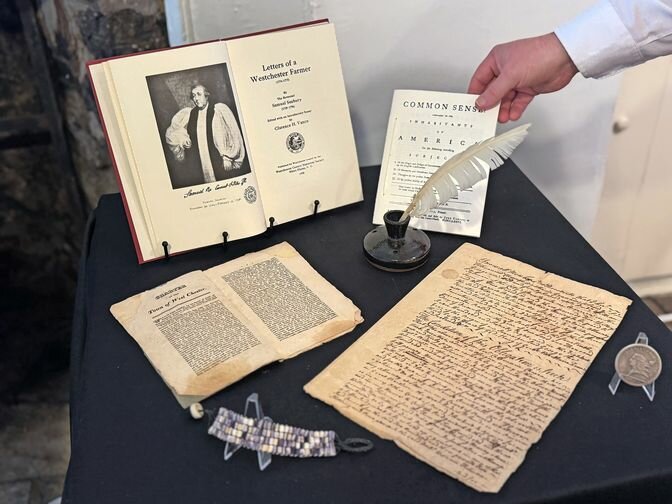
Upon entering the first-floor room holding the exhibit, visitors are met by several posters lining the walls — each one reading intricately detailed information on the Bronx’s storied past — alongside historic letters, illustrations and a modern-day replica of a Union soldier’s uniform.
“The main thread for the exhibit is different practices, different ideas of liberty from 1600 to 1850,” Payne said. “Obviously the American Revolution is a huge part of that… but it begins before and ends after the American Revolution, and it puts a lot of stories in a kind of tension with each other.”
The exhibition occupies the Valentine-Varian House at 3266 Bainbridge Avenue, one the Bronx’s oldest surviving homes. The stone house stood throughout the Revolutionary War, although it was captured by British troops in 1776. At the time, George Washington was living at the nearby Van Cortlandt House, which also served as temporary headquarters for his troops.
The show kicks off long before 1776, introducing visitors to the Lenape Native Americans who occupied the greater Riverdale and beyond, largely prior to European settlement. It explores traditions of diplomacy — including the exchange of wampum belts, which Payne said were intended to establish relationships and mutual obligations between nations. However, the practice was later misunderstood by Europeans as a form of commercial exchange.
From there, the exhibit moves through the stories of Dutch and English republican ideals, religious dissent, colonial settlement and the contradictions that emerged as Europeans sought liberty for themselves while denying it to others.
Those competing visions of freedom eventually spilled beyond political philosophy and into open conflict.
By the time the American Revolution reached the Bronx — then part of Yonkers — Payne said, questions of liberty had become deeply personal, shaped by lived experience — whether someone was an Indigenous leader defending ancestral land, an enslaved person seeking freedom, a Loyalist or a Patriot.
For greater Riverdale residents, that history is remarkably close.
Unlike many Revolutionary War battlefields that have since disappeared beneath urban development, much of the Kingsbridge battlefield survives within Van Cortlandt Park and its surrounding area, even if portions are now occupied by trails and athletic fields.
Among its most significant was the Battle of Kingsbridge, also known as the Stockbridge Massacre, which unfolded in what is now Van Cortlandt Park in August 1778. It was at the site that the Stockbridge Militia, a regiment of Mohican soldiers who had settled in Stockbridge, Massachusetts, were ambushed by British troops and Queen’s Rangers.
More than 500 British soldiers overwhelmed roughly 60 Stockbridge fighters, according to previous reporting by The Press. Between 15 and 40 were killed, while historical accounts indicate that three men who surrendered after being promised safety were executed.
The exhibit tells that story through Abraham and Daniel Nimham, Indigenous leaders who fought alongside the Stockbridge Militia after years of unsuccessfully trying to reclaim lands taken from their people by colonial landowners.
“For them it was a very personal thing, fighting against the British,” Payne said, pointing to a 1766 document describing the seizure of indigenous lands by British colonists. “It’s never entirely sure how much they were fighting for the Americans, but they were definitely fighting against the British.”
The final portions of the exhibit move beyond independence, exploring the unfinished evolution of American liberty through Gouverneur Morris’ role in shaping the Constitution, early abolitionist thought, the Underground Railroad and one of the Bronx’s earliest Black churches.
Together, Payne said, the stories reveal that the nation’s founding ideals were never fixed but continually debated and redefined.
“The main thing that I hope people take away [from the exhibit] is conversations about the complexities of American traditions of freedom,” he said. “They may mean different things to different people, but that’s always been a part of history. I think the most robust freedom comes from being able to talk and debate — and in some cases fight out — what it means, and for whom.”
Keywords
Bronx County Historical Society,
Museum of Bronx History,
America 250,
America 250: The Bronx,
Bronx history,
Revolutionary War,
American Revolution,
Battle of Kingsbridge,
Stockbridge Massacre,
Van Cortlandt Park,
Valentine-Varian House,
Riverdale history