
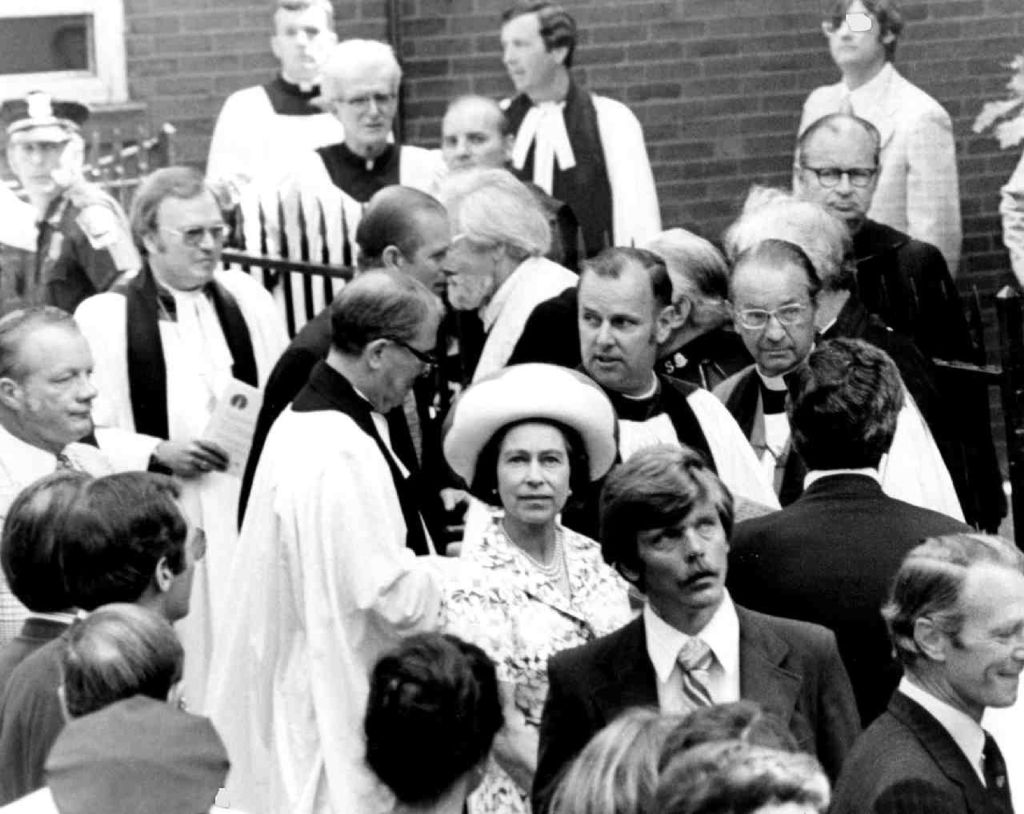
Maybe it was the hug, or the gin run, or just the heady atmosphere, but the lunch held in Kevin White’s City Hall office that summer Sunday all those years ago symbolized the promise of what Boston could become — a global city, sophisticated and metropolitan, the kind of place that could host big events and get big things done.
But let me back up a bit. Fifty years ago, this coming week, Boston hosted two visits that propelled the city out of its second-class status. First, on July 10, 1976, 30 majestic Tall Ships sailed into Boston Harbor to mark the city’s celebration of America’s Bicentennial. The second visitor came the next day, majesty of a different sort.
Queen Elizabeth II’s visit to Boston on July 11 of that year was a watershed moment for a city struggling with numerous urban problems. It was only for a day – but what a day it was. To truly grasp what her visit — and the celebration of the country’s 200th anniversary that surrounded it — meant to Boston, you first have to understand where things stood in the city that year.
The Bicentennial Year had arrived in Boston six months earlier, on a gray and windy New Year’s Day, and the mood at City Hall was just as gloomy. Because in many ways, the city was a mess.
Make no mistake: Kevin White, about to begin his third term as mayor, had made tremendous strides over the previous eight years to halt Boston’s decline and spark the rebirth of the city he loved. But there was a lot that was out of his control, developments working against him, and at the top of the list was the issue that Kevin rightly said ripped the heart out of the city: court-ordered school busing.
Judge Garrity’s busing order two years earlier was still an open, bleeding wound that worsened racial tensions and prompted protests and riots. Boston was making national news for all the wrong reasons. It seemed like NBC News had more camera crews in Boston than they had sent to Vietnam when Saigon fell.
Busing and racial disharmony might have been the biggest of Kevin’s headaches, but they were far from the only ones. As the new year broke, numerous challenges loomed over Boston like a spectre – a shaky economy that reflected the national recession, urban crime and decay, an expected $30 million budget deficit that was going to necessitate a tax hike, the need for more housing, and a downtown and waterfront in need of revitalization.
Boston’s rebirth
People who only know the Boston that resulted from the hard work of Mayors Kevin White, Ray Flynn, and Tom Menino would not have recognized the city as it looked 50 years ago. Downtown was in decline. The outdated Quincy Market was still in the process of being transformed into bustling Faneuil Hall Marketplace. Copley Place was empty. Old warehouses dotted the waterfront, and the Seaport, now the city’s modern jewel, was a desert – two great, dearly missed restaurants, Jimmy’s Harborside and Anthony’s Pier 4, stood like an oasis amid a desolate stretch of parking lots and weed-strewn parcels.
Today it might seem like Boston’s cosmopolitan status was preordained, but as 1976 dawned, the city’s future prosperity still very much hung in the balance. I was privileged, as the city’s communications director working for a visionary mayor, to have a front-row seat. Kevin knew what Boston could become, and we worked every day to close the gap between where we had been and his dream of a world-class city.
Then came the summer. To a city that had been kicked in the teeth by a lot of things out of our control – racial tensions worsened by busing, inflation and a sputtering national economy, looming budget cuts and tax hikes — the first two weeks of July 1976 restored Boston’s spirit and proved we could be a modern, resilient city with a bright future. And all it took was an international flotilla of sailing ships and a royal visit.
The Tall Ships, including some of the giants, had sailed up from New York and staged off Deer Island, before parading into the Inner Harbor in a glorious nautical spectacle escorted by the USS Constitution – just as they will do again in a few days. Media reports put the crowd watching the Parade of Sail at 650,000. Two days later, almost a million people visited the ships at their berths alongside the harbor.
The Queen’s hug
One of the Boston cops who played a large role in the security operation was Bill Bratton, then a lieutenant. Bratton, of course, would go on to run the Boston, New York, Transit, and Los Angeles Police Departments, and become the face of modern policing strategies in America.
Amid the Bicentennial celebration came one of the best days I can recall from my years in the White administration. We had known for some time that Britain’s Queen Elizabeth II was coming to Boston on July 11, and in the days leading up to the visit members of the State Department were at City Hall going over protocols, logistics, and the like. Two of their most sacrosanct rules were, one, to always address the Queen as “your majesty,” and two, never, ever, put your hands on her.
Well, I thought, no kidding. Who in their right mind was going encroach on the Queen of England’s personal space?
The Queen and her husband, Prince Philip, sailed into Boston that morning on the royal yacht Britannia, docking at the Charlestown Navy Yard. This was a big deal – for the first time ever, a British monarch was coming to the city where the flames of revolt against her country had been ignited two centuries earlier.
She began her visit reviewing a parade of cadets from the various Tall Ships from the balcony of the Old State House. The Queen understood the symbolism of the day, and she delivered the goods.
“If Paul Revere, Samuel Adams, and other patriots could have known that one day a British monarch would stand on the balcony of the Old State House… they would have been extremely surprised,” she proclaimed. “But perhaps they would also have been pleased to know that eventually we came together again as free peoples and friends to defend together the very ideals for which the American Revolution was fought.”
The Queen’s speech drew wide praise, deservedly so, a gesture of reconciliation and friendship between the two nations. But observers looking for signs of a close friendship hadn’t seen anything yet.
Late that morning the Queen arrived at City Hall and was taken in through a back entrance and up to the mayor’s office. Flowers had been placed everywhere. About a hundred people, including many of the city’s power brokers, were gathered around.
Queen Elizabeth walked in looking magnificent in a glamorous, low-cut dress. Mayor White, with his movie star looks, was there to welcome her. But Kevin must have missed the memo about no touching, because the first thing he did was give the Queen a big hug.
The suits from the State Department gasped.
And then the Queen hugged him back. The mayor held the Queen’s hand as he took her around the room to meet everyone. I was standing off to one side with Ira Jackson, Kevin’s former chief of staff who was still a source of sound advice for me. When the mayor and Queen got to us, Kevin said to her, “you know Ira and George.”
Her majesty must have been thinking, “huh?’ I can swear I saw the State Department guys shaking their heads.
The royal couple enjoyed a luncheon, and the mayor made sure plenty of fine wine was served. The Queen was offered a glass.
Dropping her voice almost to a whisper, the Queen of England asked the mayor of Boston if it would be possible to have a gin and tonic instead.
The mayor turned to me and gave an order: Find some gin. Needless to say, we had none at City Hall and since it was before noon on a Sunday, no bars were open yet. I grabbed Ron Conway, a BPD officer assigned to Area A, and explained the problem. Fortunately, there were a lot of officers around for security, and Ron dispatched two motorcycle cops to the old SeaSide restaurant at Faneuil Hall to bring back gin and tonic water. Mission accomplished.
The Queen had a winning personality. She said to someone there, “you have such a handsome mayor,” a compliment that Kevin ate up. She also admired a picture of The Rolling Stones that the mayor had in his office, a memento of the night a couple of years earlier when, enroute to a concert at Boston Garden, the Stones had been arrested at Warwick Airport in Rhode Island for assaulting a photographer. Kevin, fearing the Garden crowd would riot if the Stones didn’t show, expedited their release and got them up to Boston with a police escort, in time to take the stage just after midnight.
The Queen must have appreciated what the mayor had done for her countrymen.
Tour of the city
The rest of the Queen’s day was filled with motorcades, a parade, private engagements, and, to top it off, a huge cake created by Montilio’s Bakery in Quincy, a 3-foot by 6-foot replica of the royal yacht, with the words “Welcome to Boston / Queen Elizabeth – Prince Philip.” She loved the cake so much she wanted it put onto her yacht for a party that night. The cake was so big that it had to be hauled to Charlestown by a city truck and hoisted onto the Britannia with a crane.
By nightfall, the royal couple had departed aboard Britannia for Montreal for the opening ceremony of the Olympics. In Boston, millions of people continued to tour the Tall Ships for four more days.
Five decades later, it’s clear that July 1976 was a turning point in Boston’s history. The city had hosted a global event and the British monarch, and in doing so had shaken off its reputation as a parochial backwater. Boston earned national attention for something other than racial tension and urban decline. Our role in the founding of our nation, our historic architecture, the vast potential of our working harbor – all of it was on display for the world to see.
Kevin White went on to serve as mayor for eight more years, and his administration became known for the many brilliant, talented people he brought into local government. By the time he left office, much of his vision had become reality, or was well on its way. It was the start of a period of amazing growth. Downtown and the financial district were being revitalized. Copley Square was being developed. The waterfront was opened to greater public access. The transformation of Faneuil Hall was completed.
Most of all, the spirit of Boston was alive and healthy. The good feelings would endure and expand as the city developed into an international hub for innovation, technology, and health sciences. July 1976 showed what the city was capable of, and it all started with sailing ships and a royal visitor.
They really were healing events.
George K. Regan Jr. is the founder of a public relations firm, Regan Communications, and former communications director for Mayor Kevin White.
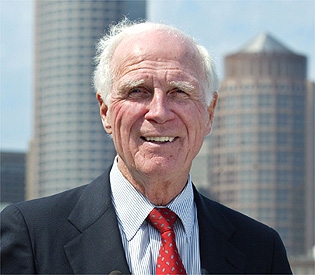 Former Mayor Kevin White. (Herald file)
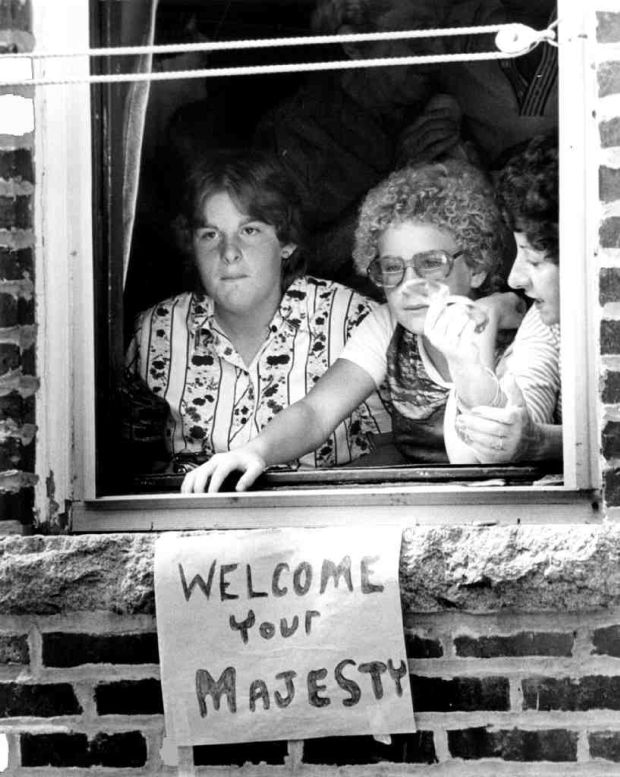 Boston welcomed the queen, circa 1976. (Herald file photo)
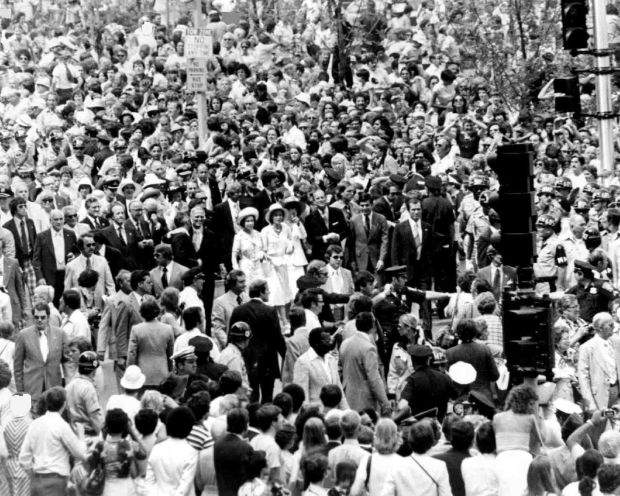 It was a wild scene in 1976 when the queen visited. (Herald file photo)
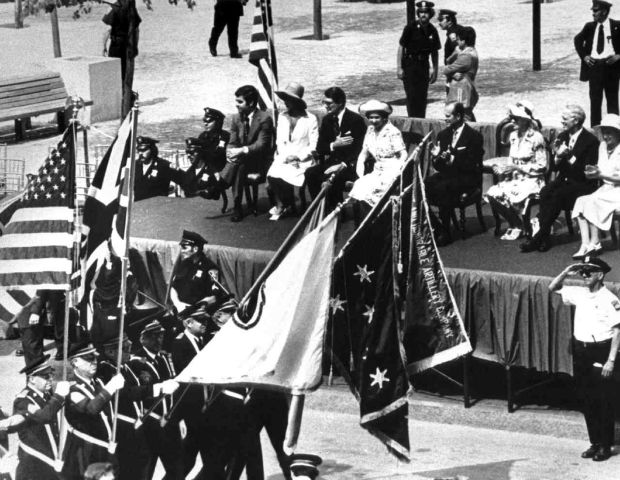 The viewing stand (Herald file)
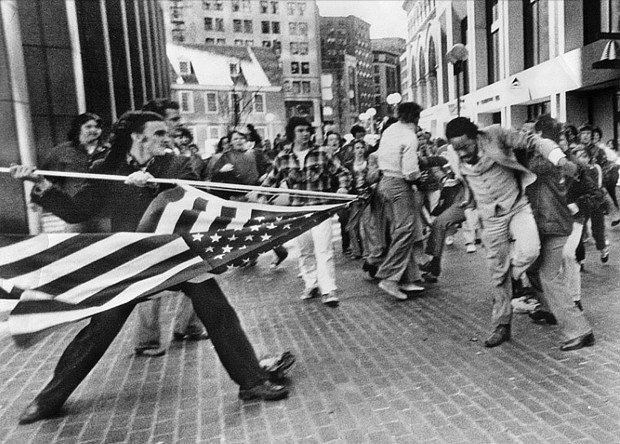 Stanley Forman’s photo titled ‘The Soiling of Old Glory,’ shows an attack on a young black lawyer, Ted Landsmark, in downtown Boston during a 1976 anti-busing demonstration. (Herald file photo)