
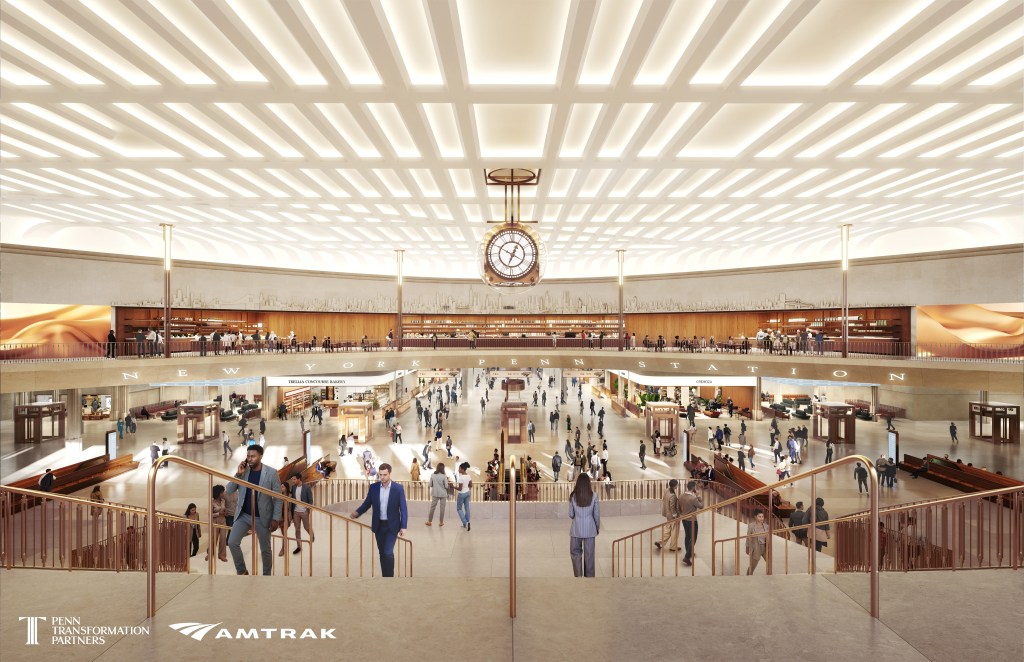
The Knicks’ first NBA championship in 53 years isn’t the only long-awaited comeback unfolding in Midtown Manhattan. Under Madison Square Garden, Penn Station is poised for its own revival as Amtrak launches an ambitious overhaul of the Western Hemisphere’s busiest rail hub.
People can be forgiven for questioning whether Amtrak’s bold new vision will ever come to life, given that more than a dozen Penn redevelopment plans have been proposed and abandoned since the original station was torn down in the 1960s.
But just as with Jalen, OG, and Coach Brown, things are different now. There are new players in the game. Just a little over a year after Secretary Sean Duffy and the U.S. Department of Transportation took control of the famed station’s overhaul, work is already underway to break ground next year and complete Penn’s redevelopment by 2034.
President Trump and the transportation secretary have made clear they will provide the support, commitment, and resources that were lacking in every previous attempt to redevelop Penn Station.
And it has marked the beginning of Penn Station’s great comeback.
I am the Penn Station project executive for Amtrak, and in the spirit of transparency that will define this entire enterprise, I want to address some fundamental questions New York is asking following the release of the new station’s stunning renderings from Penn Transformation Partners (PTP), the master developer selected for the task.
Our vision for the project is to completely reimagine Penn Station, inside and out, and to create a grand gateway for the nation.
We envision the new station as a sunlit civic landmark with ceilings rising to 55 feet and Art Deco detailing in stone and bronze. Today’s warren of low-ceilinged, dingy hallways will be replaced by a single grand concourse featuring shops and restaurants, making it a destination for New York residents and visitors.
But this will be much more than a beautiful building. The new station will offer 165,000 square feet of space for pedestrian circulation, up from 70,000 today. It will feature more open train platforms and one-third more stairs, escalators, and elevators, making the station safer and accommodating passenger growth by enabling faster boarding and alighting. Working with USDOT, we are also closely studying other ways to expand train capacity.
Meanwhile, the new station, with a much more appealing street presence, will transform the surrounding blocks into a more vibrant hub in Midtown.
Some people have asked why we can’t yet provide a more precise cost than the $7 to 8 billion public estimate. That’s because the project uses a progressive financing model, commonly used for projects of this complexity, in which final costs are set in stages as the public and private partners agree on the final scope.
A fixed price cannot be set until the design and financing are finalized; until construction sequencing is worked out to maintain 24/7 operations; until the environmental review required by the National Environmental Policy Act (NEPA) is complete; and until several other steps, as outlined in a predevelopment agreement that Amtrak and PTP signed last month, are completed.
There is nothing novel about this. Other progressive P3s — LaGuardia Terminal B and the Goethals Bridge replacement, among them — settled their final costs only after a similar predevelopment phase. Both were successfully delivered.
The 600,000-plus travelers who come through Penn Station each day — more than the NYC region’s three airports combined — will have a transformed experience, and here’s the best part: There will be no fare hikes or surcharges for Amtrak, NJTransit, and MTA riders to pay for this redevelopment.
That’s a promise. It reflects how railroads fund major capital projects in this country: through federal and state capital budgets and grant programs, not farebox revenues. Fare increases, when they occur, come from a railroad’s operating budget. That is why the MTA did not raise fares to fund the Long Island Rail Road’s Third Track expansion, and why NJT did not raise fares to build the Portal North Bridge. Penn Station will be no different.
Penn Station’s transformation will be structured as a public-private partnership, or P3 — a performance-based agreement in which the public and private sectors both share the resources and risks.
This model has delivered some of the region’s most successful recent projects, including LaGuardia Airport’s Terminal B and Moynihan Train Hall — both built by members of the PTP team. This model can often deliver an infrastructure project more efficiently and effectively with improved cost and schedule certainty compared to traditional delivery models. Funding will come from a mix of federal grants to Amtrak, low-cost federal loans, and private financing and equity raised by PTP.
The federal commitment is already tangible. The Department of Transportation has invested $243 million to date — $43 million in 2025 to jumpstart the project and another $200 million last month to fund critical design and permitting work. In addition, this project is eligible for a significant share of the nearly $5 billion the department is investing in Amtrak’s Northeast Corridor to revitalize the nation’s major rail hubs.
This is New York’s premier station, and New Yorkers deserve a seat at the table.
The public will not be a bystander to Penn’s transformation. From this summer through 2027, Amtrak will conduct robust public engagement on design, financial plans, and the environmental review.
The 1963 demolition of the original Penn Station, one of the great 20th century American edifices, was a ghastly mistake that New York has lived with and tried to correct for six decades. Now, this project has the support it needs to help our country return to its tradition of building big, beautiful infrastructure that inspires onlookers and that delights riders.
We finally have the leadership, the partnership, and access to funding to right that wrong — and the riders who pass through Penn Station every day will get the world-class entryway to New York City they and America deserve.
Byford is project executive and special advisor to the Amtrak Board of Directors for the transformation of Penn Station.