
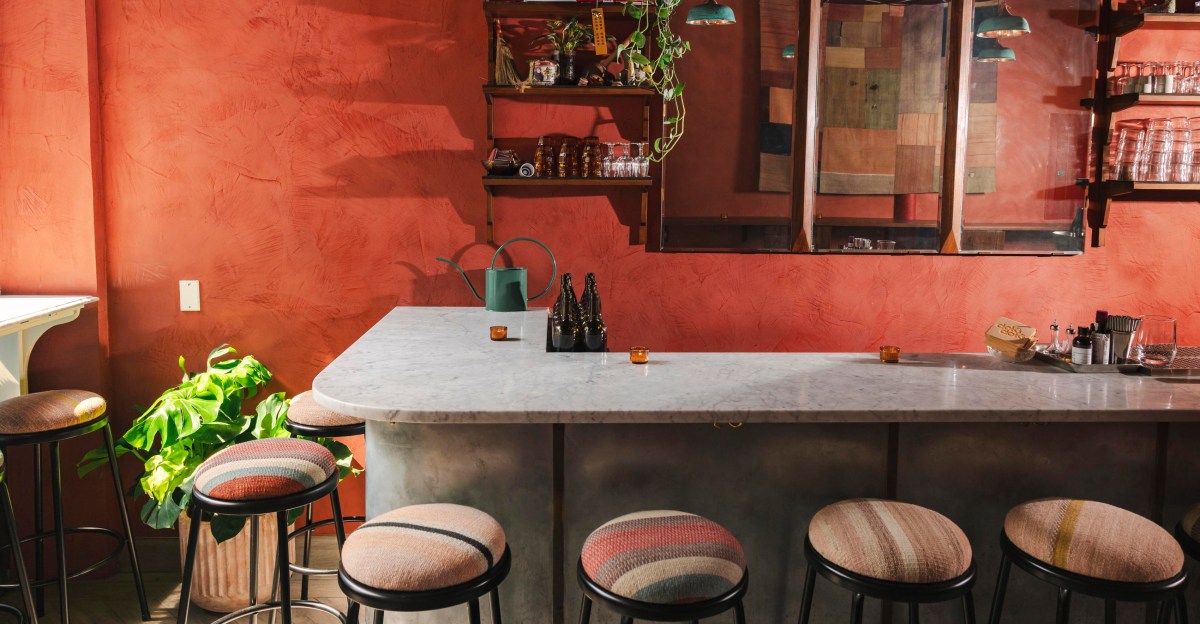
A new cocktail bar meshing the vibrancy, fun, and flavors of Japanese and Latin cultures has arrived in Brooklyn. Dokidoki opened in East Williamsburg at 160 Havemeyer Street, Suite S5, near South Second Street, on Thursday, July 2.
Dokidoki (pronounced “dough-key dough-key”) is the Japanese onomatopoeia for a beating heart. While the phrase can mean anything from anxiety to infatuation, co-owners A-K Hada and Christian Suzuki-Orellana (who also goes by Suzu) see it ecstatically. “This is how we want our guests and how we feel when we listen to some good music or have a really phenomenal drink or a bite that’s just you’re just feeling joy,” Suzuki-Orellana says.
The two, who are both half-Japanese, had been wanting to open their own bars for some time, and met because of a friend who “blind dated us,” Hada recounts. “We are both very much in line on what we find important in the spirits industry: longevity and caring for our staff.” They connected on a project with a longer lead time, so they decided to whip up something smaller ahead of that, thus, Dokidoki. The 300-square-foot space fits 30 people; it’s intimate, with droplet tables for slower days. They were inspired by tachinomi, the standing bars in Japanese train stations.

Christian Suzuki-Orellana and A-K Hada at Dokidoki. Shannon Sturgis
“We have something here that could really marry the worlds of Latin-Caribbean vibes to Japan,” Suzuki-Orellana says of Dokidoki. He knows that they’re not exploring anything brand new, pointing to Japanese and Chinese communities in Peru and Brazil. But the two want to offer their lens into what Latin-Japanese means to them, through the storytelling of their cocktails.
They’re working with a beer and wine license (no hard liquor), which allows them to play with what they’re able to. This means $16 cocktails made with shochu, sakes, and local meads.
The Ichiki Tini is a martini made with a sweet potato shochu and pineapple-lemon verbena-infused vermouth that’s served frozen and chilled. It has a slightly lower ABV than a regular martini, “but it feels very much like a martini; it has that little bite,” Hada explains.

The Ichiki Tini at Dokidoki. Shannon Sturgis

The Tropi Hai at Dokidoki. Shannon Sturgis

The Coastline Chronicles at Dokidoki. Shannon Sturgis
The Tropi Hai is their version of the ubiquitous chu-hai drink in Japan that’s everywhere, made with barley shochu, cold-brewed barley-cinnamon tea, clarified grapefruit juice, and tamarind. The Chucu-Chucu is a take on margaritas with honeydew, an agave wine, and roasted sweet potato shochu.
They tagged chef Daniel Maysonet of Puerto Rico restaurant Jungle Bird to develop the food. They’ll offer Japanese bar snacks with Puerto Rican and Salvadoran touches. The crispy pork belly is made with yuzu kosho and tamarind; the katsu sandwich is made with cod served on shokupan bread.
Hada had worked at various New York City restaurants and bars and had been the head bartender of speakeasy Please Don’t Tell for six years and helped open its Hong Kong branch. Then she became the general manager of Existing Conditions. Later on, she was the North American brand ambassador for Bacardi Rum, for which she won the Best U.S. Brand Ambassador award at the Spirited Awards in 2023 and 2024.

The cod katsu at Dokidoki. Shannon Sturgis
Suzuki-Orellana is from the Bay Area and worked in Tokyo and San Francisco bars and restaurants. He was a semifinalist on Netflix cocktail competition series Drink Masters in 2022 and ran his own Japanese-Salvadoran drinks pop-up, Kagano. He grew up more closely with the Japanese side of the family, going to Tokyo to visit his grandparents and their longtime restaurants and bars as much as three times a year. But recently, he’s been exploring his Salvadoran side.
Suzuki-Orellana points to the three cities that shaped him: San Francisco, Tokyo, and now, New York. “What all three of those places have in common is that they’re melting pots of so many different people, backgrounds, and ethnic groups. Being in these spaces and working in these kinds of places for me makes me want to have a bit of reflection in what I do for my work, and I think Dokidoki is exactly that: it is a place that is a melting pot of different backgrounds and cultures, and it becomes one homogenous beautiful thing.”
Dokidoki is open from 4 p.m. to midnight daily for walk-ins only.

A table at Dokidoki. Shannon Sturgis

The exterior of Dokidoki. Shannon Sturgis