
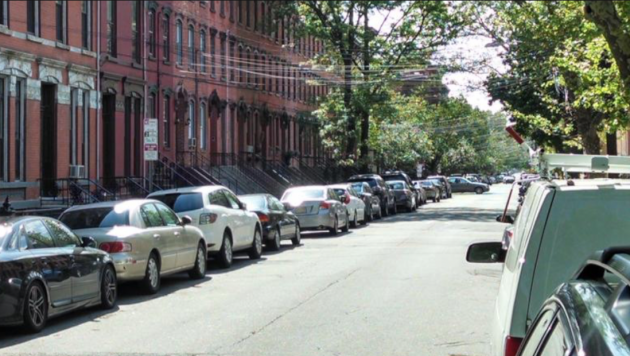
In an editorial, Jersey City resident Kevin Davis questions who bears the burden of a potential 1,100 percent increase for residential parking permit fees.
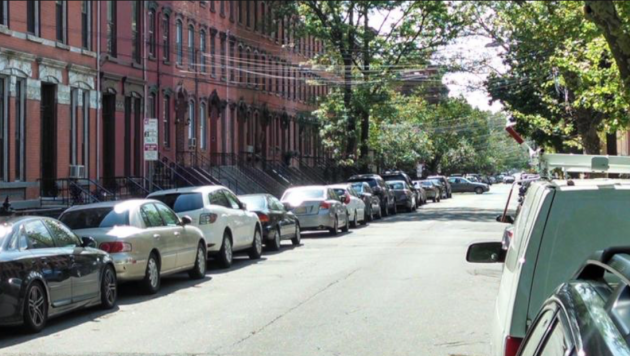 Twitter photo.
When Ward E Councilwoman Eleana Little announced she would introduce “parking reform” after promoting a proposal to raise Jersey City’s residential parking permits from $20 per year to at least $220 per year, I decided to ask a simple question, who pays?
Jersey City has a real fiscal problem. The city is debating significant property tax increases; homeowners have already seen large increases from county and school taxes, and many renters will ultimately feel those costs through higher lease renewals.
The discussion on this is focused almost entirely on raising new revenue and almost not at all on controlling spending. It is funny how every revenue proposal is always described as painless by the people who don’t have to pay the check.
I’m not arguing the city shouldn’t look for new revenue. I’m arguing that before adopting a new revenue source, we should understand who bears the burden.
To answer that question, I analyzed all 74 Jersey City census tracts using U.S. Census Bureau data and created the Jersey City Affordability Burden Index (JCABI) to estimate where a large flat increase in residential parking permit fees would be hardest to absorb.
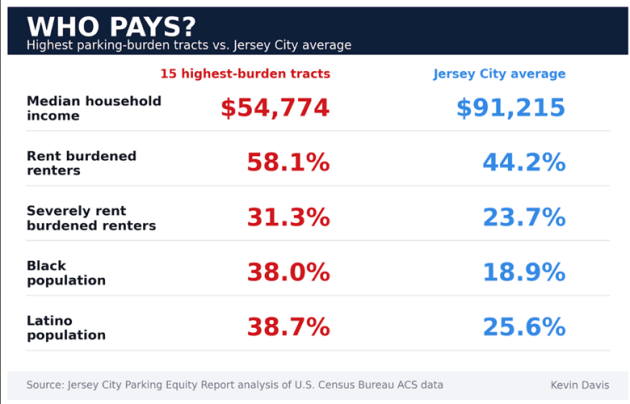
The top 15 census tracts with the highest estimated parking burden have a median household income of $54,774, compared with $91,215 citywide.
58.1% of renter households are rent burdened, meaning they spend more than 30% of their income on rent, compared with 44.2% citywide.
31.3% are severely rent burdened, meaning they spend more than half their income on housing, compared with 23.7% citywide.
Those same neighborhoods are 38.0% Black, compared with 18.9% citywide, and 38.7% Latino, compared with 25.6% citywide.
You can call it a permit, fee, or, “parking reform”, but It’s still a tax increase that only households with residential parking permits pay, on top of rising housing costs and the broader cost of living.
I don’t own a car. I get around Jersey City by bicycle and even have a part-time job giving bike tours in New York City.
I’ve publicly supported projects like the Franklin Street Protected Bike Lane, the proposed Willow Avenue protected bike lane, and the Hoboken Viaduct Shared Use Path because I believe they’re good public policy.
I’ve also advocated for stronger enforcement against dangerous cycling and for licensing commercial delivery riders.
When transportation advocates fight for better bike infrastructure, I appreciate it much of the time even if I disagree with some of their tactics, but fighting for cyclists shouldn’t mean imposing a policy whose greatest financial burden falls on lower and middle-income residents.
Ironically, fewer cars would probably benefit me personally.
My analysis does not argue that lower-income neighborhoods own more cars. In fact, wealthier neighborhoods generally have higher rates of vehicle ownership.
It asks a different question:
Among the households in each census tract that do own cars, where is another $220 annual bill hardest to absorb?
It’s the neighborhoods already facing the greatest affordability pressures.
Supporters of higher parking fees argue that better pricing of curb space can improve transportation and generate needed revenue. Those goals deserve serious discussion. But raising revenue and deciding who pays for that revenue are two different policy questions.
My tract-level analysis also found that higher estimated parking burden is associated with higher rates of rent burden and with larger Black and Latino populations. These correlations don’t prove causation, but they consistently identify the same neighborhoods as bearing the greatest estimated burden.
To be fair, not every recommendation in the broader parking reform discussion deserves criticism. Updating commercial parking policies or thoughtfully improving enforcement against dangerous illegal parking are fundamentally different from increasing residential parking permit fees sixteen-fold. Businesses using public space for profit are not the same as residents parking near their homes.
This proposal also isn’t new. Versions of substantially higher residential parking permit fees appeared in Jersey City’s 2020 parking study. What’s changed is the fiscal environment has given proponents of this idea an audience that is more willing to hurt their car-owning neighbors than they would be if the proposed property tax increase was in the single digits.
That makes it even more important to ask not only how much money a proposal raises, but where that money comes from.
Every public policy creates winners and losers.
My analysis suggests that burden falls disproportionately on neighborhoods that are already lower-income, more rent burdened, and home to larger Black and Latino populations than Jersey City as a whole.
Residents may ultimately decide that’s a tradeoff worth making, but let’s at least debate it honestly. When every curb starts looking like a revenue source, we’re no longer just talking about parking reform.
We’re turning Jersey City’s curbs into ATMs, Asphalt Teller Machines.
Authors Note: Those interested in inspecting my data can look at the attached excel worksheet.