
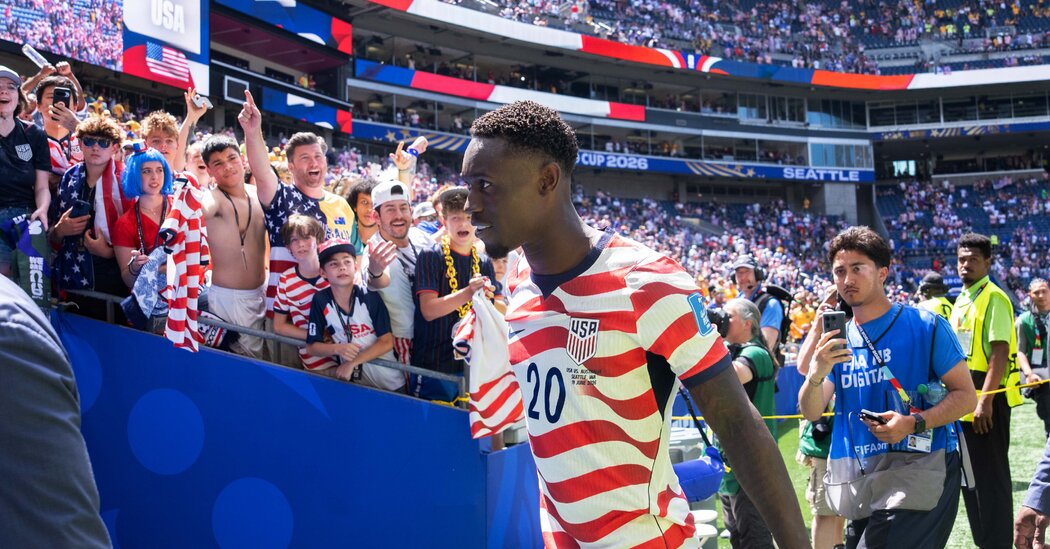
The joyful, communal festival of World Cup soccer that had seemingly brought the United States together has now been interrupted by a controversy that cuts through notions of fair play on and off the field.
And it was not hard to find opinions about it.
Last week, President Trump placed a phone call to the president of FIFA, world soccer’s governing body, that ultimately led to the reinstatement of a star U.S. player who had been suspended from Monday night’s game against Belgium in the round of 16. The player, Folarin Balogun, had been barred after getting a red card last week in a match against Bosnia and Herzegovina.
Reaction to the reversal ran from incredulity to condemnation to a few Hallelujahs.
Patrick McDonald, 48, who coaches high school soccer in Birmingham, Ala., said he agreed with the decision and pointed to his own league, where he says controversial calls have been reviewed and later reversed.
“I know an injustice was corrected and it benefited my team and I’m happy with it,” he said.
Other American fans were excited to see Balogun play — he has scored three goals in this World Cup — but they had misgivings about Mr. Trump’s influence.
“I was shocked,” said Ethan Engelken, 23, from Milwaukee, as he was getting coffee at Pike Place Market in Seattle on Monday morning. “Excited but shocked. And confused.”
He could see how a U.S. victory on Monday night might appear tainted now.
“I’d probably celebrate it like it never happened,” Mr. Engelken said. “But I can see that argument.”
John Reed, 35, a youth pastor in an Atlanta suburb, said that since the United States is benefiting from that interference, “I’m not too upset by it.”
“FIFA is so freaking corrupt anyway,” he said. “But we shouldn’t have politicians interfering.”
When Charnita West Jenkins, from Stonecrest, Ga., learned about the call, she looked at a replay of the foul.
The red card was a bad call, she said. But she believed it should stand.
“Why is the president involved in a soccer match?” said Ms. West Jenkins, who has been a soccer fan since spending the summer in England during the 2006 World Cup. “Once you change the rules you taint the game.”
Beyond the game, Ms. West Jenkins, 55, also objected to the politics around Mr. Trump’s call. In her eyes, his intervention also highlighted what she described as his convenient stance on birthright citizenship. While the president has tried unsuccessfully to limit it, he seems to have made an exception for Balogun, who was born in New York to Nigerian parents but raised in London.
“The president is talking out both sides of his mouth,” she said.
Others criticized FIFA.
Matt Gilley, a Maine lobsterman, said he disagreed with the organization’s handling of the episode.
“It shows favoritism toward the U.S.A.,” said Mr. Gilley, 41. If FIFA “thought the call was wrong, they should have reversed the call, not kicked the can down the road a year.”
Balogun was given a red card after coming down hard on a Bosnian player’s ankle in a match last Wednesday. A red card had meant an automatic suspension for the next match.
But hours later, Mr. Trump called Gianni Infantino, FIFA’s president, and on Sunday the organization reversed itself, saying that Mr. Balogun could play against Belgium.
Mr. Infantino has made extensive efforts to win Mr. Trump’s favor. Last year, he gave Mr. Trump a “FIFA Peace Prize” after the president’s unsuccessful campaign to win the Nobel Peace Prize. FIFA had never awarded such a prize.
Stephanie Brock, 50, who runs a commercial interior design firm in Portland, Maine, said Mr. Trump’s intervention and the resulting reversal was “a bad look for the sport.”
“The fix is more corrosive than the original questionable call,” she said.
Reporting was contributed by Tim Arango, Eduardo Medina, Audra D. S. Burch and Jenna Russell.