
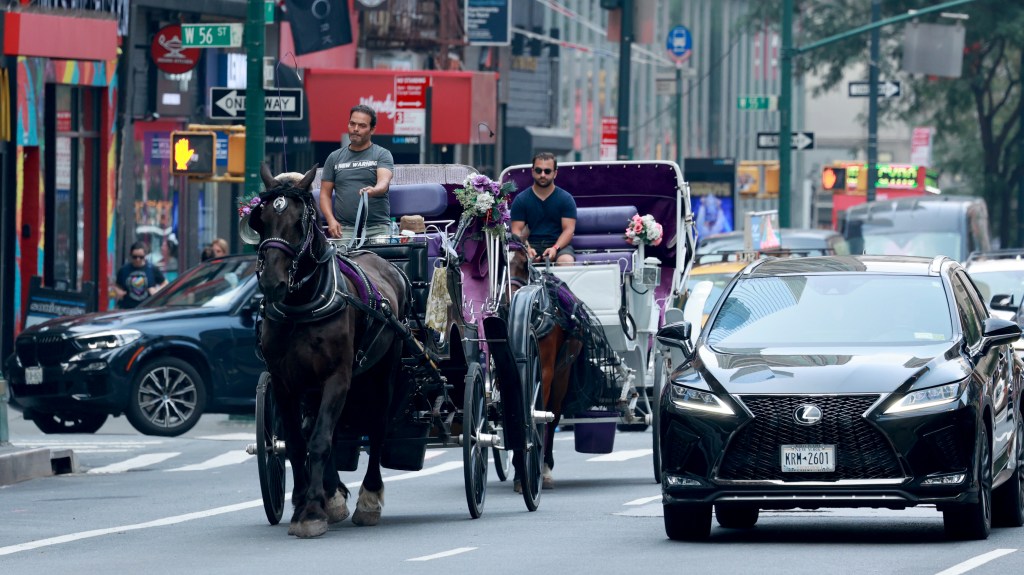
Less than a week after an 18-year-old tourist tragically died in a horse-drawn carriage accident last month, the rides in and around Central Park started up again. The carriage driver involved has reportedly been suspended and the horse retired. Still, we cannot turn the page, just as we cannot forget what happened.
The big questions remain, and before the heated debate over the presence of horse-drawn carriages cools down, it is time we all acknowledge that some practices and traditions, however appealing, no longer fit the world around them.
Cities today are not like those of an earlier time, when horses were an integral part of urban transportation and life moved at a different pace. New York, especially Midtown, is crowded, loud, fast-moving and unpredictable, and like other cities, it is filled with traffic, sirens, bicycles, scooters, dogs, construction, pedestrians and sudden movement.
Horses, no matter how well trained, experienced or handled, are sensitive and powerful animals with particular needs and instincts that are essentially at odds with such an environment.
For many years, we’ve seen crashes, runaway carriages, horse deaths and human injuries. For many years, too, we’ve seen attempts to balance the nostalgic allure of horse-drawn carriage tours with a raft of issues tied to animal welfare, traffic and pedestrian safety, emergency response and driver livelihood. Residents and politicians have marked off their positions — for, against and in between.
We are truly on a different landscape now, however, and this is a time for resolute action. Mayor Mamdani and City Council Speaker Julie Menin have rightly committed to phasing out the horse-drawn carriage industry in Central Park and Times Square; the speaker and Health Committee Chair Lynn Schulman have fast-tracked a hearing this month on Council Member Christopher Marte’s proposal to bring about change.
The city can and must take seriously the future of the horses and the livelihoods of the workers, while ensuring that no other family be burdened with the kind of grief and sorrow that has stricken the family of the teen who lost his life.
A phase out of the industry, one that includes a substantive livelihood transition initiative for drivers, stable hands and others associated with the trade, would honor the human impact of this change while making clear that horse-drawn carriage tourism cannot continue.
City leaders, the labor unions, the tourism sector, animal protection groups and other parties should join in charting a path forward, one that is merciful, responsible and pragmatic, and one that delivers on the promise of a better future for humans and animals alike. There are examples both within and outside of the animal protection sphere that point in the same direction.
Throughout the world, communities and governments are taking action to help people move away from and out of industries or practices that no longer align with the demands of public safety or the evolution of public values. The best of those transitions are built not merely on good planning and execution, but on strong commitment to the principle of dignity coupled with the recognition that change should not fall hardest on those least able to absorb it.
There are moments when it is undeniable that what is safest for people is also the most humane option for animals, and this is one of those moments.
Block is president and CEO of Humane World for Animals, formerly called the Humane Society of the United States.